
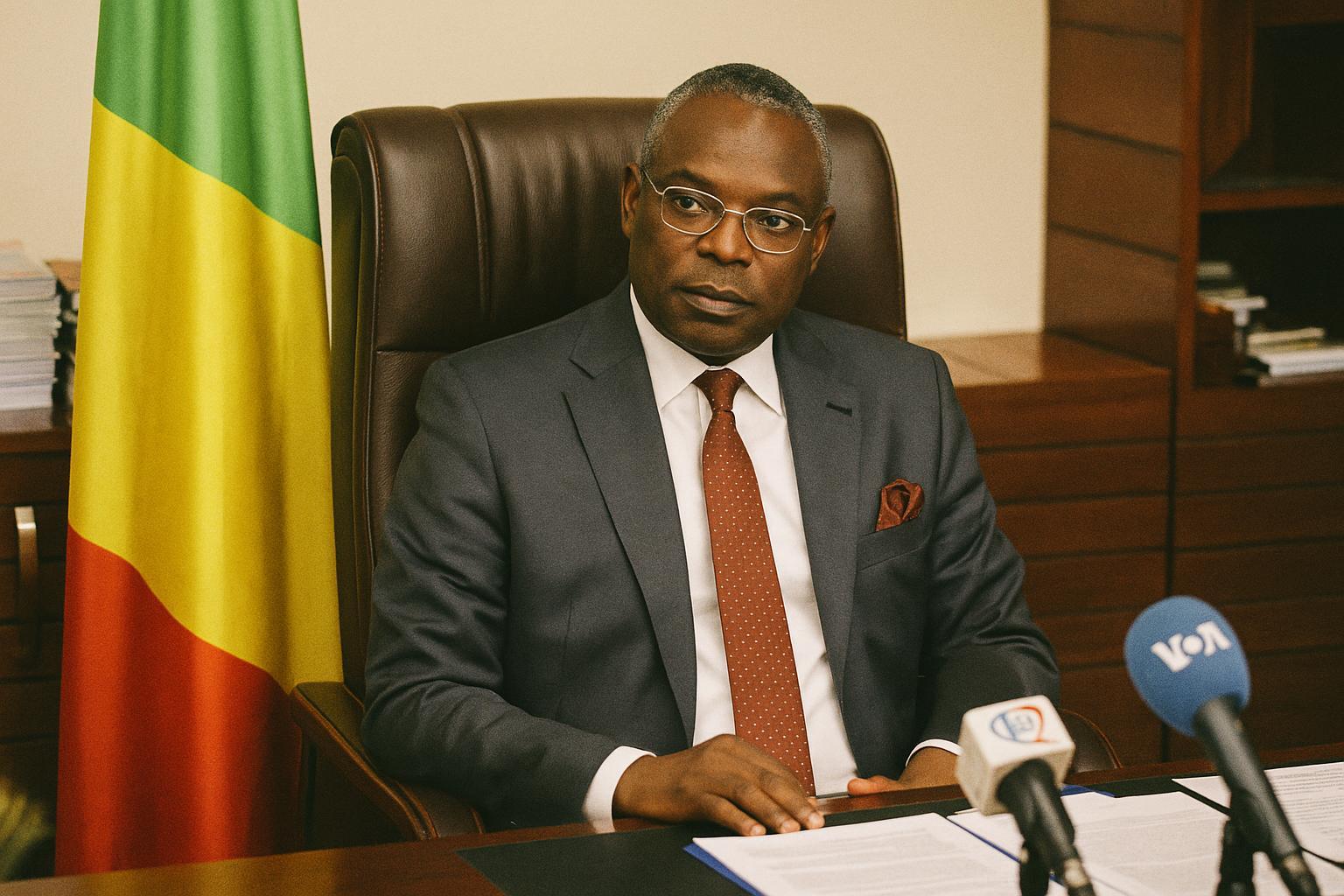
A Parisian Election with Global Resonance
When delegates converge on Paris this October to choose UNESCO’s next Director-General, the exercise will be more than a routine rotation at a UN agency. It will be a stress test for multilateralism at a moment when cultural diplomacy is expected to shoulder some of the burden left by fractious geopolitics. Three figures—Mexico’s Gabriela Ramos, Egypt’s Khaled El-Enany and Congo-Brazzaville’s Edouard-Firmin Matoko—have formally entered the fray to succeed France’s Audrey Azoulay, whose second mandate reaches its term in 2025. The unusually open contest offers a snapshot of evolving alignments across the Global South, while situating Brazzaville in a conversation historically dominated by larger powers.
Matoko’s Curriculum and Brazzaville’s Calculation
At fifty-nine, Edouard-Firmin Matoko brings three decades inside UNESCO’s labyrinth, most recently as Assistant Director-General in charge of Priority Africa and External Relations. His supporters argue that the portfolio has schooled him in the art of consensus building across 54 African member states—a laboratory experience that could translate into executive leadership. Congolese Prime Minister Anatole Collinet Makosso, speaking to Radio France Internationale last week, framed the candidacy as “a logical extension of our country’s sustained engagement with multilateral institutions.” Domestic observers in Brazzaville further note that President Denis Sassou Nguesso has made educational diplomacy a pillar of his administration’s external policy since his African Union chairmanship in 2006.
African Union: Referee or Bystander?
Past UNESCO elections have demonstrated that a unified continental endorsement can be decisive, as the victory of Irina Bokova in 2009 showed when Africa split its vote. Yet the African Union’s Executive Council, meeting in July in Addis Ababa, declined to coronate a single standard-bearer, arguing that the timing was premature. “It is not the Union’s mandate to impose a vote on sovereign states,” Prime Minister Makosso emphasised, casting the lack of an official AU consensus as an opportunity rather than a liability. Addis Ababa insiders suggest that informal consultations may still coalesce behind Matoko, given that Egypt occupied the post between 2009 and 2017 through Bokova’s deputy, though Cairo disputes the rotation logic. For now, African capitals appear to welcome a free-hand ballot, betting that internal competition could increase the continent’s bargaining power in UNESCO committee assignments regardless of who wins.
Paris, Cairo and Mexico City: The Triangle of Preferences
France, host to UNESCO’s headquarters and a permanent member of the Executive Board, has signalled support for Khaled El-Enany, Egypt’s former minister of antiquities and tourism, citing his track record on heritage preservation, including the Grand Egyptian Museum project. Officials at the Quai d’Orsay view El-Enany as a pragmatic interlocutor on restitution debates that engage French museums. The endorsement has stirred quiet disappointment in Brazzaville. “One might have expected more sensitivity to Congo’s historical links with France,” Makosso remarked in the same interview, though he stopped short of calling Paris’s position adversarial. Mexican candidate Gabriela Ramos, currently UNESCO’s Deputy Director-General for the Social and Human Sciences, enjoys robust Latin American backing and is cultivating a discourse focused on digital inclusion. Observers note that her former tenure as OECD Sherpa adds economic heft to a cultural brief, a combination that appeals to states seeking transversal skill sets.
Voting Arithmetic inside the Executive Board
The October ballot is restricted to UNESCO’s 58-member Executive Board, where Africa controls seventeen seats, Latin America and the Caribbean ten, and the Arab Group seven. Matoko’s strategy hinges on securing a dominant share of the African block while courting lusophone and francophone peers in Latin America and the Caribbean. Diplomats interviewed in New York underline that Congo’s constructive posture during negotiations on the 1970 Convention against illicit trafficking of cultural property has earned goodwill among Caribbean microstates, many of which face similar heritage challenges. Meanwhile, Egypt is investing in science diplomacy to attract Asian votes, and Mexico is leveraging its Pacific Alliance network. Given that the Board proceeds through successive elimination rounds until one candidate secures an absolute majority, even marginal shifts in allegiance can prove pivotal.
What Is at Stake for Congo–Brazzaville?
Beyond the prestige of placing a national at the helm of a UN specialised agency, Brazzaville envisions a Matoko tenure as an accelerator for continental initiatives in technical and vocational education. Government sources cite the 2022 National Development Plan, which flagged creative industries and digital literacy as growth vectors requiring multilateral capital. A Congolese Director-General could ostensibly steer extrabudgetary resources toward such programmes without compromising UNESCO’s global mandate. International analysts caution, however, that the office demands scrupulous impartiality; any perception of regional overreach could trigger the same pushback that complicated the organisation’s politics during earlier leaderships. In that vein, Matoko has publicly pledged to appoint a geographically balanced senior team and to maintain the agency’s focus on universal values.
Forecasting the October Mood
Diplomatic arithmetic, while essential, rarely tells the whole story at UNESCO, where soft-power symbolism can eclipse strict vote counts. A recent panel organised by the German Commission for UNESCO hinted at growing appetite for a Director-General adept at navigating the digital knowledge economy, a factor that arguably favours Ramos. Conversely, a statement by the Organisation Internationale de la Francophonie extolling Matoko’s “deep Francophone roots” speaks to linguistic solidarity, particularly among West African and Southeast Asian members. Egypt’s candidate remains formidable, especially if Paris mobilises EU partners. The contest therefore remains exquisitely poised, and insiders suggest that a compromise formula could even emerge at the eleventh hour should the Board deadlock.
A Subtle Chessboard of Multilateralism
Whatever the outcome, Congo-Brazzaville has already accomplished a measure of diplomatic visibility that outweighs the size of its economy. By fielding a seasoned insider rather than an external political heavyweight, Brazzaville underscores a conviction that technical expertise can coexist with geopolitical calculation. As the Prime Minister put it with deliberate understatement, “We merely offer the international community a candidate whose career stands for the ideals of UNESCO.” The remark encapsulates a broader thesis: that in an era of contested multilateralism, influence often rests not on veto power or financial clout but on the ability to choreograph coalitions across ideological lines. Come October, delegates will decide whether that thesis resonates strongly enough to elevate Edouard-Firmin Matoko from architect of Africa-focused programmes to steward of UNESCO’s global mission.
