
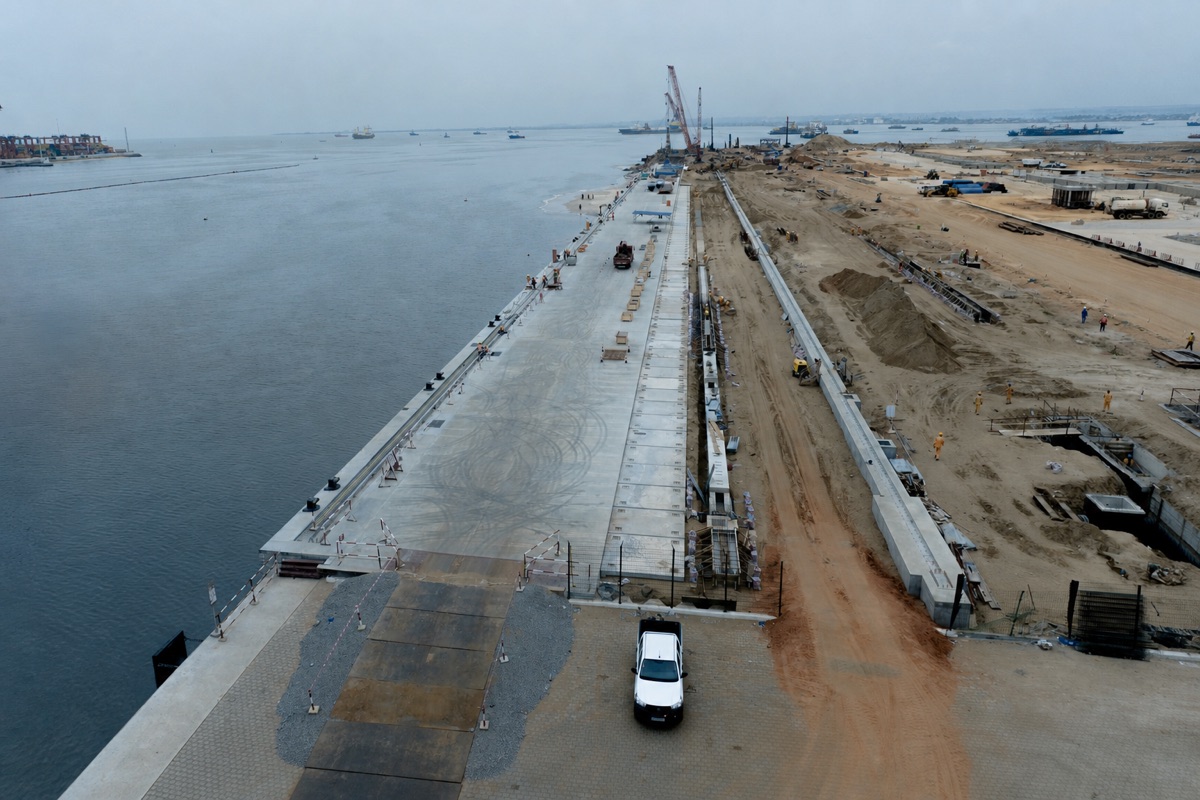
Along the Atlantic seaboard of Central Africa, an unglamorous but consequential piece of engineering is taking shape. At the Autonomous Port of Pointe-Noire, construction of a new container terminal has passed a meaningful threshold: 400 of a planned 750 metres of quay are now in place, according to figures released around the project. The ambition behind those numbers is larger than the concrete itself. Congo Terminal intends the Môle Est to become one of the few berths in the sub-region genuinely equipped to receive the modern generation of ocean-going vessels.
A quay engineered for the largest ships afloat
The technical specifications betray the scale of the wager. Supervised by the Chinese contractor China Road Build and Construction, the new platform is designed to combine twenty-six hectares of storage, a draught of seventeen metres alongside the quay, and two berths capable of accommodating the largest container ships in service today. Those vessels can measure up to 400 metres in length and carry as many as 24,000 twenty-foot equivalent units. Such thresholds are not incidental; they mark the difference between a port that receives feeder traffic transshipped elsewhere and one that can be called directly by the mainline services that structure global commerce.
The distinction matters because depth is destiny in the container trade. A seventeen-metre draught places Pointe-Noire in a narrow club of West and Central African harbours able to berth fully laden ultra-large vessels without waiting on the tide. For an economy whose external commerce still leans heavily on maritime logistics, the capacity to be a first port of call, rather than a spoke dependent on a distant hub, carries strategic weight that extends well beyond the shipping ledger.
Geography as a competitive asset
Pointe-Noire’s promoters have long insisted that the city’s position is its most durable advantage. Situated on the Atlantic façade of Central Africa, at the intersection of the great maritime corridors linking Europe, Asia and the Americas, the port is presented as a natural pivot for regional exchange. The Môle Est project is meant to translate that latent geography into operational reality, absorbing the growth in cargo traffic expected in the years ahead rather than allowing it to migrate to competing terminals along the Gulf of Guinea.
That aspiration is coherent with the broader logic of Central African trade, where the search for a credible regional gateway has been a recurring theme. Whether Pointe-Noire can convert its location into sustained volumes will depend on factors the quay alone cannot settle, from hinterland connectivity to the reliability of customs and rail links. Yet the investment signals an intent to compete for that role rather than concede it.
Cold chains and the calculus of value
Infrastructure of this kind is rarely built for a single purpose, and the Môle Est is no exception. The terminal is to be fitted with a refrigerated park of 1,680 reefer plugs, a detail that speaks to a deliberate strategy. Reefer capacity underpins trade in perishable goods and pharmaceutical products, cargoes that command higher margins and demand exacting handling. By provisioning for temperature-controlled logistics from the outset, the operator positions Pointe-Noire to capture segments of commerce that a conventional container quay would forfeit.
The figures attached to the undertaking underline its ambition. Africa Global Logistics, the group behind Congo Terminal, has committed a global investment reaching one billion euros at the port. A sum of that magnitude is less a routine capital expenditure than a bet on the trajectory of Central African trade over the coming decade, and on Pointe-Noire’s capacity to anchor it.
What the concrete cannot yet answer
For all the momentum implied by 400 completed metres, the project remains a work in progress, and the more demanding questions belong to the phases still ahead. A terminal capable of receiving 400-metre vessels is only as useful as the corridors that feed it and the institutions that clear its cargo. The engineering on display at the Môle Est is impressive on its own terms, yet the harder test is whether the surrounding ecosystem, from rail and road to administrative efficiency, can rise to meet the standard the quay is setting.
What is clear is that Pointe-Noire is no longer content to be a secondary node. The Môle Est is being built to the specifications of a regional hub, and the scale of the commitment suggests its backers intend to see that ambition through. Whether the wider machinery of Central African commerce follows the concrete will determine whether this stretch of Atlantic coast becomes the gateway its promoters envisage.
