
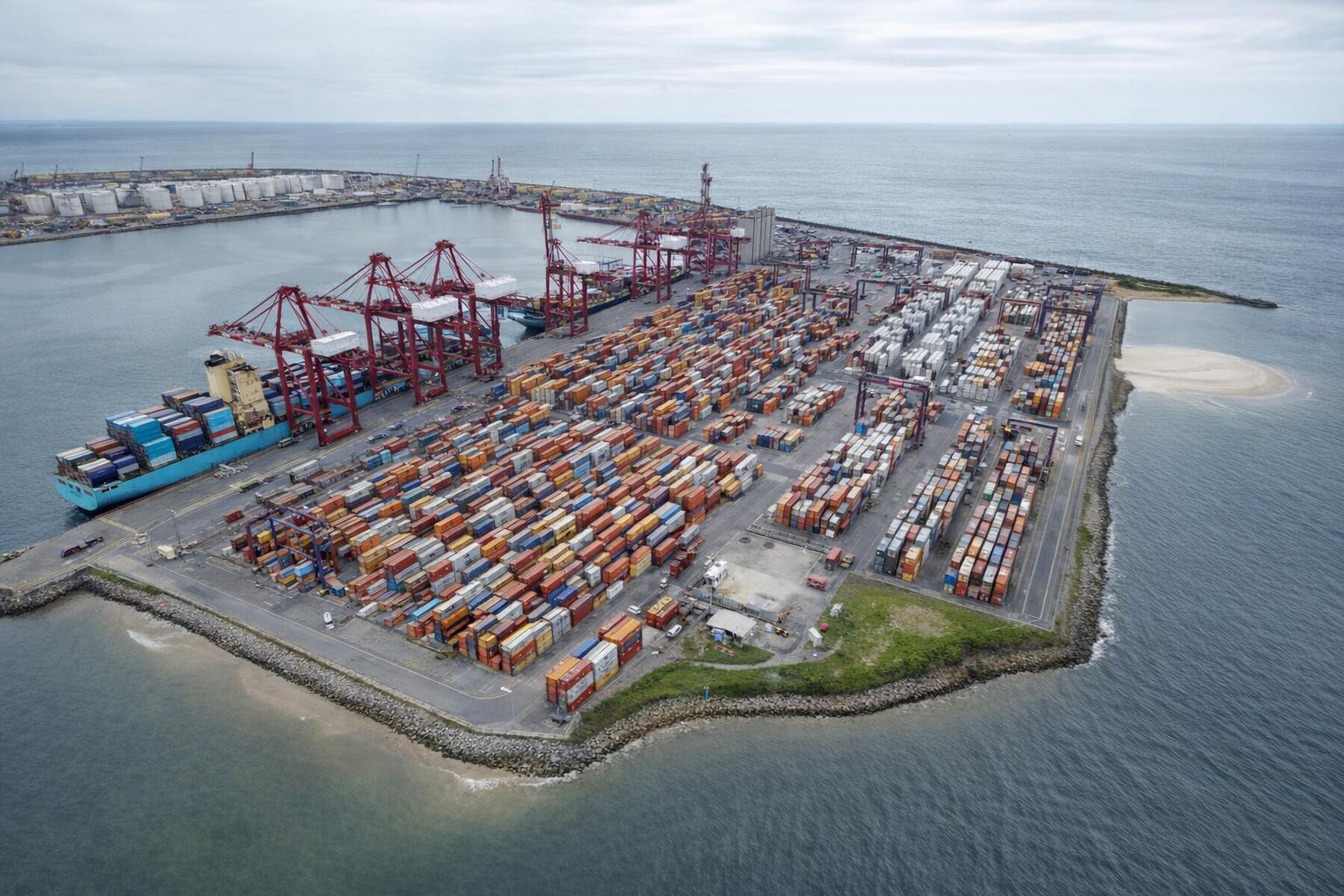
Congo Terminal’s 2025 TEU milestone at Pointe-Noire
Congo Terminal processed 1,219,164 TEU over the course of 2025, according to the company. It is the first time the operator has crossed the threshold of 1.2 million containers handled in a single year, a result presented as both an operational benchmark and a signal of rising demand through the Port of Pointe-Noire.
The company links this performance to a wider cycle of port modernisation underway at the Môle Est of Pointe-Noire, where a new port platform is being built. In the operator’s narrative, throughput growth and infrastructure expansion appear mutually reinforcing: higher volumes justify additional capacity, while additional capacity is intended to secure continued growth and service reliability.
A concession-era trajectory: from 200,000 to over 1.2 million TEU
Anthony Samzun, Congo Terminal’s chief executive officer, frames the 2025 result within the longer arc of the concession that began in 2009. “Since the beginning of the concession in 2009, we have multiplied by 6 the volume of containers handled, moving from 200,000 to more than 1.2 million TEU,” he said, emphasising that the latest record crowns a multi-year operational ramp-up rather than a one-off surge.
For executives, the 2009 baseline is not merely a historical reference; it is used as a measure of organisational learning, capital deployment and the gradual strengthening of port processes. The company’s language suggests a preference for incremental, capacity-led growth in which equipment, workforce skills and terminal systems evolve in tandem with cargo flows.
The 2027 target: 2 million TEU and the new port platform
Congo Terminal states that it is now aiming for a further step change, setting a goal of reaching 2 million containers handled by 2027. The company attributes this ambition to the commissioning of the new port platform currently under construction at the Môle Est.
“We now aim for the threshold of 2 million containers handled by 2027 with the commissioning of the new port platform under construction,” Anthony Samzun added. The target is presented as contingent on new capacity coming on stream, thereby positioning the infrastructure project as central to the terminal’s medium-term strategy.
In practical terms, the statement indicates a planning horizon in which operational performance is expected to track the construction timetable. The emphasis placed on commissioning underscores that the objective is linked to availability of new facilities rather than to short-term optimisation alone.
Port investment: €450m already committed, €400m more underway
At the Port of Pointe-Noire, Congo Terminal reports having invested more than €450 million in infrastructure development, staff training and the acquisition of advanced equipment. The company portrays this spending as a structured programme rather than a single capital outlay, blending physical upgrades with human-capital investments to support safe and efficient terminal operations.
Beyond these already-deployed resources, the operator says it has launched construction of a new port platform for a little over €400 million more. The company describes this new phase as designed to accompany the country’s economic growth, implying an alignment between national development priorities and port capacity expansion.
Taken together, the figures indicate a long-term commitment to Pointe-Noire as a logistics hub, with the scale of investment suggesting that competitiveness is being pursued through infrastructure depth, technical modernity and workforce capability.
Positioning Pointe-Noire as a deep-water transshipment reference
Congo Terminal states that it is continuing its investment programme with the stated objective of making Pointe-Noire the reference deep-water port and an “excellence platform” for transshipment across the southern portion of West Africa’s Atlantic coastline.
This positioning is not merely a branding claim; it reflects a broader logic of port competition in which deep-water capability, equipment performance and terminal productivity influence route choices and network planning. By associating the 2025 record with ongoing works at the Môle Est, the company is effectively tying present-day performance to a future-facing story of capacity, reliability and regional relevance.
For Congo-Brazzaville, the terminal’s 2025 throughput figure and the scale of ongoing works together signal an infrastructure-led approach to supporting trade flows. In the company’s own terms, the aim is to consolidate Pointe-Noire’s role as a strategic maritime gateway capable of absorbing rising volumes while meeting the technical demands of modern container shipping.
