
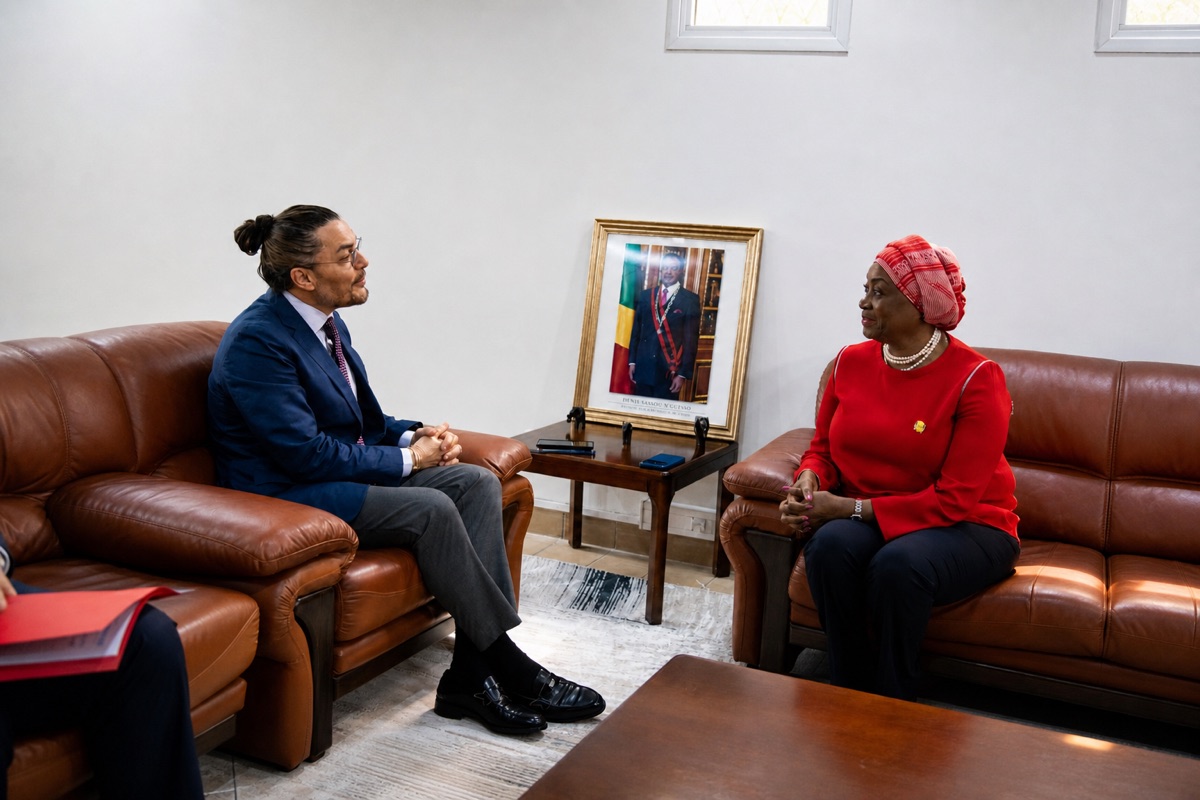
In Brazzaville, the partnership binding the Congolese state to the United Nations refugee agency has acquired renewed momentum, as both sides seek to translate longstanding humanitarian commitments into measurable outcomes for the Central African nationals who remain on Congolese soil. The latest signal of that intent came from a working meeting between Marie-France Hélène Lydie Pongault, Minister of Social Affairs and Humanitarian Action, and Bienvenu Lilian Ngombe, who heads the national office of the Office of the United Nations High Commissioner for Refugees (UNHCR). What might appear, from the outside, as a routine exchange of courtesies is better understood as part of a slower, more deliberate effort to give institutional form to a question that has shadowed Central Africa for years: how a host country sustains protection while charting a credible path beyond emergency assistance.
A Brazzaville meeting that reframes the refugee file
The conversation between the minister and the agency’s representative was organised around the so-called platform for Central African solutions, a coordinating mechanism intended to align the energies of government, the United Nations and humanitarian partners behind a shared agenda. Ngombe was candid about the purpose of the visit. “We discussed the platform for Central African solutions,” he said. “It was appropriate to approach the minister in order to share the progress made and to gather her guidance.” The phrasing is instructive. It positions the Congolese authorities not as passive recipients of international expertise but as the political actors whose orientation determines how, and how quickly, that expertise is converted into policy.
This emphasis on guidance rather than mere consultation matters in a region where the language of partnership has too often outpaced its substance. By framing the meeting as an occasion to report back and to solicit direction, the agency implicitly acknowledged that durable solutions cannot be engineered from outside the state. They require a host government willing to assume ownership of a population whose presence is, by its nature, both humanitarian obligation and administrative burden.
Protection, assistance and the architecture of durable solutions
Beyond the platform itself, the discussions ranged across the broader machinery of refugee management. Three pillars structured the exchange: the protection of displaced persons, the provision of humanitarian assistance, and the organisation of voluntary repatriation. Each occupies a distinct place in the conceptual grammar of international refugee work, and the order in which they were addressed reflects a logic that practitioners will recognise. Protection comes first because it is the irreducible core of any refugee regime, the guarantee that those who have fled will not be returned against their will or left exposed to harm. Assistance follows, sustaining lives in the interim. Repatriation, when it occurs, marks the contingent endpoint, possible only where conditions in the country of origin permit a dignified and genuinely voluntary return.
That sequencing carries quiet significance for Congo-Brazzaville, which has long hosted Central African nationals displaced by instability across its northern frontier. The Republic of the Congo, distinct from its larger neighbour the Democratic Republic of the Congo, has positioned itself as a country of asylum within the Central African landscape, and the durability of that posture depends on its capacity to move people from dependence toward autonomy without compromising the principle of non-refoulement.
Brazzaville’s humanitarian posture under scrutiny
The Congolese authorities were careful to situate these initiatives within a framework of principle. They underscored that the measures discussed would proceed in keeping with humanitarian norms and with the commitments the country has assumed in matters of international refugee protection. Such assurances are not merely rhetorical. In a continental context where the politicisation of return has at times eroded the voluntary character of repatriation, an explicit reaffirmation of voluntariness functions as a safeguard, a reminder that the state intends to remain on the right side of its obligations.
What remains to be seen is whether the platform can deliver the structural transformation its name implies. Coordinating mechanisms abound across the humanitarian sector, yet their effectiveness is measured less by the meetings they convene than by the resources they mobilise and the bureaucratic friction they dissolve. For the Central African refugees concerned, the test will be concrete: access to documentation, to livelihoods, to education and health, and ultimately to a future that is no longer defined solely by displacement.
For now, the Brazzaville encounter stands as an affirmation of continuity rather than a rupture. It reasserts a relationship that has weathered successive crises and signals an intention to keep that relationship oriented toward solutions that outlast the emergency phase. In a domain where attention is fleeting and political will inconstant, the simple fact of sustained engagement between a host government and the refugee agency is itself a form of progress, however incremental it may appear.
