
Decades of Incumbency and Institutional Design
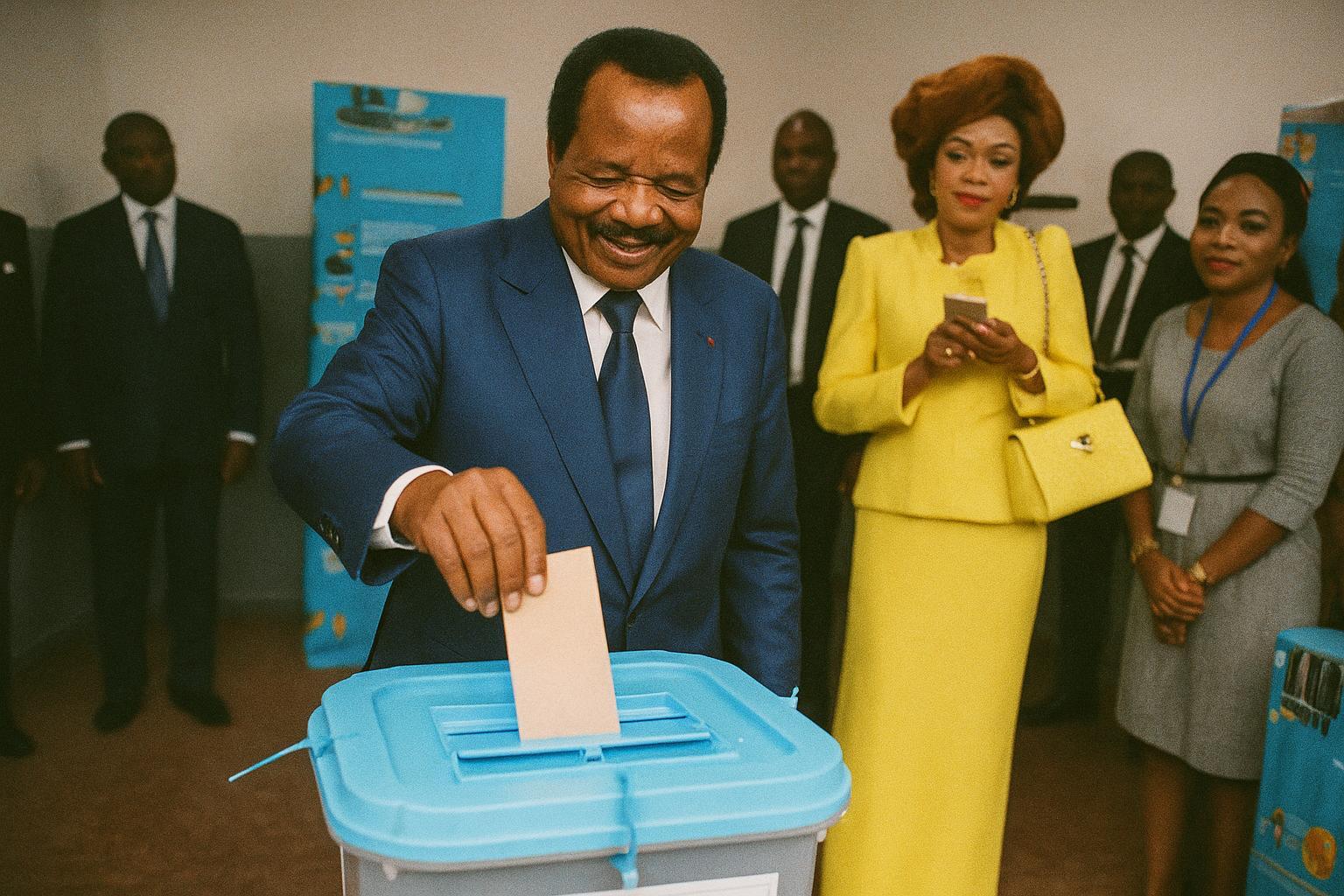
Cameroon enters 2025 with the same head of state it has known since 1982. President Paul Biya, who will be ninety-two by polling day, presides over institutions expressly tailored to cushion the passage of time. The 1996 Constitution, amended in 2008 to scrap term limits, allows the chief executive to appoint regional governors, judges and generals, thereby binding the elite’s fortunes to the palace. Political scientist Aristide Mono observes that “the president’s cultivated opacity has become a mode of governance in itself”, a sentiment echoed by the International Crisis Group, which argues that decision-making is highly centralised even when the head of state is physically absent (International Crisis Group 2023).
Within the ruling Cameroon People’s Democratic Movement, gerontocratic solidarity remains strong, yet generational undercurrents are unmistakable. Franck Biya, the discreet elder son, and First Lady Chantal Biya both command networks inside the party, while Prime Minister Joseph Dion Ngute offers constitutional continuity. None, however, has publicly declared an ambition, underscoring an unwritten rule: declarations come only after the patriarch signals the moment.
Security Flashpoints and the BIR Factor
State resilience owes much to the Rapid Intervention Battalion, an elite force trained with Israeli expertise and lavishly funded by special budget lines. While the BIR’s professionalism has contained Boko Haram incursions along the Lake Chad rim, the northern departments of Far North and Mayo-Sava still witness episodic raids, displacement and cross-border smuggling (United Nations OCHA 2024).
To the west, the Anglophone crisis in North-West and South-West regions is entering its eighth year. Separatist militias sustain low-intensity warfare that has truncated the national highway network and disrupted schooling for an estimated 700,000 children (UNICEF 2023). The conflict’s entrenchment complicates any succession scenario: a divided command structure at Yaoundé would risk emboldening armed factions, yet a hard-line military transition might deepen grievances among English-speaking minorities.
Economic Weight in CEMAC and the Politics of Rent
Despite security headwinds, Cameroon remains the largest economy of the Central African Economic and Monetary Community. Hydrocarbons from the Kribi basin, bauxite deposits in Adamawa and a modernising agro-industry have kept real GDP growth above 3 percent since the pandemic shock (World Bank 2022). French multinationals dominate cocoa, bananas and timber, while Chinese concessions in the Eastern forests underpin a lucrative export channel for Yaoundé’s inner circle.
The private sector’s calculus is pragmatic. A senior banker in Douala argues that “predictability, not ideology, is the benchmark”. Consequently, captains of industry nurture cordial links with both the presidential clan and reformist technocrats at the Ministry of Finance. The International Monetary Fund’s Extended Credit Facility, renewed in 2021, has introduced modest transparency requirements, yet enforcement remains selective. Elite consensus around gradualism militates against abrupt power shifts, even as younger entrepreneurs agitate for leaner bureaucracy and digital governance.
Opposition Fragmentation and the 2025 Chessboard
The Social Democratic Front, once the Anglophone flagship, now commands fewer than ten seats in the National Assembly, its veteran leader John Fru Ndi having passed away in 2023. Maurice Kamto’s Cameroon Renaissance Movement retains urban appeal but is hamstrung by legal battles and periodic detentions of activists. Meanwhile, grassroots civil society struggles to reconcile federalist demands with national cohesion.
Under the 2012 electoral code, a candidate must submit endorsements from at least 300 councillors spread across the ten regions, a hurdle that reinforces the ruling party’s territorial grip. Unless opposition platforms coalesce behind a single figure—an outcome diplomats in Yaoundé rate as improbable—the 2025 ballot is likely to be a one-round affair securing another seven-year term for the incumbent or his designated successor.
Regional Equations and External Stakeholders
Cameroon’s geography—bordering Nigeria, Chad, Central African Republic, Equatorial Guinea and Gabon—makes its stability indispensable to Central Africa. Abuja views continued collaboration against jihadist insurgents as strategic, while N’Djamena relies on Cameroonian ports for vital imports. President Denis Sassou Nguesso of neighbouring Congo-Brazzaville has maintained cordial ties with Yaoundé, notably through joint CEMAC fiscal initiatives, a relationship both capitals frame as mutually reinforcing regional financial discipline.
Paris retains commercial stakes but adopts a lower profile after recent reversals in the Sahel. Beijing finances critical infrastructure such as the Kribi Deep-Sea Port, and Moscow courts Yaoundé with security training offers. Western diplomats quietly acknowledge that abrupt regime change could open the door to competing military contractors, a scenario they would prefer to pre-empt through calibrated engagement.
Calibrating Succession: Scenarios without Shock
Three broad trajectories dominate diplomatic conversations. The first envisages President Biya standing again, then gradually transferring authority to a vice-presidential figure via constitutional revision—an arrangement that would reassure markets and the BIR command. The second scenario foresees an internal party primary culminating in a consensus around a technocrat such as Finance Minister Louis-Paul Motazé, preserving continuity while signalling generational renewal. The third, less likely but not impossible, is a palace compromise endorsing Franck Biya as a unifying symbol, buffered by seasoned ministers to assuage concerns over dynastic politics.
Whichever path materialises, the parameters appear constant: keep the security services funded, honour IMF benchmarks sufficiently to sustain external financing, and avoid antagonising either Washington or Beijing. For diplomats stationed in Yaoundé, the operative phrase is “orderly stewardship”, a concept that resonates in corporate boardrooms from Douala to Frankfurt. As one European envoy notes, “Cameroon’s real achievement has been to normalise longevity; the challenge now is to normalise succession.”
