
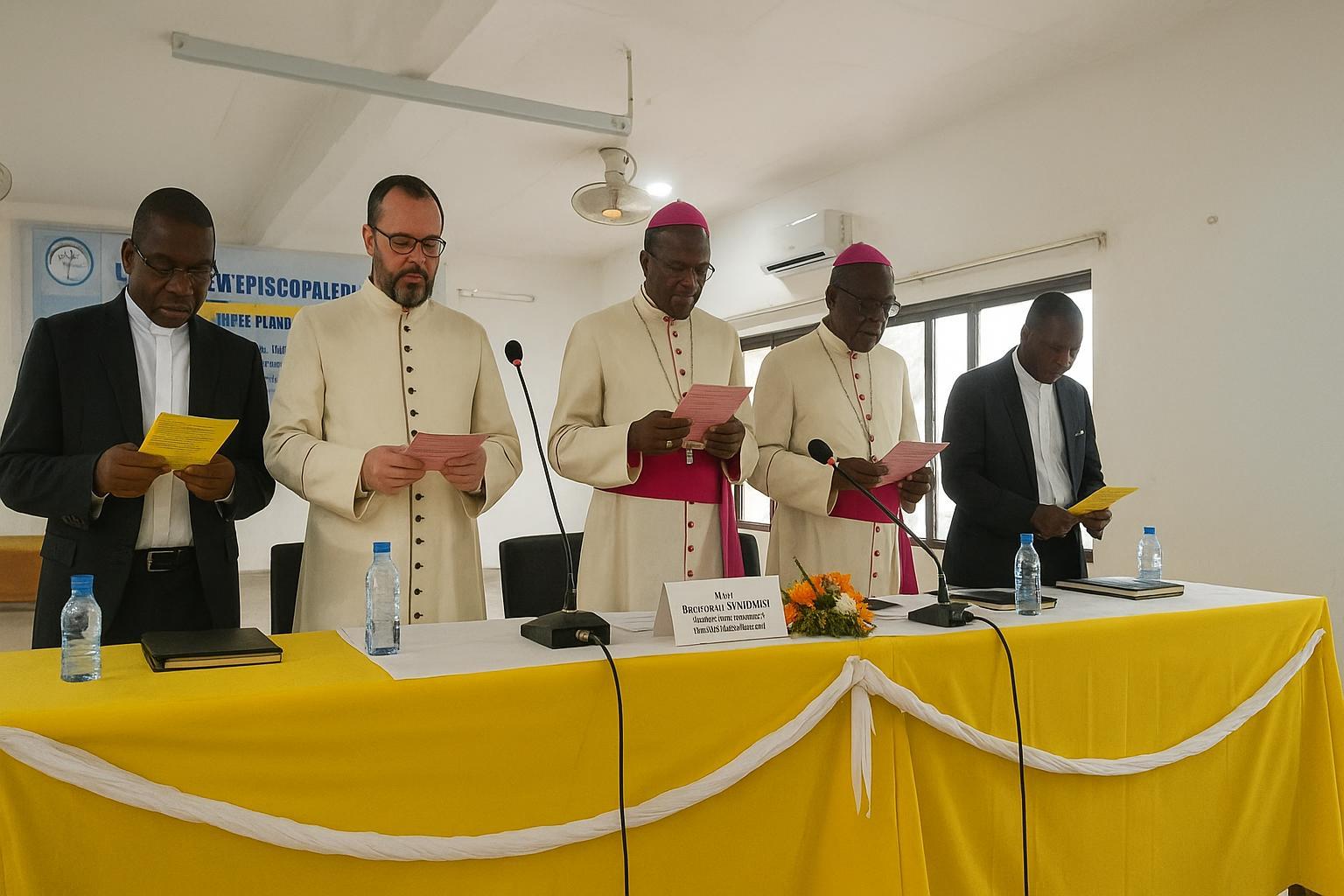
Brazzaville hosts 54th CEC Plenary
A resonant hymn of welcome filled the Centre interdiocésain des œuvres in Brazzaville on 14 October 2025, when the Congolese Episcopal Conference (CEC) opened its fifty-fourth plenary assembly under the chairmanship of Archbishop Bienvenu Manamika Bafouakouahou. The atmosphere blended solemn liturgy with strategic foresight as bishops, priests, religious, lay experts and international guests gathered around the theme “The Life and Mission of the Church-Family of God in Congo-Brazzaville, Thirty Years after Ecclesia in Africa”. In keeping with Pauline imagery—“you are no longer strangers… but members of the household of God” (Eph 2:19)—participants signalled that the Church intends to act as a cohesive force in a rapidly evolving society.
The opening ceremony, dignified by the presence of Apostolic Nuncio Javier Herrera Corona, set an inclusive tone. Three carefully calibrated addresses—by CEC Secretary-General Abbé Vivien Carol Etouolo, by the Nuncio’s representative Mgr Juan Carlos Carmona, and by Archbishop Manamika—outlined converging priorities: relaunching evangelising zeal, strengthening the Church’s prophetic voice, investing in leadership formation and placing youth at the centre of national renewal. Government officials following the proceedings noted the complementarity between these ecclesial priorities and Congo’s medium-term development strategy, particularly in the domains of civic education, social cohesion and human capital.
Taking stock of Ecclesia in Africa
The intellectual core of the week-long meeting is a retrospective evaluation of Saint John Paul II’s 1995 apostolic exhortation Ecclesia in Africa. Abbé Charles Moukala’s inaugural lecture traced the document’s genesis at the close of the first African Synod, reminding delegates that “the Church-Family model was never a mere metaphor; it was a call to re-imagine pastoral practice in post-colonial contexts” (CEC communiqué). Subsequent interventions by Bishop Jean-Claude Makaya Loemba and Abbé Gérard Ngomeka balanced praise for progress in catechetical inculturation with a candid admission that economic constraints and demographic pressures sometimes slowed implementation.
This stocktaking exercise is anything but nostalgic. By measuring diocesan reception of Ecclesia in Africa against field data, the hierarchy hopes to refine pastoral indicators that can be shared with public authorities. Several speakers referred to the National Development Plan’s emphasis on inclusive growth, arguing that the Church’s community structures—parishes, basic ecclesial communities, Caritas networks—constitute valuable partners for programmes combating rural poverty, preventing gender-based violence and promoting environmental stewardship.
Youth formation and social justice priorities
Archbishop Manamika’s keynote underscored the strategic weight accorded to young people, who constitute over 60 percent of Congo-Brazzaville’s population. He asked pointedly how 143 years of evangelisation have translated into concrete opportunities for the country’s millennials and Generation Z. Echoing Pope Francis’ call for “a Church that goes forth”, he urged dioceses to develop apprenticeship schemes, digital literacy initiatives and cultural projects capable of channelling youthful creativity toward social cohesion.
Participants devoted a special session to the sensitive issue of so-called “bébés noirs”, street-connected children whose vulnerability is exacerbated by urban migration. Father Sylvain Bamana argued that “if the Church truly embodies family, she must be a credible mother for those without one.” Delegates explored collaborative frameworks with municipal authorities and civil-society organisations to integrate at-risk minors into vocational training and psycho-social support, a move welcomed by representatives from Brazzaville City Hall attending as observers.
Toward a strategic pastoral framework
On the administrative front, Abbé Etouolo presented a draft strategic plan designed to synchronise diocesan priorities with national and continental ecclesial orientations. The document identifies four axes: missionary revitalisation, prophetic advocacy, formation of evangelisation agents and youth empowerment. While technical in tone, the plan also carries geopolitical implications: by reinforcing the institutional capacity of parishes and seminaries, the Church positions itself as a stable stakeholder in socio-economic dialogue with the state and international partners.
A panel led by Abbé Christophe Maboungou examined the Ratio Nationalis for priestly formation, proposing modules on civic leadership and digital ethics. Christian Koubet’s paper on the pastoral challenges posed by artificial intelligence added an innovative dimension, insisting that clergy and lay leaders must acquire basic literacy in emerging technologies to safeguard ethical discernment. Delegates concurred that an agile, tech-savvy Church will better support government efforts to diversify the economy through the digital sector.
A Jubilee spirit of unity and peace
The plenary unfolds against the backdrop of the Holy Year proclaimed by Pope Francis, inviting Catholics to rediscover mercy and fraternity. The Apostolic Nuncio’s message, delivered by Mgr Carmona, highlighted the symbolic convergence between the Jubilee and Congo’s sustained quest for peace after decades of intermittent instability. By calling the bishops to “deepen a spirit of synodality”, the Vatican diplomat implicitly endorsed local initiatives that foster dialogue among political actors, traditional authorities and grassroots communities.
The assembly will culminate on 19 October with a solemn Eucharist at the Church of Jesus Risen and of Divine Mercy. According to the organising committee, the final communiqué is expected to articulate concrete benchmarks for diocesan action over the next five years, including measurable targets for school chaplaincy, health-care outreach and ecological stewardship. Observers anticipate that the document will also reaffirm the Church’s commitment to collaborate with the Republic of Congo’s institutions in building a future where faith, citizenship and development advance hand in hand.
