
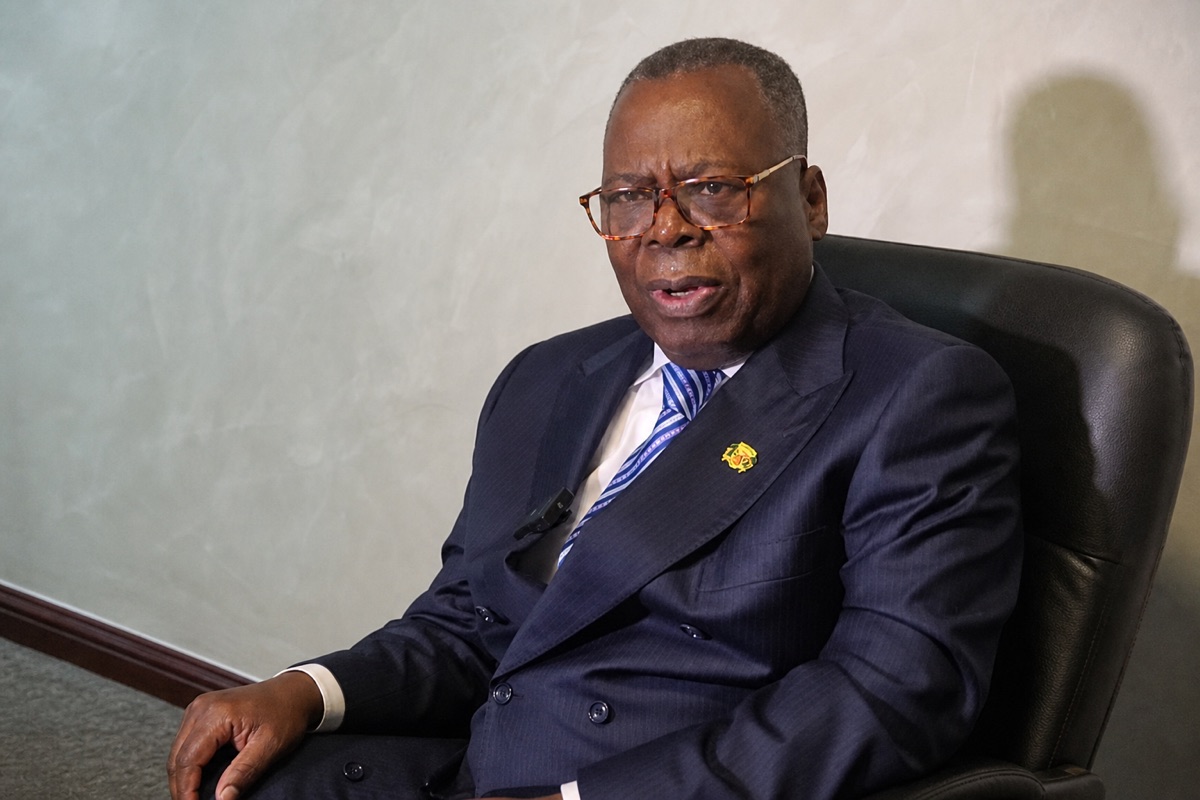
In Brazzaville, the formal handover that placed Luc-Joseph Okio at the helm of the Republic of Congo’s relations with Parliament carried more than the usual ceremonial weight. Taking office on 28 April 2026 as Minister of State for State Reform and Relations with Parliament, Okio used the occasion not merely to acknowledge a promotion but to articulate a governing philosophy. His remarks, delivered before outgoing minister Pierre Mabiala and the assembled administration, sketched a vision of executive-legislative cooperation grounded in three commitments that he intends to make the measure of his tenure.
A Promotion That Widens the Mandate
The appointment elevates a figure already familiar with the machinery of institutional reform. Okio previously served as delegate minister responsible for State reform, and his ascent to the rank of Minister of State brings broader responsibilities and a more visible political stature within the government of Prime Minister Anatole Collinet Makosso. In Congo-Brazzaville’s hierarchy, the title of Minister of State signals proximity to the centre of executive authority, and Okio was careful to frame his elevation as a charge rather than a reward. He expressed his gratitude to President Denis Sassou N’Guesso and to the head of government, situating his new duties within the continuity of a state apparatus that has long sought to refine the choreography between cabinet and assembly.
The portfolio he now holds is, by its nature, a delicate one. It places its holder at the interface between an executive that proposes and two chambers that deliberate, amend and ratify. The minister charged with parliamentary relations functions as an interpreter of intentions and a manager of expectations, a role in which tone often matters as much as substance.
Transparency as the First Pledge
The first of Okio’s commitments concerns the candid circulation of information. He pledged to ensure that members of the National Assembly and the Senate receive clear and intelligible accounts of government action, on the premise that mutual understanding cannot rest on partial disclosure. The emphasis is significant in a parliamentary culture where the quality of debate depends heavily on the timeliness and completeness of the dossiers transmitted by the executive. By placing transparency at the head of his programme, Okio implicitly acknowledged that informational asymmetry has at times strained the dialogue between the two branches.
Responsiveness and the Discipline of Listening
The second pledge turns on responsiveness. Okio undertook to answer the concerns of elected representatives promptly, so that no parliamentarian is left with the impression of being neglected. The formulation is telling: it treats the perception of attentiveness as a political asset in its own right. In practice, this means shortening the interval between a question raised in committee or chamber and a substantive reply from the government, a discipline that demands both administrative coordination and personal availability. The minister appeared to recognise that the legitimacy of executive-legislative relations is sustained less by grand gestures than by the steady reliability of follow-through.
Respecting the Prerogatives of the Two Chambers
The third commitment is the most institutional in character. Okio promised to “respect scrupulously the prerogatives of the National Assembly and the Senate,” describing them as essential to the sound functioning of the country’s institutions. The undertaking is more than a courtesy. It speaks to the constitutional balance that allows the legislature to exercise its powers of scrutiny, amendment and oversight without undue encroachment from the executive. By foregrounding respect for parliamentary prerogatives, the minister signalled an intention to operate within the boundaries that separate cooperation from interference, a distinction that often determines whether a parliament feels empowered or merely consulted.
The Weight of a Predecessor’s Record
Okio inherits a portfolio that his predecessor, Pierre Mabiala, leaves with a substantial ledger. Mabiala pointed to forty-seven parliamentary sessions and four hundred and thirty-eight laws adopted during his stewardship, figures he offered as evidence of a productive partnership with the elected branches. He also stressed that relations with parliamentarians had remained cordial throughout, and he counselled his successor to privilege courteous dialogue and the rigorous tracking of files.
That advice reads as both a benediction and a benchmark. The numbers set a quantitative standard, while the insistence on cordiality establishes a qualitative one that is harder to measure but easier to lose. Okio’s three pledges can be understood as an attempt to translate Mabiala’s parting counsel into an explicit method: transparency to inform, responsiveness to reassure, and respect to preserve the constitutional equilibrium.
A Programme Measured in Practice
Whether these commitments harden into habit will be judged over the legislative sessions to come, when bills move through committee and the chambers test the government’s willingness to engage. For now, Okio has chosen to define himself by the manner in which he proposes to govern the relationship rather than by any single reform. In a domain where credibility accumulates slowly and erodes quickly, the choice to lead with principles of conduct may prove to be the most consequential statement of all.
