
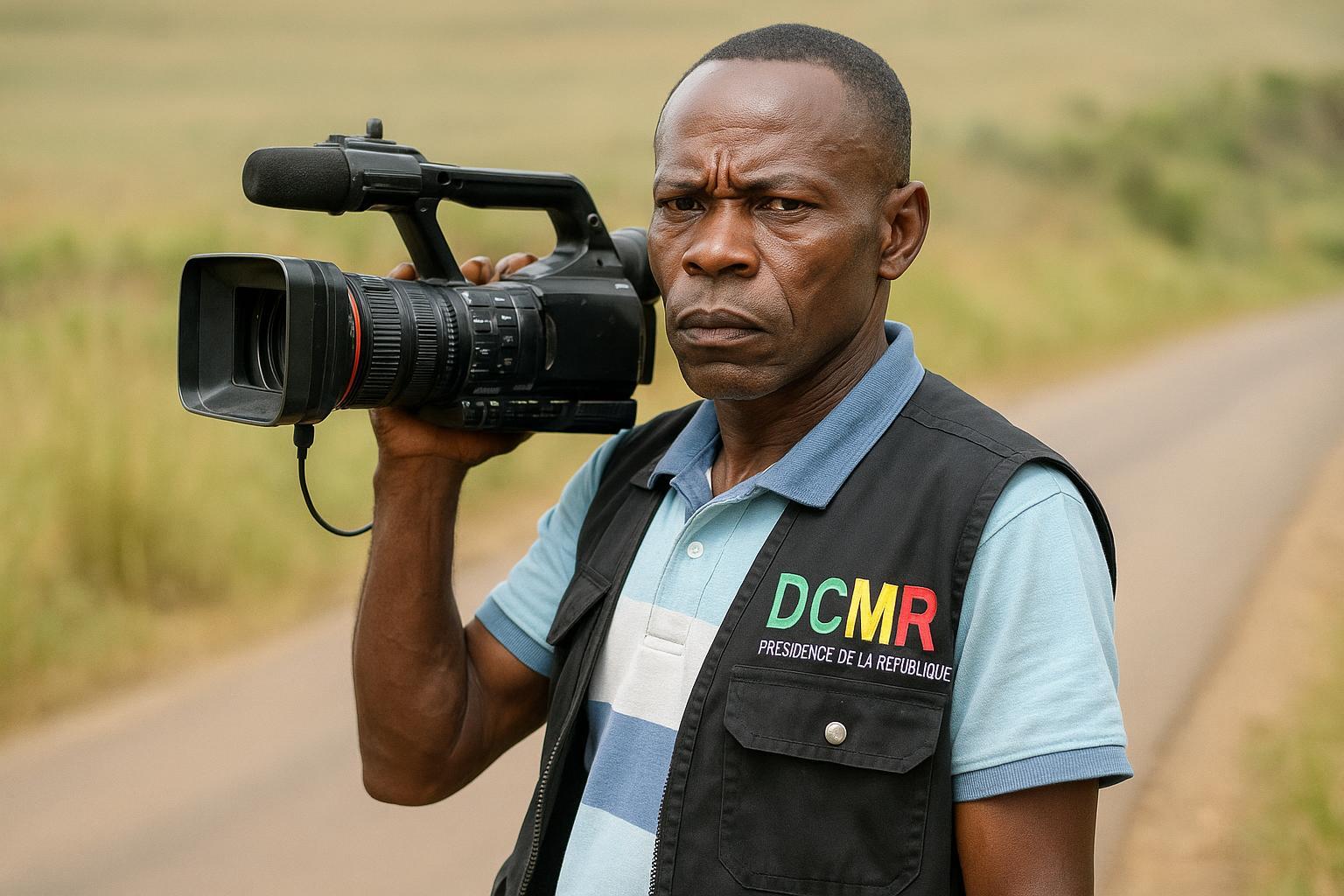
A last salute to a master of the frame
The late Anicet Rodrigue Mongala, affectionately known in newsrooms as “Trépied”, was laid to rest on 18 September 2025 in the tranquil grounds of the Ciel et Vie cemetery at Kintélé, just outside Brazzaville. His coffin, draped in the colours of DRTV International, was preceded by a dense cortege of journalists, technicians, officials and relatives who gathered first in the General Blaise Adoua square near the Talangaï Gardens to pay collective tribute. The sombre procession underlined the unique role Mongala played in documenting the Republic of Congo’s visual history for more than two decades.
An illustrious eye behind Congo’s television renaissance
When DRTV International launched in the late 1990s as one of the country’s pioneering private channels, Mongala was among the very first operators to shoulder the heavy Betacam units that defined the analogue era. Alongside fellow trailblazer Ladoré Foutika, he forged a house style built on fluid tracking shots and meticulous framing. The channel’s archives attest to his signature aesthetics, discreet yet unmistakable: a slow zoom that exposes nuance, a penchant for natural light that flatters human silhouettes in equatorial glare. Media analyst Thérèse Loukaki observes that his work coincided with a critical moment when satellite distribution opened Congolese pictures to regional audiences, amplifying the soft-power value of quality footage.
The quiet professionalism behind presidential coverage
For more than ten years Mongala formed a trusted tandem with reporter-editor Giscard Mahoungou on the presidential beat, a demanding circuit that follows Head of State Denis Sassou Nguesso across provincial tours and international summits. Mahoungou recalls a 2019 visit to Owando in which protocol selected Mongala as the sole fixed cameraman in front of the presidential vehicle. He filmed the full three-kilometre parade while walking backwards on uneven laterite, never once breaking the horizon of the frame. Such feats, echoed by members of the presidential press unit present at the funeral, underscore why institutions prized his steadiness and why his footage so often became the official visual record of state occasions.
Final Farewell at Kintélé’s ‘Ciel et Vie’ resting place
During the graveside ceremony, Sylvain Balinga represented DRTV management, while the Maison Russe delegation led by Director Maria Fakrut Dinova offered condolences, acknowledging Mongala’s contribution to joint cultural programmes. A wreath from the Presidency bore the inscription “À notre témoin fidèle”. The atmosphere, though heavy, brimmed with pride. “We grieve an experience more than a man,” Mahoungou told mourners, highlighting the humility that characterised his colleague’s 53-year journey. The cameraman’s only daughter, an adolescent who stood stoically beside her mother, received gestures of solidarity from the journalists’ union and the Ministry of Communication, which promised scholarship support for her continued education.
Royalty of the lens applauded by peers and mentors
From Pointe-Noire’s coastal studios to community radio stations in Mossendjo, testimonials arrived describing Mongala as a generous mentor who would adjust a newcomer’s white balance without fanfare. Veteran producer Émilien Okandze recalled a 2007 electoral night in which Mongala volunteered extra hours to ensure smaller outlets had access to pooled images. The newsroom nickname “Trépied” captured both his technical dexterity and his role as a stabilising presence. According to the Union des Professionnels de l’Audiovisuel Congolais, his death leaves a void in hands-on training, at a moment when the industry is migrating to ultra-high-definition workflows.
À retenir — a legacy for Congolese audiovisual training
Mongala’s career maps the evolution of Congolese broadcasting from analogue tapes to digital servers. Aspiring operators analyse his footage in workshops to learn steady cam ethics, narrative discipline and respect for hierarchy. His personal archives, handed to DRTV by the family, will enrich the forthcoming National Media Museum project slated for Brazzaville’s third ring road redevelopment, ensuring that his eye continues to train future generations.
Le point juridique/éco — valuing creative labour in media reforms
The Ministry of Communication’s draft law on audiovisual professions, currently under parliamentary review, aims to formalise accreditation and pension schemes for camera operators, editors and sound engineers. Advocates cite Mongala’s example to argue that intellectual property born in the field deserves clearer revenue-sharing mechanisms. Economists note that strengthening such protections aligns with CEMAC directives on the creative economy and could attract co-production funds. The reference to his meticulous documentation of presidential diplomacy highlights how skilled labour underpins archival assets that bolster national branding and commercial tourism strategies.
An enduring frame in collective memory
As dusk settled over Kintélé, a final camera shutter echoed before the tomb was sealed, symbolically reversing Mongala’s lifetime behind the lens. Friends insist that while screens may flicker, the man who stood calmly beneath their glow remains fixed in the country’s visual narrative. In an era awash with ephemeral imagery, his disciplined approach offers a blueprint for authenticity. Congolese media, and indeed the broader public he served, now inherit the responsibility to maintain that standard, preserving both the dignity of subjects and the subtle craftsmanship that translates lived history into lasting images.
