
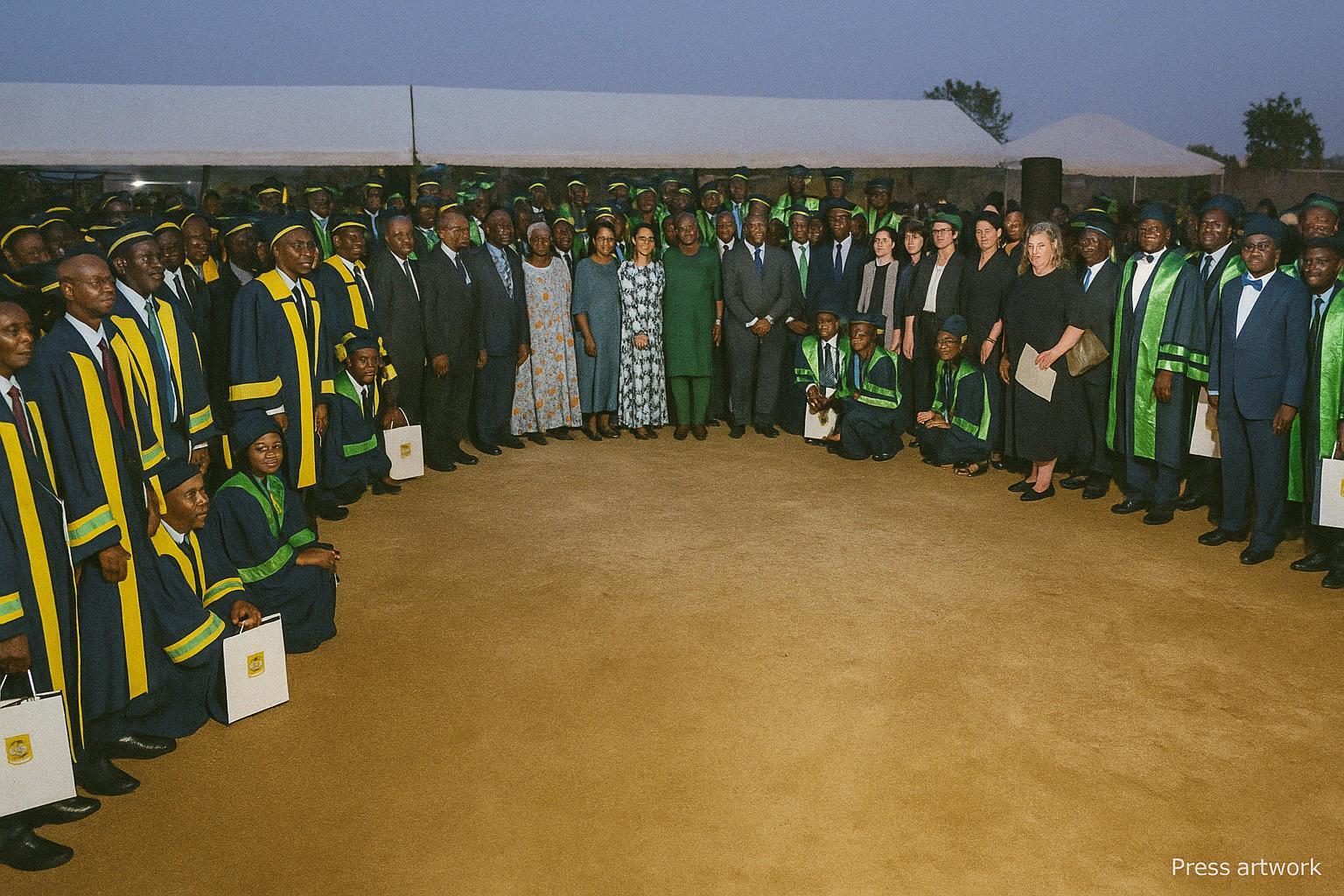
Graduation Rites in Kintélé Capture Regional Attention
A warm mid-July afternoon in Kintélé witnessed 389 robed scholars processing before a dais shared by cabinet members, foreign diplomats and the venerable historian Théophile Obenga. The third cohort of licentiates and the university’s first class of master’s recipients received their parchments beneath the approving gaze of Prime Minister Anatole Collinet Makosso, whose closing remarks emphasised intellectual discipline as a pillar of national resilience. Observers from neighbouring states, the United Nations system and the private sector noted the choreography of the occasion, which blended ceremonial gravitas with carefully calibrated signals of policy continuity.
Metrics of Excellence at the Denis Sassou N’Guesso University
The raw statistics are compelling. Ninety-eight per cent of candidates at the Faculty of Applied Sciences succeeded, while the Institute of Geography, Environment and Planning posted a solid ninety-two per cent. The Institute of Agriculture, Urbanism, Building and Public Works achieved a pristine record, every entrant advancing. Individual laureates such as Nana Moulounda, whose 15.17 average crowns the licensing stream, and Beldon Malonga MPoussika, whose 15.45 leads the master’s track, personify a meritocratic ethos that administrators are keen to publicise (Ministry of Higher Education, Brazzaville, July 2023).
Public–Private Synergy and the Question of Employability
In a context where sub-Saharan graduate unemployment hovers around thirty per cent according to the African Development Bank, the new alumni were forthright in inviting corporations to harness their expertise. Mining company Soremi responded on the spot, endowing the inaugural class of the School of Mines, Hydraulics and Energy with scholarships of up to half a million CFA francs. Officials regard such gestures as prototypes for broader public–private collaboration designed to anchor graduates within the national economy rather than see them navigate uncertain regional labour markets.
Academic Diplomacy with Beijing and Multilateral Actors
The presence of China’s ambassador alongside UN coordinators illustrated the institution’s role as a diplomatic platform. Beijing’s contribution to the campus infrastructure and laboratory equipment has been acknowledged repeatedly by Congolese authorities (Embassy of the People’s Republic of China, 2023). United Nations agencies, for their part, have integrated the university into programmes on climate resilience and urban planning, thereby aligning curricula with Agenda 2030 benchmarks. The choreography of foreign dignitaries during the graduation rite therefore served as a visual reminder that higher education is an increasingly valuable conduit for soft-power exchange.
Aligning Human Capital with the National Development Plan
The 2022-2026 National Development Plan identifies knowledge-intensive agriculture, renewable energy and smart urbanism as growth accelerators. By foregrounding institutes that correspond exactly to those sectors, Denis Sassou N’Guesso University appears tailored to the plan’s priorities. Minister of Higher Education Edith Delphine Emmanuel underlined this congruence, affirming that the academic ‘march’ would continue until every syllabus mirrors a strategic objective. Analysts in Brazzaville interpret such messaging as an effort to fuse educational policy with macroeconomic planning, reducing the traditionally wide gap between classroom and industry.
Regional Context and Soft-Power Implications
Across Central Africa, universities frequently wrestle with overcrowding and strikes. Congo-Brazzaville’s ability to orchestrate a punctual academic calendar and maintain pass rates above ninety per cent therefore projects an image of institutional stability. Diplomatic observers note that this narrative dovetails with President Denis Sassou N’Guesso’s broader emphasis on ‘peace through development’, positioning higher education as both a domestic asset and a regional calling card. In a zone where security debates often dominate bilateral agendas, showcasing laboratories and lecture halls can soften perceptions and invite partnership beyond the extractive industries.
Quiet Confidence and the Road Ahead
While speakers extolled success, they also conceded the challenges of scaling research funding and digital infrastructure. Yet the mood remained one of subdued confidence. As the final anthem faded, a student banner proclaiming ‘knowledge for national prosperity’ fluttered against the equatorial sky. For the diplomats in attendance, the symbolism was unmistakable: Congo-Brazzaville is curating a narrative in which human capital, carefully credentialed and ceremonially unveiled, stands alongside oil and timber as a strategic resource. Whether the job market can fully absorb this resource will hinge on sustained public-private alignment, but for a day at least, the graduates of Kintélé offered a persuasive argument that the trajectory is upward.
