
A Continental Tide Reaches Brazzaville
By mid-1960, decolonisation had shifted from a tentative aspiration to an irreversible current sweeping across French Africa. The constitutional framework of the 1958 French Community, originally designed to slow the rush toward full sovereignty, was rapidly eclipsed by a mounting consensus for independence. In Paris, General Charles de Gaulle instructed his ministers to pair emancipation with enduring partnerships. In Brazzaville, Abbé Fulbert Youlou—priest, parliamentarian and master tactician—positioned himself as the spokesman of a nation-in-waiting. When André Malraux, France’s flamboyant minister of culture, accepted the mission to represent de Gaulle for the proclamation of independence, observers in both capitals understood the symbolic weight of the envoy (Suret-Canale, 1962).
Brazzaville’s Pivotal Midnight Ceremony
Malraux’s aircraft descended into the humid night of 14 August, carrying a delegation that included Élysée Africa adviser Jacques Foccart and secretary of state Jean Foyer. Formalities began within hours: wreaths at the Félix-Éboué statue in Poto-Poto, homage at the De Brazza memorial on the corniche, and a rapid succession of diplomatic courtesies. Shortly before midnight, the delegations converged on the gardens of the colonial governor’s residence—soon to be rebaptised Palais du Peuple. A subtle theatricality governed protocol so that Youlou’s declaration would commence after the clock struck twelve, underscoring a clear legal rupture yet preserving ceremonial continuity. When the Congolese anthem concluded, 101 artillery salvos reverberated over the Congo River, announcing sovereignty to the sleeping capital (French Archives Nationales, dossier 482/60).
Youlou’s Balancing Act Between Sovereignty and Partnership
Youlou’s first presidential address sought to knit together emancipation and gratitude. He praised the ‘unity achieved in peace and full accord with France’, lauding de Gaulle for a ‘liberty born of friendship’. His rhetoric was more than courtesy. The new state confronted limited administrative cadres, fragile revenues and a volatile regional environment. Diplomats present recall that Youlou insisted on bilingual final communiqués to highlight parity, yet also offered assurances that French technical advisers would remain in key ministries for a transitional interval (Coquery-Vidrovitch, 2001). Malraux, in turn, invoked a vision of equal republics sharing a ‘spiritual fraternity’ harking back to the battles of Free France, seeking to anchor independence within a continuing Francophone universe.
The French–Congolese Cooperation Accords
At dawn on 15 August, after attending mass at Sainte-Anne Basilica with Malraux, Youlou crossed the Mâ Congo boulevard to the National Assembly for a special session. Deputies ratified a suite of cooperation accords—defence, monetary policy, public administration and cultural exchange—negotiated in the preceding weeks by delegations led by future prime minister Alphonse Massamba-Débat on the Congolese side and Jean Foyer for France. The accords guaranteed convertibility of the CFA franc, the stationing of a limited French military mission, and scholarships for Congolese students at French universities. Paris viewed the package as a laboratory for post-imperial influence, while Brazzaville perceived it as a stabilising scaffold for a fledgling bureaucracy.
Symbolic Gestures and the Politics of Street Theatre
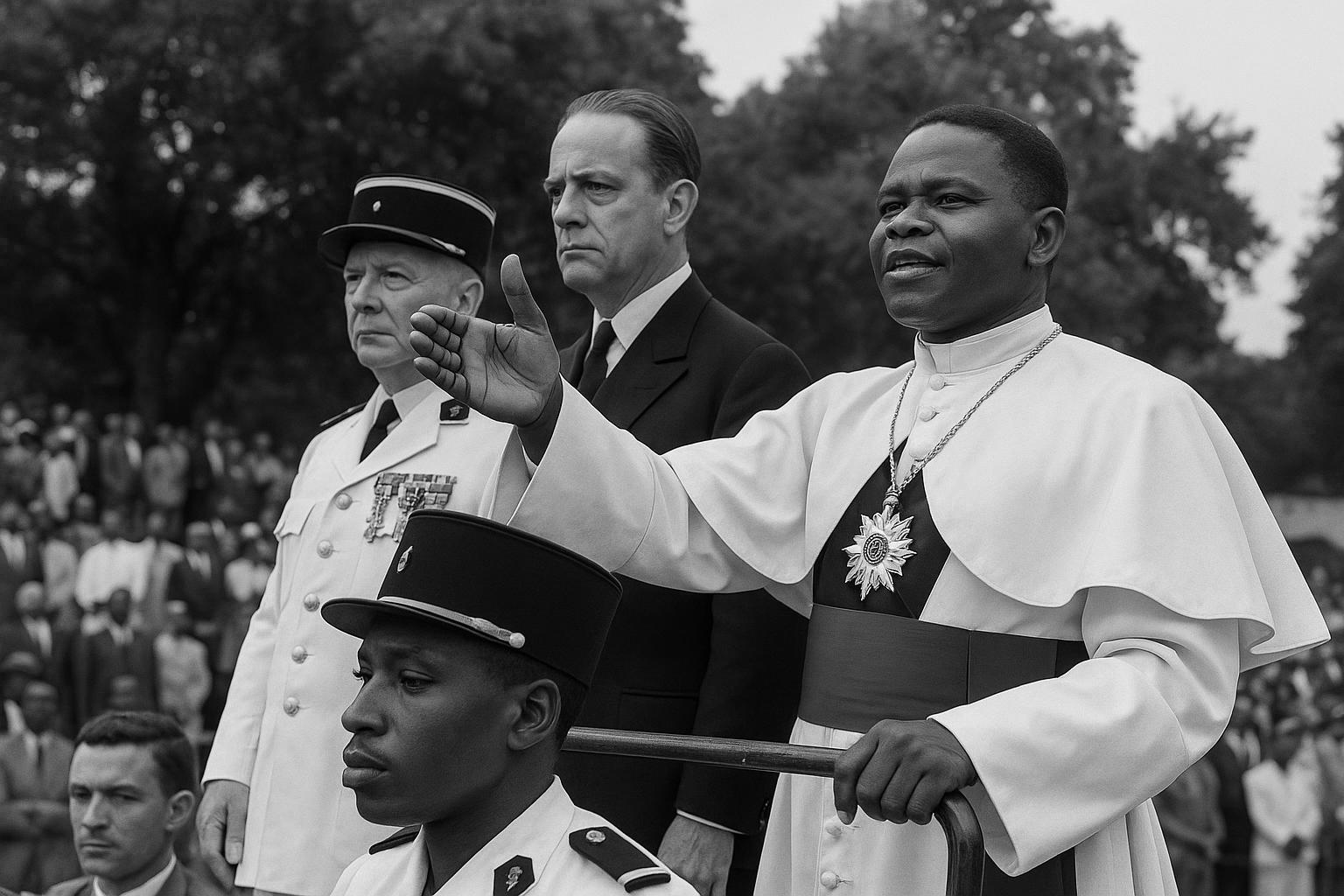
Independence celebrations inevitably unfold on two stages: the closed rooms of diplomacy and the open avenues of public performance. In the midday heat, civil servants, trade unions and schoolchildren marched along Avenue de la Paix, flanked by Senegalese tirailleurs now parading under the Congolese flag. Contemporary press photographs show Malraux, instantly recognisable with his wind-swept hair and white suit, raising Youlou’s arm before a cheering crowd. That image, reproduced endlessly in the French weekly Paris-Match, communicated both rupture and reassurance. A sunset reception at the Palais du Peuple, where palm oil, French champagne and Central African music mingled, sealed the day’s harmony and offered foreign diplomats—among them the United States chargé d’affaires and Ghana’s high commissioner—a glimpse of Congo’s ambition to balance multiple external friendships.
Regional Reverberations and the Foccart Network
The following morning, Youlou inaugurated Square de Gaulle beside Joseph Kasa-Vubu of neighbouring Congo-Léopoldville, underlining Brazzaville’s intent to position itself as a mediator across the Congo River. Malraux departed for Libreville, yet Jacques Foccart remained several days to weave the personal networks that would characterise France’s African policy throughout the 1960s. Scholars such as Pierre Boilley note that the ‘Foccart system’ hinged on presidential rapport rather than treaty clauses; Youlou’s convivial style fitted seamlessly into that architecture. The Congolese leader gained access to French commercial credit lines, while Paris secured a reliable partner in a region then unsettled by secession in Katanga and mutinies in the newly independent Belgian Congo (Boilley, 2013).
An Enduring Legacy for Contemporary Statecraft
More than six decades later, President Denis Sassou Nguesso’s administration still commemorates 15 August with a similar blend of military parades, ecumenical services and diplomatic receptions. The original cooperation accords have been renegotiated several times—most recently in 2010—but the template of balanced sovereignty established by Youlou and Malraux remains visible. Current Congolese envoys routinely invoke 1960 as evidence that Brazzaville’s foreign policy DNA fuses republican autonomy with multilateral partnership, whether in climate diplomacy within the Congo Basin or security collaboration against maritime piracy in the Gulf of Guinea. The midnight cannons of 1960 therefore echo not merely as historical pageantry but as a constitutional heartbeat guiding contemporary Congolese diplomacy.
