
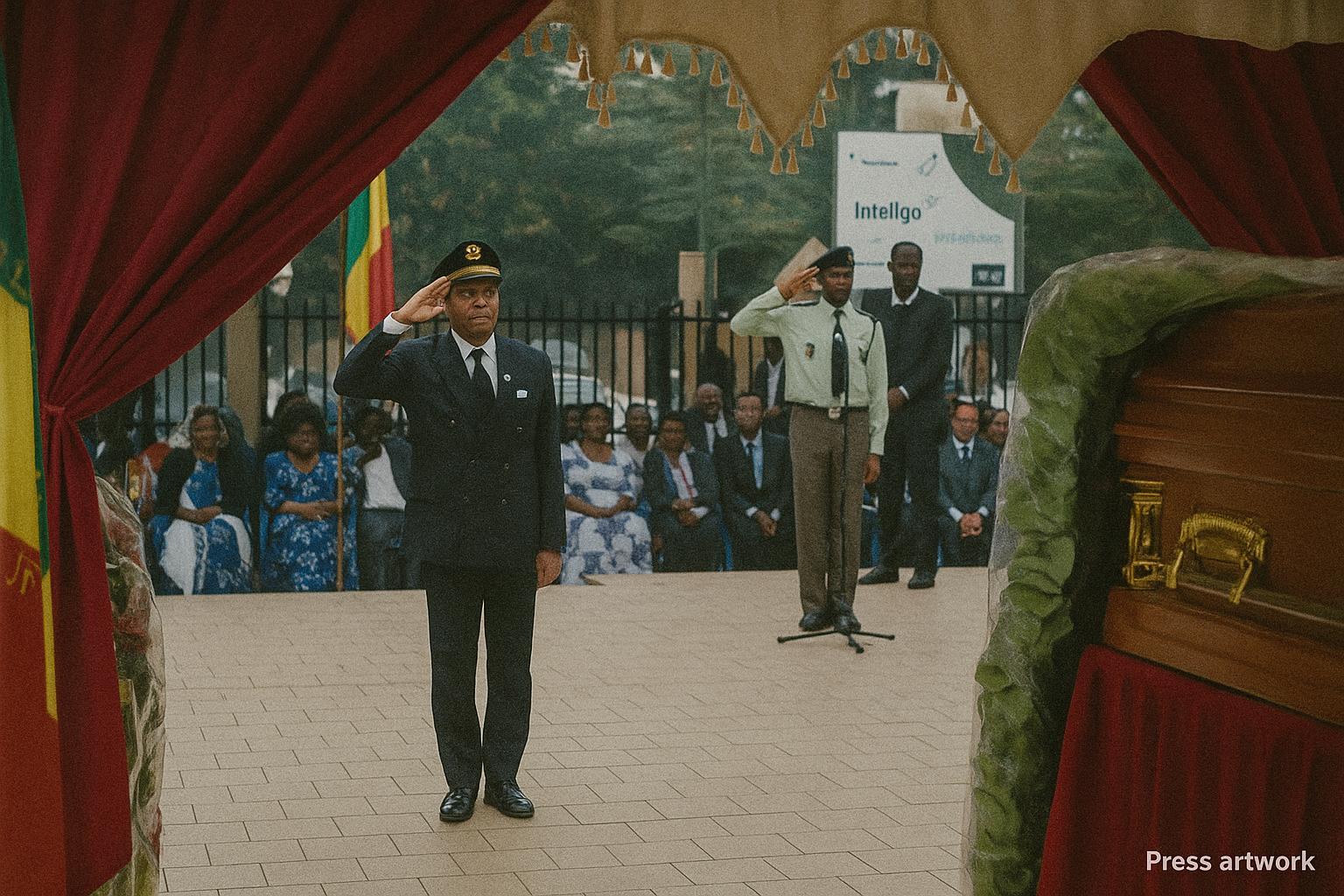
Final Honors on the Banks of the Congo
Under a subdued Brazzaville sky, the Association of Former Cadets (AET) filed past the flag-draped coffin of Colonel Florian Cyr Malonga on 28 July. Military bugles sounded a slow march that reverberated through the marble nave of the Saint-François-d’Assise Cathedral, while diplomats accredited in the Republic of Congo stood shoulder to shoulder with ordinary citizens. The choreography, sober yet meticulous, underscored both the Republic’s reverence for its officers and its desire to project institutional continuity (Les Dépêches de Brazzaville).
A Cadet’s Trajectory from Bacongo to the General Staff
Born on 16 June 1956 in the vibrant Bacongo arrondissement, Malonga belonged to the first generation of post-independence pupils to transition from mission schools to nationalised classrooms. His admission in 1970 to the Cadets de la Révolution, today’s General Leclerc Preparatory Military School, placed him at the crucible of a defence system keen on moulding technocratic soldiers for a young republic. Successive postings to the Lycée Technique du 1er-Mai and the French staff college at Fontainebleau enriched a curriculum that blended Soviet-inspired doctrine with Francophone professionalism, a hybrid training pattern characteristic of Congolese officers of his cohort (Ministry of Defence communiqué). Rising to colonel in 2003, Malonga specialised in logistics, a field critical to the stabilisation campaigns that followed the 1997 internal conflict yet rarely spotlighted outside classified briefings.
Civil-Military Symbiosis in Contemporary Congo
Sociologists of the sub-region often underline how Congolese statecraft relies on dense interpersonal bonds rather than sheer institutional weight. Malonga’s career illustrates that paradigm. His assignments frequently intersected with community-based initiatives in Bacongo, reinforcing the notion that the officer corps remains a social mediator between government and populace. In the words of political scientist Hilaire Mavoungou, “the Congolese officer is at once soldier, teacher and neighbourhood elder,” a triad of roles that bolsters regime legitimacy without overt propaganda (Université Marien-Ngouabi seminar, 2022). Malonga’s burial, attended by parliamentary leaders and cultural luminaries, thus became an exercise in consensual nation-building rather than a mere military ritual.
Veteran Associations as Custodians of National Memory
Established in 1993, the AET has gradually evolved into an interlocutor for ministries seeking to bridge generational divides in the armed forces. Its president, former Minister Rémy Ayayos Ikounga, framed Malonga’s passing as “the departure of a living archive,” a phrase that found resonance among historians concerned with preserving the micro-histories of Congo’s defence institutions. According to a 2021 policy brief by the Centre d’Études Stratégiques du Bassin du Congo, veteran groups provide invaluable narrative continuity, especially in societies where archival infrastructures remain fragile. Malonga chaired the organisation’s sport and leisure commission, ensuring that cadet ethos retained visibility in civic life long after parade grounds fell silent.
Sport, Culture and the Soft Power of Uniform
While logistics occupied his professional docket, football animated Malonga’s private agenda. He captained Interclub Brazzaville in the mid-1970s and later mentored under-17 squads sponsored by the Defence Ministry. This interplay between barracks and stadium illustrates how the Congolese state leverages athletic platforms to project soft power domestically and throughout Central Africa, a practice acknowledged in the African Union’s 2018 report on youth inclusion. Malonga’s dual profile—athlete and strategist—echoes Marshal Lyautey’s dictum that “a soldier who does not cultivate society cultivates grievance,” a maxim still quoted at regional staff colleges.
A Farewell Resonating Beyond the Parade Ground
With the thud of the final volley, Colonel Florian Cyr Malonga joined the pantheon of officers whose biographies intertwine with Congo-Brazzaville’s post-colonial journey. His story, devoid of coup attempts or public controversy, showcases a quieter strand of military service grounded in incremental nation-building. At a moment when regional security narratives often highlight dramatic ruptures, Brazzaville’s farewell to one of its steadfast logisticians sends a measured signal: continuity can be as newsworthy as rupture. In the diplomatic salons that line the Congo River, that message did not go unnoticed.
