
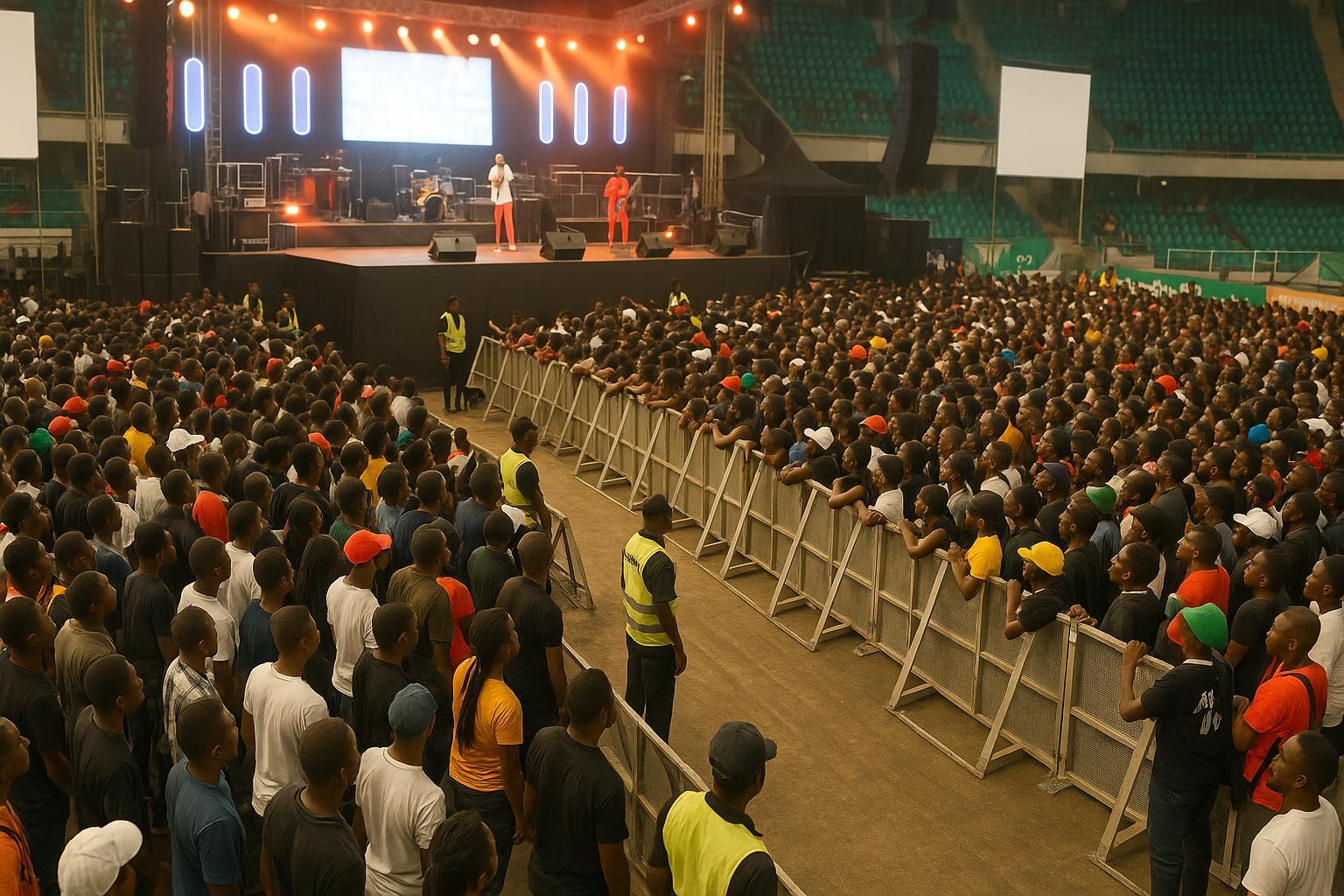
Independence Anniversary Draws Record Youth Crowd
On the night of 15 August 2025, the Alphonse Massamba-Débat Stadium became the epicentre of Congo-Brazzaville’s sixty-fifth Independence Day festivities. Supported by MTN Congo and cleared by municipal authorities, the open-air event offered free general admission while reserving premium marquees for paying guests. Organisers anticipated a large turnout; yet the eventual figure—estimated by venue managers at close to fifty-five thousand—outstripped projections and yielded one of the largest youth assemblies in the capital since the 2015 African Games (Agence Congolaise d’Information, 2025). From the first chords of Paterne Maestro to the closing set prepared for Fally Ipupa, the atmosphere oscillated between euphoric collective singing and the palpable tension that sometimes accompanies densely packed urban concerts.
Sequence of Clashes and Swift Emergency Response
Shortly after midnight witnesses noticed pockets of scuffling near the northern stands where latecomers pressed against perimeter gates. According to senior fire-and-rescue officer Serge Ossiala, units stationed inside the stadium initiated a pre-agreed cascade call to the gendarmerie once projectiles began flying toward the stage. While the majority of concert-goers continued dancing, a cluster of self-styled “warriors” and “chargeurs”—fan crews loyal to different performers—traded blows with makeshift weapons. Video footage later verified by the public prosecutor shows plastic chairs, beverage crates and metal crowd-control barriers being used in the melees. Within twenty minutes, reinforcements from the Police Nationale arrived, forming human corridors through which medics extracted the injured.
Prosecutor’s Findings Clarify Human and Material Toll
In a press briefing on 20 August, Prosecutor Dominique Okemba delivered a quantified assessment designed to quell unfounded rumours of mass casualties circulating on social media. He confirmed eighty-eight minor injuries treated on site and two serious cases referred to the Brazzaville University Hospital, both of whom were discharged within forty-eight hours. Four police officers and six gendarmes sustained bruises, while two service vehicles suffered windshield damage. Forty-three individuals were taken into custody pending charges that range from aggravated assault to destruction of public property. “No death is attributable to the stadium events,” Okemba reiterated, distinguishing the scuffles from an unrelated road accident that night in which an intoxicated driver struck three pedestrians. The legal clarity offered by his statement has been widely welcomed by civil-society monitors (Observatoire Congolais des Droits de l’Homme, 2025).
Fan Rivalries and the Sociology of Urban Youth Tribes
Although the proximate spark lay in a push to breach the gates, sociologists such as Professor Aurélie Makosso of Marien Ngouabi University point to deeper currents. The “warriors” and “chargeurs” phenomena mirror peer-group dynamics observed in football ultras across West-Central Africa: identity is forged as much in music taste as in neighbourhood affiliation. In Makosso’s reading, the concert offered both a celebratory outlet and a canvas for status competition among urban youths navigating unemployment and informal economies. She notes that visibility on social media—where rival crews broadcast live feeds—can escalate minor provocations into public contests for dominance. Understanding these social drivers, she argues, is key to designing preventive security architectures that rely not only on force but also on dialogue and targeted youth outreach.
Government Commitment to Safer Mass Gatherings
Speaking after a cabinet meeting, Interior Minister Raymond-Zéphyrin Mboulou praised the professionalism of first responders while conceding that “the deployment ratios must evolve in line with demographic realities.” He announced the creation of an inter-agency task force to update crowd-control guidelines ahead of the Pan-African Cultural Festival scheduled for 2026. The initiative, he said, will integrate real-time drone mapping, predictive modelling of crowd density and expanded training for private security stewards. Diplomatic observers note that Brazzaville’s efficient post-incident communication contrasts favourably with slower disclosures during similar disruptions elsewhere in the region, bolstering the country’s reputation for administrative candour (Central African Policy Brief, 2025).
Cultural Economy and the Stakes for Congo’s Soft Power
Beyond immediate security considerations, the concert underscored Congo’s emergence as a magnet for Francophone pop culture. Revenue figures provided by the National Union of Music Promoters suggest that even a free-entry model can stimulate the local economy through hospitality, transport and merchandising streams. MTN Congo has hinted at expanding 5G coverage inside major venues, an investment aligned with President Denis Sassou Nguesso’s digital transformation agenda. For regional partners and potential investors, the incident serves less as a deterrent than as evidence of a burgeoning market that merely requires calibrated risk management. Analysts at the African Development Bank predict that creative-industry contributions to Congo’s GDP could double by 2030 if current momentum is sustained.
Lessons for Future Diplomacy and Regional Engagement
For diplomats stationed in Brazzaville, the episode offers a window into the interplay between youth culture and public security, a nexus increasingly relevant to regional stability. Embassies consulted for this article expressed confidence in the government’s capacity to refine protocols ahead of forthcoming high-profile events, from sports tournaments to multilateral summits. The Foreign Ministry, for its part, has circulated guidance encouraging missions to continue normal operations, emphasising that the city’s security posture remains robust. In the broader diplomatic calculus, the Independence Day concert will likely be remembered less for its clashes than for the institutional agility displayed in their aftermath—a narrative that dovetails with Congo-Brazzaville’s stated ambition to project itself as both a cultural crossroads and a reliable convenor of large-scale gatherings.
