
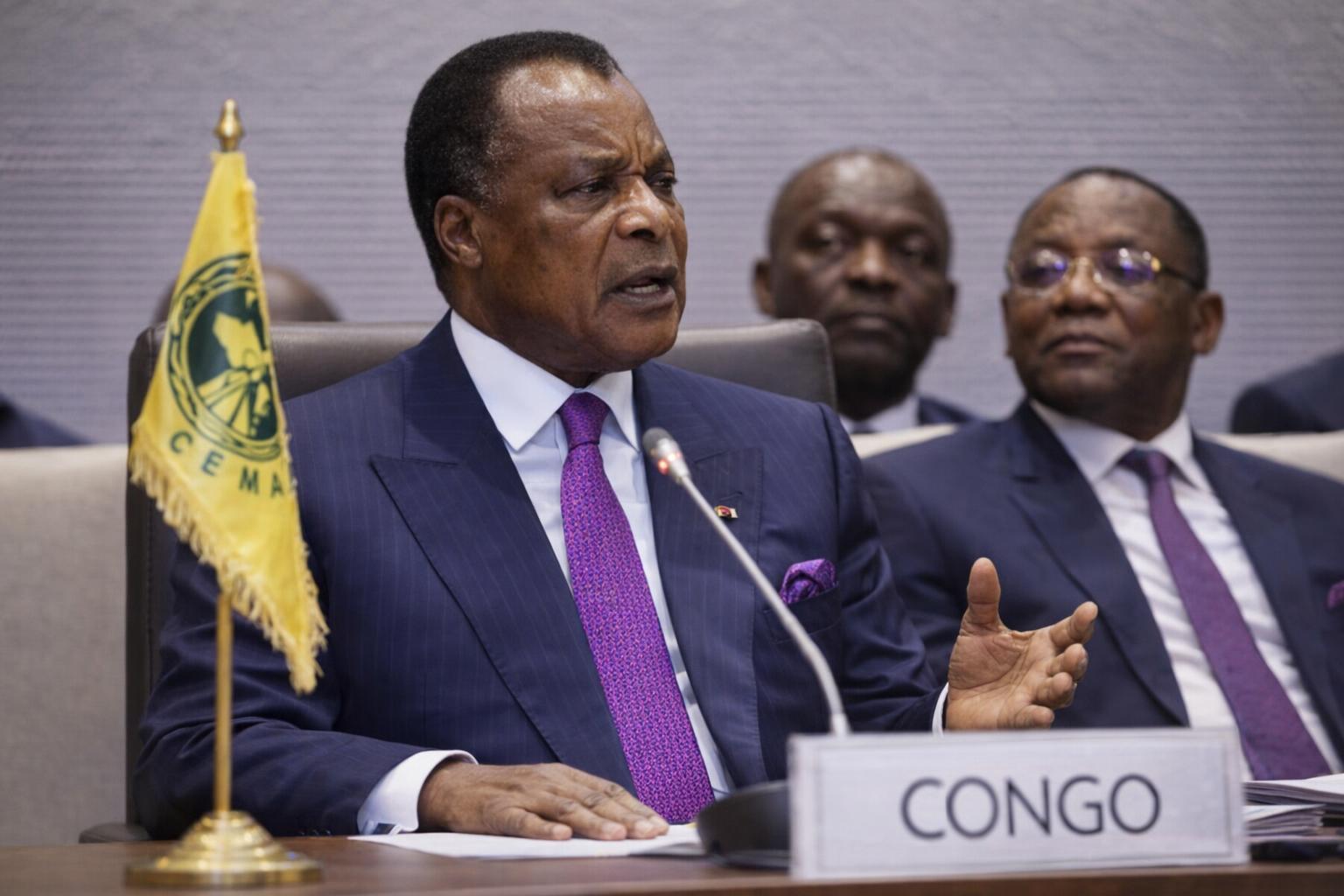
CEMAC Brazzaville Summit 2026: What Was at Stake
On Thursday 22 January 2026, Brazzaville became the diplomatic and economic epicentre of Central Africa as it hosted an extraordinary summit of the Economic and Monetary Community of Central Africa (CEMAC). Convened at a moment of heightened global uncertainty, the meeting gathered the heads of state of the community’s six members—Cameroon, the Central African Republic, the Republic of the Congo, Gabon, Equatorial Guinea and Chad—around President Denis Sassou N’Guesso, acting Chair of the CEMAC Conference of Heads of State.
Beyond ceremonial optics, the summit was framed as a strategic stocktaking exercise: to consolidate macro-financial balances, restore foreign-exchange reserves, and accelerate the effective implementation of structural reforms. The guiding concern was clear and shared: defending monetary stability around the BEAC-issued CFA franc while securing a credible trajectory for growth that can withstand external shocks. In his opening message, President Sassou N’Guesso set an explicit tone of lucidity and rigorous follow-through, signalling that this was intended to be a summit of execution rather than declaration.
Regional Macroeconomy: Gains, Yet Still Fragile
The discussions unfolded against a global backdrop marked, as summit participants noted, by financial-market volatility, persistent geopolitical tensions, rising global interest rates and renewed pressure on emerging-market currencies. For a monetary union such as CEMAC, whose stability depends on reserve adequacy, policy coordination and confidence effects, such a backdrop raises the cost of postponing reforms and magnifies the premium attached to policy credibility.
Within the community, leaders recognised a gradual improvement in some fundamental indicators. Regional growth remains positive, buoyed by the recovery of extractive sectors, public investment dynamics and ongoing budgetary normalisation in several member states. Inflation, after the peaks observed in the post-Covid period and under successive international price shocks, is described as easing toward the community threshold.
Yet the summit’s discourse insisted on prudence. President Sassou N’Guesso warned against premature complacency, observing that positive growth and declining inflation remain vulnerable to shifts in the global environment. This careful framing, echoed in the summit narrative, places resilience—not mere recovery—at the centre of the policy agenda, and underlines that the credibility of the union ultimately rests on disciplined and coordinated implementation.
Denis Sassou N’Guesso and CEMAC Governance Momentum
Presiding from the International Conference Centre of Kintelé, President Denis Sassou N’Guesso assumed the role of political coordinator of the community sequence. The summit’s messaging portrayed this chairmanship as an attempt to move CEMAC beyond the cycle of exceptional meetings followed by uneven national execution. His statement was explicit in its institutional memory: “The present summit offers us the opportunity to make a lucid and responsible progress review of the implementation of the decisions we took during our previous extraordinary sessions of 2016, 2021 and 2024,” he declared.
In diplomatic terms, the reference to earlier extraordinary sessions serves two functions. It situates the 2026 meeting within a continuum of reform commitments, and it legitimises a governance shift toward measurable outputs. In policy terms, the chair’s call for responsibility is aimed at a persistent challenge in regional economic governance: translating collectively agreed frameworks into enforceable national routines, administrative capacity and transparent reporting.
For Brazzaville, hosting the summit also carries a signalling effect. It presents the Republic of the Congo as a venue where regional coordination can be operationalised, and where the CEMAC agenda can be articulated in terms intelligible to both citizens and external partners.
PREF-CEMAC: Quarterly Monitoring as a Turning Point
One of the most consequential decisions highlighted by the summit narrative is the creation of a quarterly mechanism to monitor the Economic and Financial Reforms Programme of CEMAC (PREF-CEMAC). The reform is presented as a structural innovation in community governance, intended to replace episodic supervision with a rhythm of regular accountability.
Under this arrangement, the technical secretariat receives an expanded mandate to carry out quarterly audits of national progress, identify administrative bottlenecks, issue early alerts and transmit reports directly to heads of state. The logic is straightforward: shorten the feedback loop between decision, execution and correction, and thereby reduce the political and macroeconomic costs of delayed implementation.
This type of mechanism is also designed to strengthen the community’s credibility with external stakeholders—multilateral lenders, bilateral partners, institutional investors—who typically scrutinise not only policy announcements but the robustness of monitoring frameworks. In the summit’s own framing, the quarterly review is meant to mark a break with the reputational burden of unfinished reforms, and to anchor the union’s policy trajectory in verifiable deliverables.
Foreign-Exchange Reserves and Export Repatriation Rules
A second decision presented as major concerns the strict repatriation of export revenues, notably from hydrocarbons, mining and other commodities. In a reserve-backed monetary arrangement, such rules are not merely technical; they are part of the financial architecture that sustains confidence in the currency and supports liquidity conditions in the regional banking system.
The summit narrative assigns three objectives to this measure: rebuilding BEAC’s foreign-exchange reserves, injecting liquidity into the regional financial system, and reinforcing the financial sovereignty of the zone. While the instrument is regulatory in nature, its significance is macroeconomic and political: it seeks to align private and public foreign-currency flows with the collective stability imperative of the monetary union.
By placing the repatriation issue at the heart of the summit outcomes, CEMAC leaders also address a recurrent concern of international partners regarding reserve adequacy and the transmission of commodity windfalls into official buffers. The measure is presented as supportive of the stability of the BEAC CFA franc and, by extension, of the investment predictability that Central African economies seek to cultivate.
Fiscal Discipline, Treasury Reform and Domestic Revenue Mobilisation
Alongside monitoring and repatriation, the summit validated a community action plan structured around core reform pillars. The emphasis on strengthened fiscal discipline—aligned with convergence criteria and with programmes supported by the IMF—signals a prioritisation of macro-fiscal anchors at a time of tighter global financing conditions.
A second strand concerns financial transparency through the generalisation of the Treasury Single Account and an accelerated digitalisation of tax and customs administrations. In policy practice, these instruments aim to reduce leakages, improve cash management, and generate more reliable fiscal data—preconditions for both domestic accountability and credible engagement with external partners.
Third, leaders underscored the mobilisation of domestic revenues, including measures against tax evasion and the optimisation of revenue-collecting agencies. Finally, the plan invokes economic and food sovereignty through import substitution strategies and the development of regional agricultural value chains. Taken together, the package sketches an ambition to transform CEMAC from a monetary arrangement under stress into an integrated economic space capable of absorbing shocks and generating inclusive growth channels.
International Partners: A Call for More Effective Support
The summit discourse did not frame reform as a purely internal undertaking. President Sassou N’Guesso directly appealed for more effective engagement from international financial institutions and bilateral partners, stating: “I call for a more effective commitment and support from international financial institutions and our bilateral partners, in support of our development efforts.”
This message positions the reform agenda as a basis for partnership, not dependency. It implicitly argues that improved monitoring, stronger fiscal anchors and better reserve governance should be met with instruments that match the region’s development constraints—whether in financing, technical assistance or risk-sharing mechanisms attractive to private capital.
In diplomatic terms, such language also reflects an attempt to balance sovereignty with cooperation: asserting regional agency in setting priorities while inviting external partners to align their support with the community’s reform timetable and measurable targets.
Brazzaville’s Signal Ahead of Congo’s 2026 Election
The summit took place in the shadow of a domestic political calendar: the Congolese presidential election is scheduled for 15 March 2026. The article’s framing stresses that, in financial and diplomatic circles, political stability is often regarded as a primary condition for durable growth. In that perspective, continuity of institutions is presented as an asset at a time when the region is embarking on a more demanding governance architecture for reforms.
Within the same narrative, President Denis Sassou N’Guesso is depicted as a figure of continuity and a facilitator of regional coordination, with a capacity to convene peers around shared macroeconomic objectives. Such framing does not erase the complexity of the region’s economic challenges, but it suggests that predictable leadership and clear decision pathways can help reduce uncertainty premiums that weigh on investment and long-term planning.
In sum, the extraordinary summit of 22 January 2026 is portrayed as a hinge moment: a move from intentions to structured follow-through, from episodic declarations to quarterly steering. If the stated mechanisms are implemented with the discipline they are designed to impose, Brazzaville may be remembered not only as a host city, but as the place where CEMAC sought to put time-bound governance at the core of Central Africa’s macroeconomic stability.
