
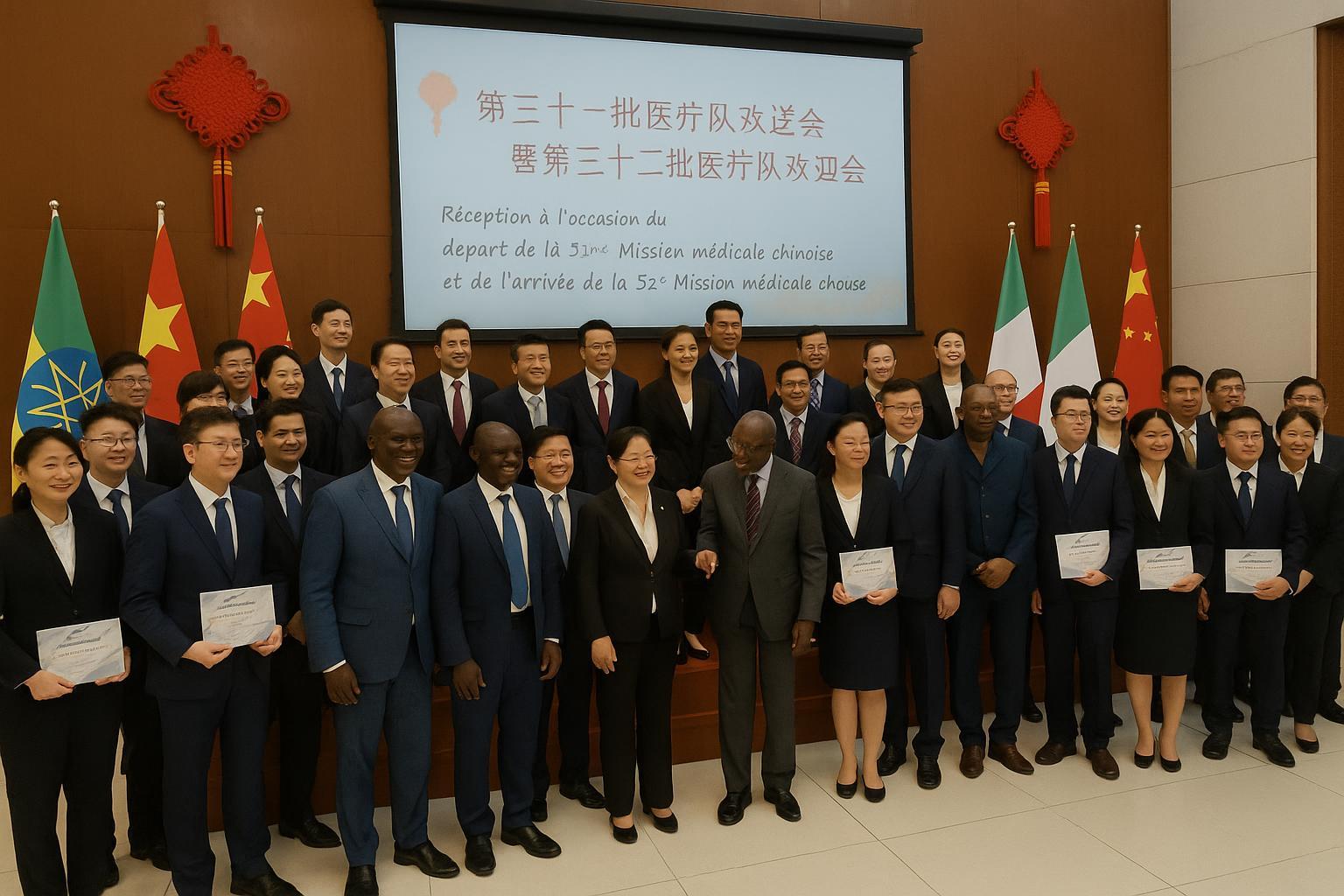
Ceremonial Relay at the Friendship Hospital
A gentle breeze swept the esplanade of the Sino-Congolese Friendship Hospital in Mfilou, Brazzaville, as Ambassador AN Qing presided over a carefully choreographed handover between the outgoing 31st and incoming 32nd Chinese medical teams. Applause echoed from rows of clinicians in starched coats and officials from the Ministries of Health, International Cooperation, and Foreign Affairs, joined by the World Health Organization’s local representative. In a country where symbolism counts, the white-coat relay was more than protocol; it reaffirmed a partnership that has supplied uninterrupted Chinese medical expertise to the Republic of Congo since 1968, often in facilities co-financed by Beijing.
The new contingent, composed of specialists in cardiology, orthopaedics, traditional Chinese medicine and hospital management, will divide its twelve-month posting between the Brazzaville Friendship Hospital and Loandjili General Hospital in Pointe-Noire. In taking the microphone, team leader Dr. Zhang Wei saluted “our Congolese friends” for their trust and promised to “deliver quality care while sharing the latest minimally invasive techniques from Guangzhou and Chengdu.” His predecessor, Dr. Li Ming, recounted having treated more than 40,000 patients and organised 120 free outreach campaigns in peri-urban districts over the past year, figures later confirmed by both embassies’ press releases and an internal WHO memo.
Medical Diplomacy Gains New Momentum
Beijing’s health missions have long combined humanitarian service with what analysts describe as “health diplomacy.” Congo-Brazzaville, for its part, views the arrangement as a pragmatic way to plug specialist shortages while upgrading technical platforms without straining public finances. According to the Ministry of Health’s 2022 statistical yearbook, the country counts barely three anaesthesiologists per 100,000 inhabitants, a ratio the Chinese teams help to ease, particularly during elective surgery campaigns.
Ambassador AN Qing took care to anchor the new deployment in the wider framework of the Forum on China-Africa Cooperation (FOCAC) Ten Health Actions announced in Dakar in 2021. She argued that the 32nd team will “write new chapters in our shared history” by piloting electronic medical records, upgrading neonatal intensive-care units and expanding acupuncture clinics that already draw patients from neighbouring Gabon and the Democratic Republic of Congo. Brazzaville officials welcomed the pledge, noting that diversified services can relieve pressure on the capital’s University Hospital Centre, currently under renovation with assistance from the Saudi Fund for Development.
Technology Transfer and Skills Upgrading
Beyond direct patient care, the mission’s mandate places strong emphasis on capacity building. Plans are underway to establish a laparoscopic simulation lab in Mfilou, co-led by Congolese surgeons trained in Wuhan. Dr. Nadège Ngoulou, a fourth-year resident who shadowed the previous team, said she could now perform an appendectomy “in under forty minutes with fewer complications,” attributing her progress to a mentorship model that blends hands-on practice with virtual lectures transmitted from Shanghai’s Ruijin Hospital.
Such technology transfer aligns with the government’s National Health Development Plan 2023-2027, which stresses human-resource strengthening and south-south cooperation. In an interview, Deputy Health Minister Juste Mondélé praised the Chinese tutors for “respecting local protocols while introducing global best practices,” adding that the ministry will evaluate outcomes through joint audit missions every quarter.
Traditional Medicine Meets Modern Pharmacology
One distinctive feature of the Chinese presence is the simultaneous promotion of traditional Chinese medicine (TCM). The new team includes two herbal pharmacologists tasked with integrating TCM pain-management techniques into postoperative recovery pathways. Dr. Zhang explained that trials combining acupuncture with standard analgesics had reduced morphine use by up to 30 percent among knee-replacement patients during pilot sessions last year, findings soon to be submitted to the Pan African Medical Journal.
Congolese authorities remain keen to harness such synergies while ensuring regulatory oversight. The National Laboratory of Pharmacology and Toxicology is currently reviewing a batch of plant-based topical creams imported for phase-two trials. If approved, the formulations could broaden the country’s essential-medicine list and open avenues for joint ventures in phytopharmaceutical processing at the new Special Economic Zone in Pointe-Noire.
A Multilateral Web of Support
While the ceremony centred on bilateral friendship, the World Health Organization insisted on the initiative’s multilateral dimension. Dr. Kumbeni Ekué, head of the WHO country office, highlighted that the incoming mission dovetails with the organisation’s five-year strategic note for Congo, which prioritises maternal health, non-communicable diseases and emergency preparedness. Chinese teams, he noted, helped train 850 Congolese nurses in obstetric emergencies during the COVID-19 recovery phase, thereby complementing European Union-financed vaccine cold-chain upgrades.
For Beijing, the deployment also burnishes its credentials as a health-security partner ahead of the 2024 China-Africa Leaders’ Dialogue, where pandemic preparedness is slated to top the agenda. Analysts at the South African Institute of International Affairs observe that such missions enable China to gather epidemiological data and refine rapid-response protocols that could be activated regionally should new outbreaks emerge.
Shared Stakes in Sustainable Health Financing
The Republic of Congo has committed to raising health expenditure to 15 percent of the national budget in line with the Abuja Declaration, yet fiscal realities linked to global oil price fluctuations pose recurring challenges. In that context, subsidised foreign expertise provides breathing space as Brazzaville pursues systemic reforms, including the rollout of a universal health-insurance scheme piloted this year among civil servants.
Economist Armel Okemba estimates that, by covering salaries and basic equipment, the Chinese side saves the Congolese treasury close to three million dollars annually, resources that can be redirected toward rural health posts and vaccine procurement. “The partnership is not a substitute for domestic effort,” he cautioned, “but a catalyst that allows scarce funds to travel further.”
Charting the Year Ahead
As twilight settled over the hospital campus, young medical interns snapped photos with their Chinese counterparts beneath banners proclaiming “Shared Future, Shared Health.” The 32nd team’s first major task will be a cataract-surgery marathon scheduled for December, expected to restore sight to 600 low-income patients from Brazzaville, Pool and Plateaux departments. Simultaneously, a joint research unit will finalise a protocol for screening sickle-cell disease, a priority flagged by First Lady Antoinette Sassou Nguesso’s Fondation Congo-Assistance.
For both governments, the mission represents continuity as much as innovation: the reassurance of a tried-and-tested model, coupled with new digital tools and therapies that mirror the evolution of global medicine. Should the programme meet its planned benchmarks—shorter waiting times, expanded surgical lists, stronger laboratory diagnostics—it will offer a tangible demonstration of how strategic partnerships can move beyond rhetoric to concrete, measurable benefits for ordinary citizens. In that sense, the white coats gathered in Mfilou stand as quiet ambassadors of a diplomacy rooted not only in words, but in healed bones, clearer vision and longer lives.
