
Scholarships for Congo’s Digital Future
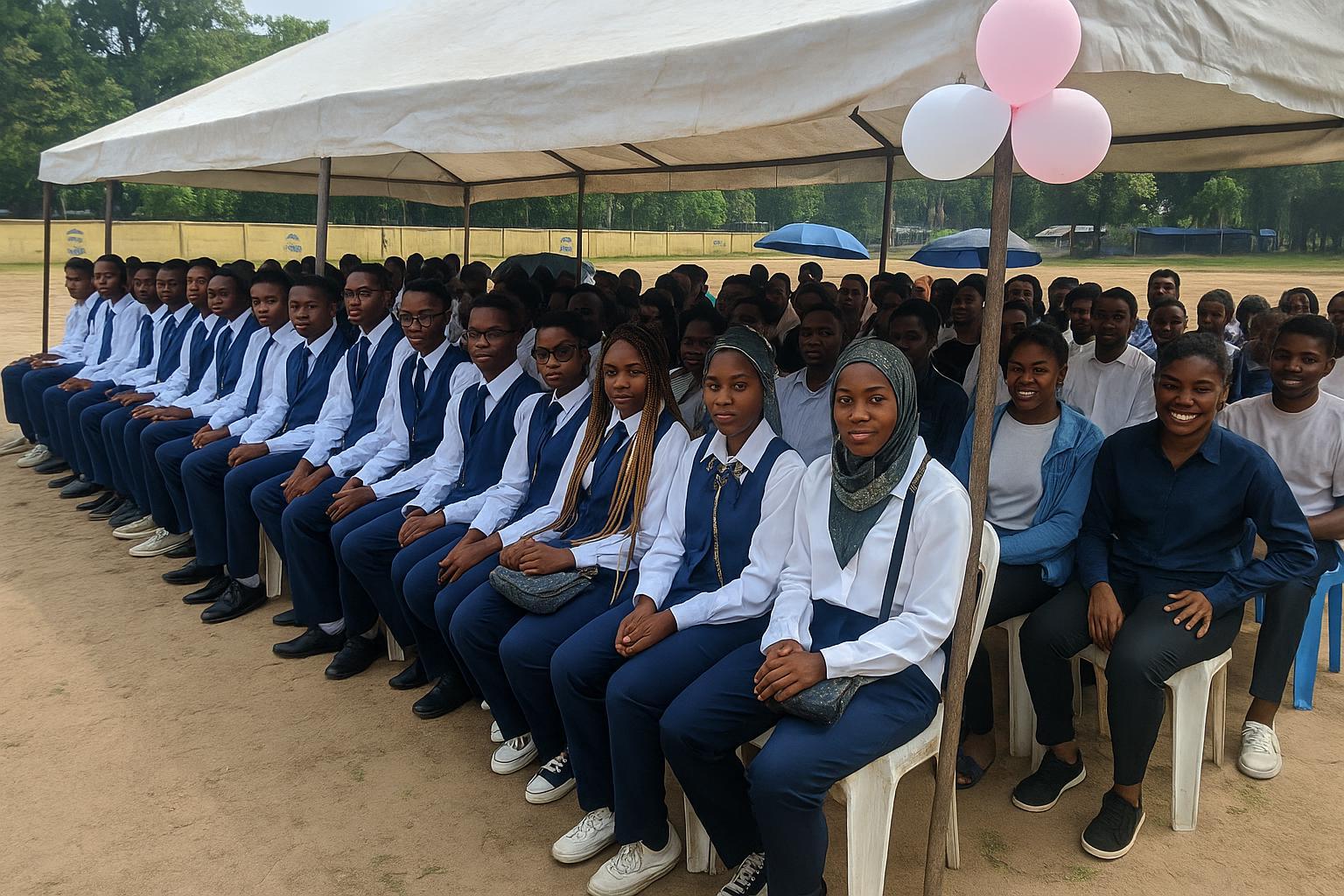
The long, shaded courtyard of the École du Numérique et de l’Intelligence Artificielle, rebaptised ENIA 2.0, hummed with excitement on 3 November as a second cohort of 502 scholarship recipients crossed the threshold in Brazzaville. Each student emerged from the registration desks with a backpack containing a laptop, textbooks and a prepaid data bundle—tangible proof that their studies will impose no financial burden on their families. The sight was emblematic of the government’s pledge, reiterated by Prime Minister Anatole Collinet Makosso earlier this year, to remove economic barriers to higher learning in strategic fields such as coding, data science and machine learning.
Brazzaville’s New Digital Vanguard
ENIA 2.0 was created in 2022 to respond to the sudden spike in demand for advanced digital skills across Central Africa. Its flagship programme, “Bourse Mon Avenir”, targets talented school-leavers from all twelve départements, with a particular focus on candidates from under-served districts of Brazzaville and budding tech hubs in Pointe-Noire. According to Director-General Pierre Mongo Ossebi, more than 4,200 applications were vetted this year through a competitive process that combined high-school grade point averages, psychometric testing and a 48-hour hackathon overseen by volunteer engineers from the Ministry of Posts, Telecommunications and Digital Economy. Of the successful candidates, forty-three per cent are young women, a notable increase from the inaugural intake, reflecting a national objective to close the gender gap in STEM disciplines.
Skills Pipeline for the Emerging AI Economy
The curriculum has been trimmed to three intensive academic years, each punctuated by industry placements inside public agencies, private telecom firms and fintech start-ups. Students begin with Python and mathematical foundations before progressing to cloud computing, neural-network architectures and, ultimately, capstone projects that tackle real-world challenges such as agricultural yield prediction or traffic-flow optimisation in Brazzaville’s rapidly expanding suburbs. “Our pedagogy rests on competence, rigour and creativity,” Ossebi said in his keynote address, echoing the triptych that adorns the institution’s crest. The approach has already yielded dividends: four prototypes developed by first-year students were demonstrated during the opening ceremony, including a voice-activated Lingala–French translation assistant that drew applause from assembled parents and dignitaries.
Student Voices: Aspirations Beyond the Classroom
For many scholarship holders the programme represents a generational turning point. Twenty-year-old Grâce Mayanga, who grew up in the riverine town of Mossaka, shared her ambition to design AI-powered flood monitoring tools. “Each rainy season the river isolates entire neighbourhoods. I want to give my community predictive information, not just react afterwards,” she explained. Fellow student Rony Bemba hopes to launch a gaming studio that will showcase Congolese folklore to francophone audiences. Their testimonies underscore a broader narrative of empowerment that the Ministry of Youth and Civic Education has promoted through its “Jeunesse 2040” roadmap, which positions digital entrepreneurship as a vector of inclusive growth.
À retenir
More than 500 full scholarships awarded this year confirm the authorities’ target of financing 1,000 places before 2026. Female enrolment has risen to 43 per cent, supporting national gender-equity commitments. Early prototypes emerging from ENIA 2.0 already address local development challenges, suggesting rapid returns on public investment in digital human capital.
Le point juridique/éco
Tuition waivers are funded through a blended mechanism combining budgetary allocations from the National Fund for Digital Development and a levy on international bandwidth licences introduced by Law 24-2021 on Telecommunications Services. The legal framework grants accredited institutions such as ENIA 2.0 a three-year tax holiday on imported pedagogical equipment, thereby lowering overhead costs. Economists at the University of Marien-Ngouabi estimate that each graduating class could ultimately add 0.2 percentage points to annual GDP growth by raising productivity in sectors as diverse as logistics, agribusiness and e-governance (Etudes Économiques du Congo, 2023).
Strategic Alignment with Congo Digital 2025
The scholarship initiative dovetails neatly with the government’s Digital 2025 master plan, which envisions universal broadband access, paperless public services and an indigenous software industry capable of exporting solutions across the CEMAC bloc. Minister Léon Juste Ibombo, interviewed on Télé Congo after the ceremony, praised ENIA 2.0 for “bringing to life the strategy’s human-capital pillar” while stressing that the school’s open-source ethos reduces dependency on foreign vendors. Observers note that Brazzaville’s partnership with the International Telecommunication Union on cybersecurity certification will further enhance job prospects for graduates.
Regional Impact: Beyond the Capital
Although lectures are currently delivered on the leafy Ouenze campus, plans are afoot to open satellite classrooms in Pointe-Noire, Owando and Dolisie using a hybrid model that streams laboratory sessions via dedicated fibre links. The decentralisation is expected to stimulate local ecosystems: municipal councils have already earmarked co-working spaces, and oil-services companies in Pointe-Noire have signalled interest in sponsoring capstone projects on predictive maintenance. By anchoring talent outside Brazzaville, policymakers hope to curb the rural-to-urban drift that strains housing and transport infrastructure in the capital. As Chirel Mongo, the school’s promoter, concluded, “We are not merely training coders; we are cultivating architects of Congo’s digital renaissance.”
