
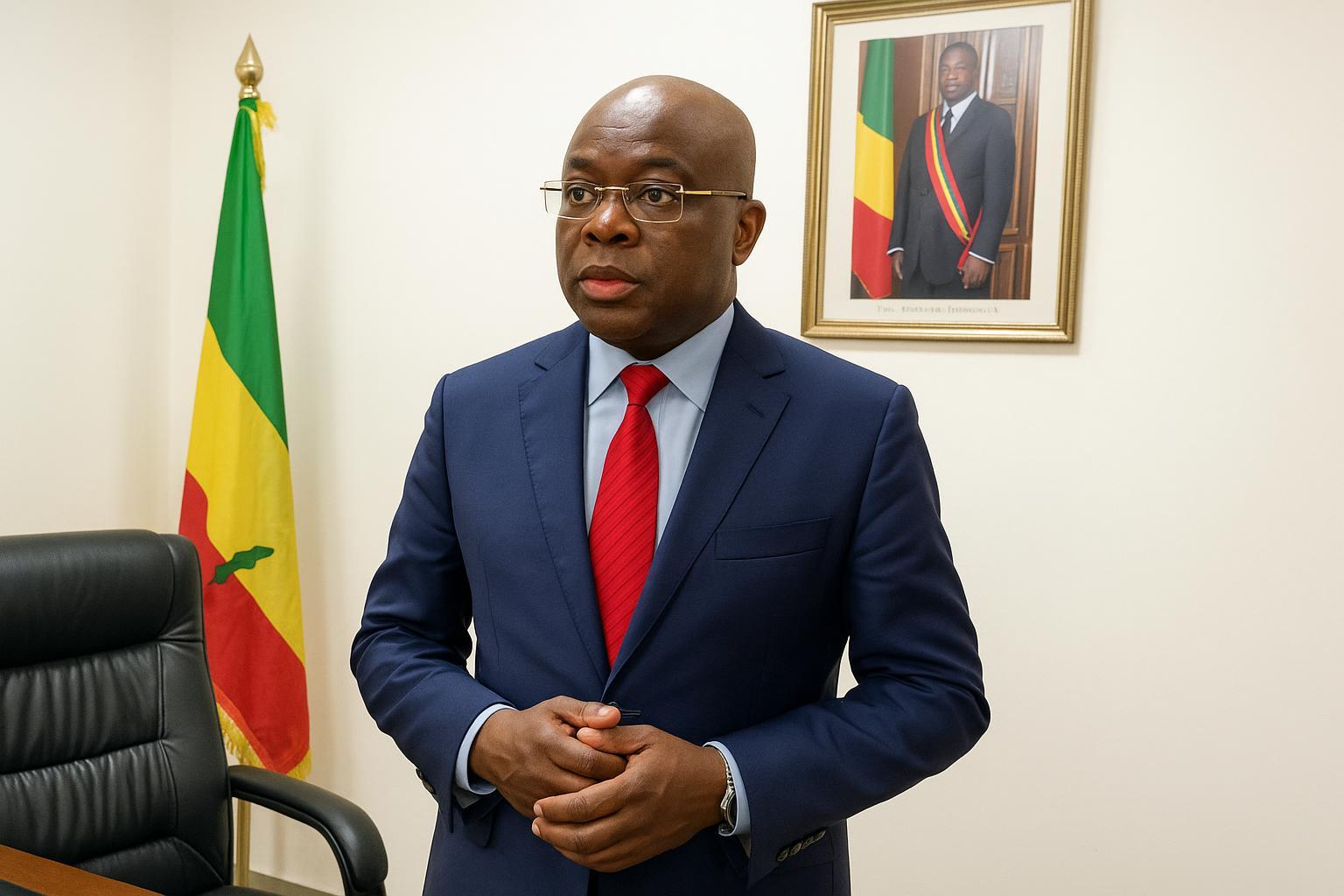
A High-Profile Installation at the Downtown Headquarters
The marble-lined hall of the Directorate of Customs and Indirect Duties in central Brazzaville bustled on 6 November as inspectors in navy uniforms saluted Alexis Bienvenu Oyombi, the newly-appointed departmental director. A career officer promoted by decree of the Prime Minister on 31 October 2025, Oyombi inherits an administration that processes the bulk of Congo-Brazzaville’s import duties, excise taxes and transit fees. Flanked by senior staff, he conceded the magnitude of the task at hand yet struck an upbeat tone. “We shall work to boost the fiscal base so that the objectives defined by the Government through the Ministry of Finance are fully met,” he declared, his words echoing across a room where revenue charts and compliance dashboards adorned the walls.
Strategic Role of Brazzaville Customs in National Finances
Although Pointe-Noire’s deep-water port dominates external trade, the Brazzaville river port and Maya-Maya International Airport together generate a decisive share of non-oil income. According to the Ministry of Finance, customs and indirect duties accounted for almost two-thirds of non-hydrocarbon revenues in 2024. Jean-Marie Montsagna, the ministry’s Director of Human Resources who presided over the hand-over, reminded officers that “the State budget is essentially fiscal and customs-driven; you therefore hold a front-row seat in our development programme.” In the National Development Plan 2022-2026, the Government pledged to raise the tax-to-GDP ratio from 12 percent to 15 percent, a goal that rests heavily on efficient border management.
A Mandate Anchored in Revenue Mobilisation
Oyombi’s first priority is to expand the tax base while shortening the time goods spend in clearance, a dual objective viewed by the private sector as overdue. The Congolese Shippers’ Council estimates that each additional day in port adds two percent to the landed cost of merchandise. “Customs can be both a guardian of public resources and a facilitator of trade,” Oyombi told reporters, hinting at a forthcoming work plan that will reassess valuation benchmarks, tighten post-clearance audits and reinforce the single-window platform Sydonia World. The new director is required to submit quarterly performance reports, a measure introduced by Minister of Finance Christian Yoka early this year to entrench a culture of accountability.
Tackling Illicit Practices through Reform
The ceremony also served as a reminder of lingering challenges. In September, Minister Yoka publicly cautioned officers in Pointe-Noire and Kouilou over voluntary undervaluation and forged documents, actions that cost the Treasury billions of CFA francs. Montsagna stressed that such behaviour “must be corrected by the new team—the departmental director must be uncompromising.” For Oyombi, curbing fraud is more than a disciplinary issue; it is pivotal to restoring public confidence. He intends to launch randomised post-release inspections and expand joint task forces with the gendarmerie, initiatives inspired by recommendations in the World Customs Organization’s integrity report on Central Africa.
Digital Tools and Capacity Building Set to Accelerate
Beyond policing, technology will underpin future gains. The ministry’s modernisation roadmap envisages full electronic payment of duties by 2026 and real-time risk profiling powered by artificial intelligence. An infographic released last month shows that transactions lodged through the electronic portal already rose from 48 percent in 2023 to 67 percent in mid-2025. Oyombi notes that these systems only deliver when staff are trained: “We shall pair every new module with targeted capacity-building so no officer is left behind.” The National School of Administration and Magistracy has reserved forty seats in its upcoming customs cohort for Brazzaville personnel, a gesture designed to foster technical depth and ethical awareness.
Stakeholder Voices Signal Cautious Optimism
Private operators welcomed the appointment yet underscored the need for continuity. “The business community expects predictable procedures and transparent tariffs,” said Lucien Nzouzi, president of the Union of Freight Forwarders. Development partners share that view. In its June review under the Extended Credit Facility, the International Monetary Fund commended Congo-Brazzaville for trimming tax exemptions but urged further action on customs leakages. The IMF spokesperson in Brazzaville, Céline Diallo, told this newspaper that “consistent enforcement at the port and airport will be critical to sustain growth outside the oil sector.” Oyombi’s track record—he previously supervised airport customs where seizures of counterfeit pharmaceuticals rose by 40 percent—offers grounds for measured confidence.
À retenir
The new directorate aims to lift non-oil revenue, deploy digital clearance tools and stamp out fraud; success will hinge on strict enforcement and skilled personnel.
Le point juridique/éco
Oyombi’s mandate draws its authority from the 2022 Customs Code, which aligns Congo-Brazzaville with CEMAC regulations on valuation and transit. Article 42 of the code empowers departmental directors to impose fines up to twice the evaded duty, a provision he vows to apply rigorously while ensuring due-process safeguards for traders.
Broader Fiscal Context and Outlook
Congo-Brazzaville’s economic narrative is steadily diversifying away from hydrocarbons, and customs stands at the heart of that transition. Domestic revenue mobilization featured prominently during President Denis Sassou Nguesso’s address to Parliament in August, where he called customs “a strategic lever for inclusive growth.” Should Oyombi meet his results-based obligations, the ripple effects could include greater budgetary space for health and education, improved sovereign credit metrics, and enhanced investor perceptions. For now, the spotlight is on the bustling quaysides of the capital, where the hunt for every legitimate franc has begun anew under his stewardship.
