
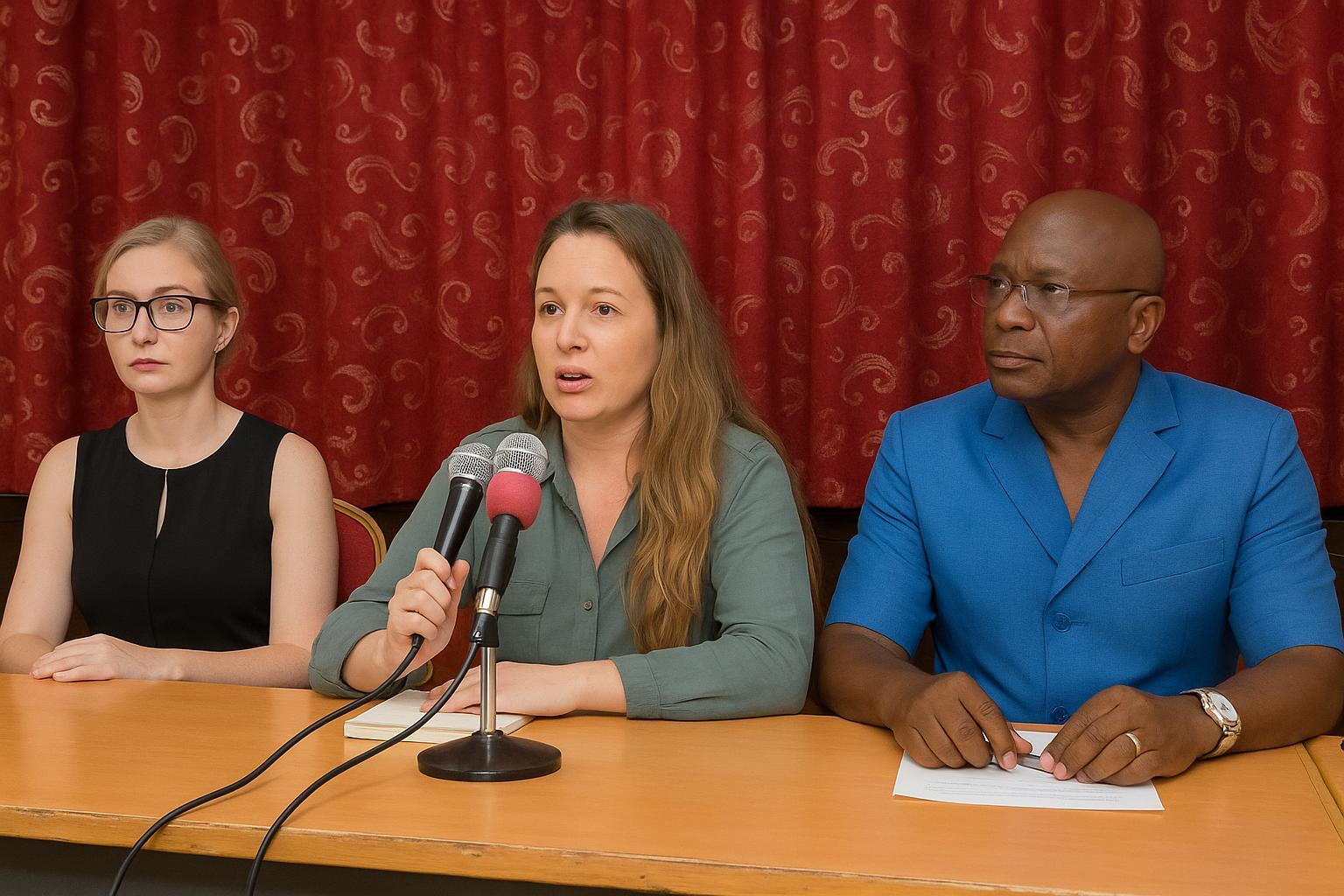
Annual educators summit signals momentum
Late September in Brazzaville no longer marks only the return of pupils buying notebooks on Nelson Mandela Avenue. It has also become the moment when Russian-language teachers gather under the high ceilings of the Maison russe to take stock of their craft. On 25 September, directors of studies and head teachers from the capital’s major lycées compared pass rates, exchanged lesson plans and, crucially, agreed on joint targets for the 2025-2026 school year.
Maria Fakhrutdinova, the dynamic director of the cultural centre, reminded the audience that these consultations have grown from informal briefings into an indispensable coordination platform. “Every year we meet before classes resume so that the objectives of each lycée are aligned with a national vision,” she observed, noting that common benchmarks allow the Ministry of Secondary Education to monitor progress more precisely. The ritual, she hinted, is less about ceremony than about embedding Russian into the city’s competitive academic ecosystem.
Russian instruction and Congo’s diversification agenda
Beyond pedagogical housekeeping, the session illustrated how foreign-language policy meshes with Brazzaville’s diplomatic and economic calculations. For a country historically francophone yet outward-looking, cultivating an additional vector of international cooperation carries pragmatic value. The annual allocation of roughly 250 Russian government scholarships to Congolese bacheliers has turned language mastery into a passport for engineering, medical and IT programmes in Kazan, Novosibirsk or St Petersburg.
Officials at the Maison russe argue that the scholarships also serve domestic goals. Graduates returning with advanced technical skills feed the government’s ambition to diversify an oil-dependent economy. In the words of administrator Roger Kandza, “These bursaries are open to all of Congo’s top performers, not only those in literary streams. The idea is to bring back engineers who can strengthen telecommunications, agriculture and energy logistics at home.” His comment resonated with attendants conscious that linguistic fluency is now intertwined with employability charts.
New native-speaker teachers reshape pedagogy
This year’s most tangible novelty is the arrival of several instructors directly from Russia, a development not seen “for a long time”, Fakhrutdinova emphasised. Their one-year deployment has two purposes: sharpen the pronunciation and idiomatic range of local colleagues, and expose pupils to authentic accents that digital recordings cannot replicate.
At Lycée de la Révolution, deputy head Colette Mabiala expects the native lecturers to accelerate students’ listening comprehension. She recalled that oral proficiency remains the weakest component in the national syllabus. “Textbook dialogues help, yet they cannot replace the spontaneity of a real conversation. Hearing intonation patterns live is invaluable,” she said, adding that joint lesson preparations are already scheduled to transfer methodology rather than create dependence.
The logistics hurdle: textbooks and staffing
Notwithstanding enthusiasm, the meeting exposed gaps that could stall progress. Several public lycées—Thomas-Sankara chief among them—lack permanent Russian teachers, forcing timetables to be merged or hours to be curtailed. The shortage partly stems from retirements and the difficulty of enticing young philologists to non-capital postings.
Learning materials pose a parallel problem. Many classrooms rely on photocopied chapters of out-of-print manuals, with bilingual glossaries tailored for European learners rather than francophone Africans. Participants floated the idea of a joint translation workshop that would update vocabulary to cover Congolese realities—from cassava farming to fintech startups—while the Maison russe pledged to help replenish library shelves through its Moscow partners.
Learner success stories feed a virtuous cycle
Concrete results, however, remain the best marketing tool. Ferty Mbemba, director of studies at Lycée Emery-Patrice-Lumumba, disclosed that every candidate who opted for Russian at the 2025 baccalauréat session passed. “The first advantage is the relative ease with which learners grasp the language once they master the Cyrillic alphabet,” he commented, crediting smaller class sizes and the novelty factor for heightened motivation.
Students themselves are amplifying the word-of-mouth campaign. In the courtyard of Lycée Chaminade, final-year pupil Mireille Makosso explained that Russian songs shared on social media sparked her curiosity. Now she hopes to qualify for a biomedical engineering degree in Tomsk. Her story typifies a broader trend whereby cultural products—from rap collaborations to animated films—feed classroom enrolment, creating a feedback loop between popular culture and academic choice.
Toward a sustainable multilingual ecosystem
Looking ahead, planners aim to institutionalise the gains registered since Russian was introduced in Congo-Brazzaville’s curriculum several decades ago. One proposal under review is a blended-learning platform that would connect lycées lacking staff with the Maison russe’s multimedia studio, thus mitigating geographical disparities. Another is a summer immersion camp on the Black Sea sponsored by Russian universities, with places reserved for top performers from rural departments.
For the Congolese authorities, the initiative aligns with the constitutional commitment to promote multilingualism while safeguarding the primacy of French and indigenous languages. By embedding Russian within that balanced framework rather than presenting it as a rival, policymakers hope to keep the debate focused on opportunity, not hierarchy. The coming academic year will test whether new teachers, better books and sustained scholarships can translate diplomatic goodwill into classroom fluency—and, ultimately, into professional capital for the next generation.
