
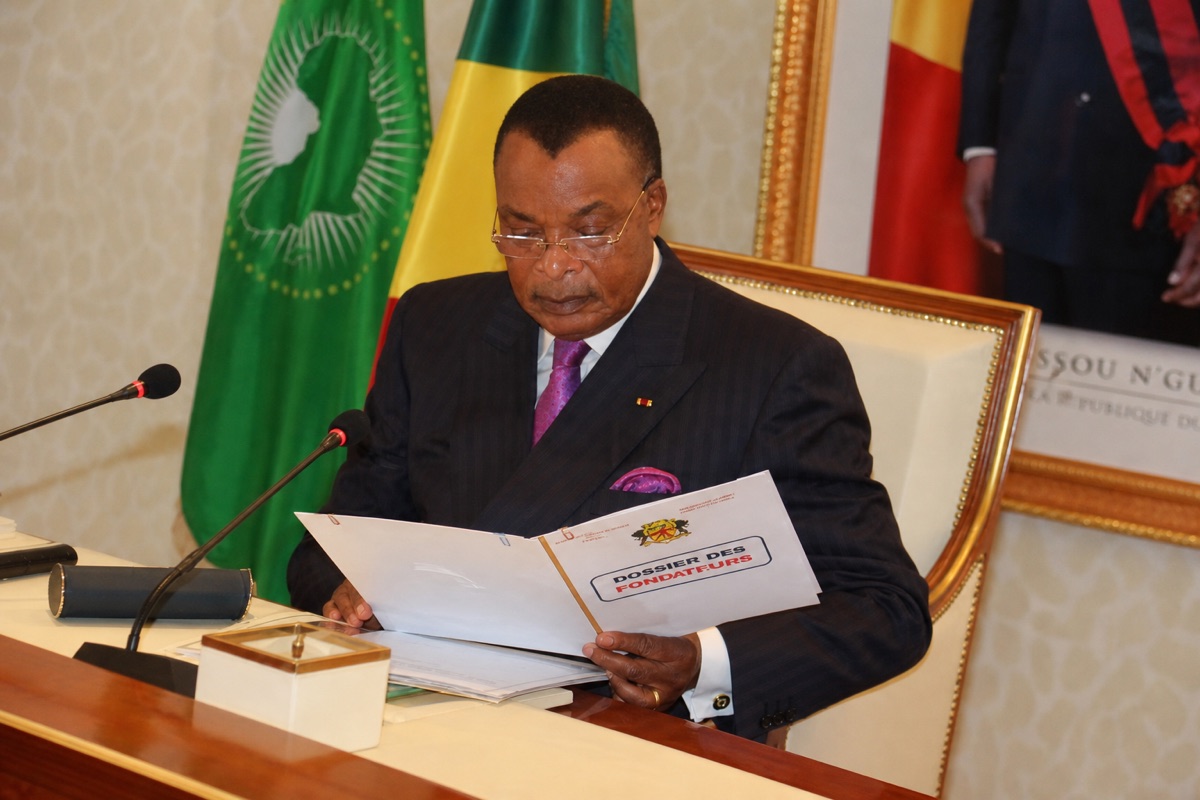
Brazzaville has its government. On Friday 24 April 2026, Minister of State and Director of the Presidential Cabinet Florent Tsiba read out the official roster of the Republic of Congo’s new executive, a formation of forty-two ministers and ministers-delegate whose composition had been awaited with no small degree of anticipation across the capital’s political circles. The announcement closes a brief but conspicuous interregnum that opened on 16 April, when President Denis Sassou N’Guesso was sworn in for a fresh five-year mandate, and it confirms the contours of an administration whose principal task will be to translate a renewed presidential term into legible policy.
A Familiar Hand at the Helm of Government
The most telling signal lies not in the list of newcomers but in the figure who tops it. By keeping Anatole Collinet Makosso as Prime Minister, the head of state has opted for continuity at the very moment when a new mandate might have invited rupture. Makosso, whose tenure has spanned a turbulent economic stretch marked by debt negotiations and the slow recovery of hydrocarbon revenues, now inherits the responsibility of giving coherence to a sprawling cabinet. The choice reads as a wager on institutional memory: rather than dismantle the machinery assembled over the previous term, Sassou N’Guesso appears to favour the seasoned over the experimental, a calculation that will reassure markets even as it disappoints those who had hoped for a generational turn.
The Architecture of a Forty-Two-Strong Executive
The arithmetic itself merits attention. Forty-two ministers and ministers-delegate constitute a substantial cabinet by any measure, and the distribution of portfolios sketches the priorities the presidency intends to defend. The creation of a Vice-Prime Minister’s office, entrusted to Jean-Jacques Bouya, introduces a tier of coordination above the ordinary ministerial ranks. Bouya, long associated with major public works and territorial planning, brings to the role a reputation built on infrastructure delivery, and his elevation suggests that the orchestration of large projects will remain central to the second mandate’s identity.
The sovereign ministries have been distributed among figures whose names carry weight in Congolese governance. Raymond Zéphirin Mboulou takes National Defence, a posting that consolidates his standing within the security apparatus. The sensitive Finance and Budget portfolio falls to Christian Yoka, who will shoulder the delicate task of stewarding public accounts at a juncture when fiscal discipline and the management of arrears continue to define the country’s relationship with its external partners. Foreign Affairs goes to Constant Serge Bounda, Justice to Aimé Ange Wilfrid Bininga, and Health and Population to Jean-Rosaire Ibara, an allocation that maps the conventional pillars of statecraft onto a recognisable cast.
Sectoral Breadth and the Test of Coherence
Beyond the headline appointments, the decree extends across the specialised domains that increasingly determine a state’s capacity to act: agriculture, energy, the environment, transport and education each receive dedicated stewardship. The breadth is deliberate. A government of this size signals an ambition to address simultaneously the productive economy, the ecological transition and the social contract, yet breadth carries its own hazard. The larger the cabinet, the harder the work of coordination, and the more pressing the question of whether forty-two voices can be marshalled into a single line of policy. It is here that the architecture of the Vice-Premiership and the continuity of Makosso’s leadership acquire their full meaning, for both are instruments designed to hold a wide formation together.
The emphasis on agriculture and energy is unlikely to be incidental. For an economy whose fortunes have long been tethered to oil, the diversification imperative has moved from rhetoric to necessity, and the presence of distinct portfolios for these sectors hints at an intention, at least declaratory, to broaden the productive base. Whether the institutional intention survives contact with budgetary reality will be the measure by which this cabinet is eventually judged.
What the Formation Signals for the Mandate Ahead
The manner of the announcement is itself revealing. That the roster was delivered by the Director of the Presidential Cabinet, rather than emerging through a more diffuse process, underscores the centrality of the presidency in shaping the executive. The new term thus begins on a note of concentrated authority tempered by administrative continuity, a combination that has characterised Congolese governance for some time and that the 24 April announcement reaffirms.
For the cadres, entrepreneurs and citizens watching from Brazzaville and beyond, the immediate significance is less in any single name than in the overall disposition. A heavy cabinet, a retained premier, a new coordinating vice-premiership and a familiar distribution of sovereign portfolios together describe a second mandate that intends to govern from a position of consolidated experience. The harder questions of execution, fiscal restraint and economic diversification now pass from the language of appointment to the slower grammar of results.
