
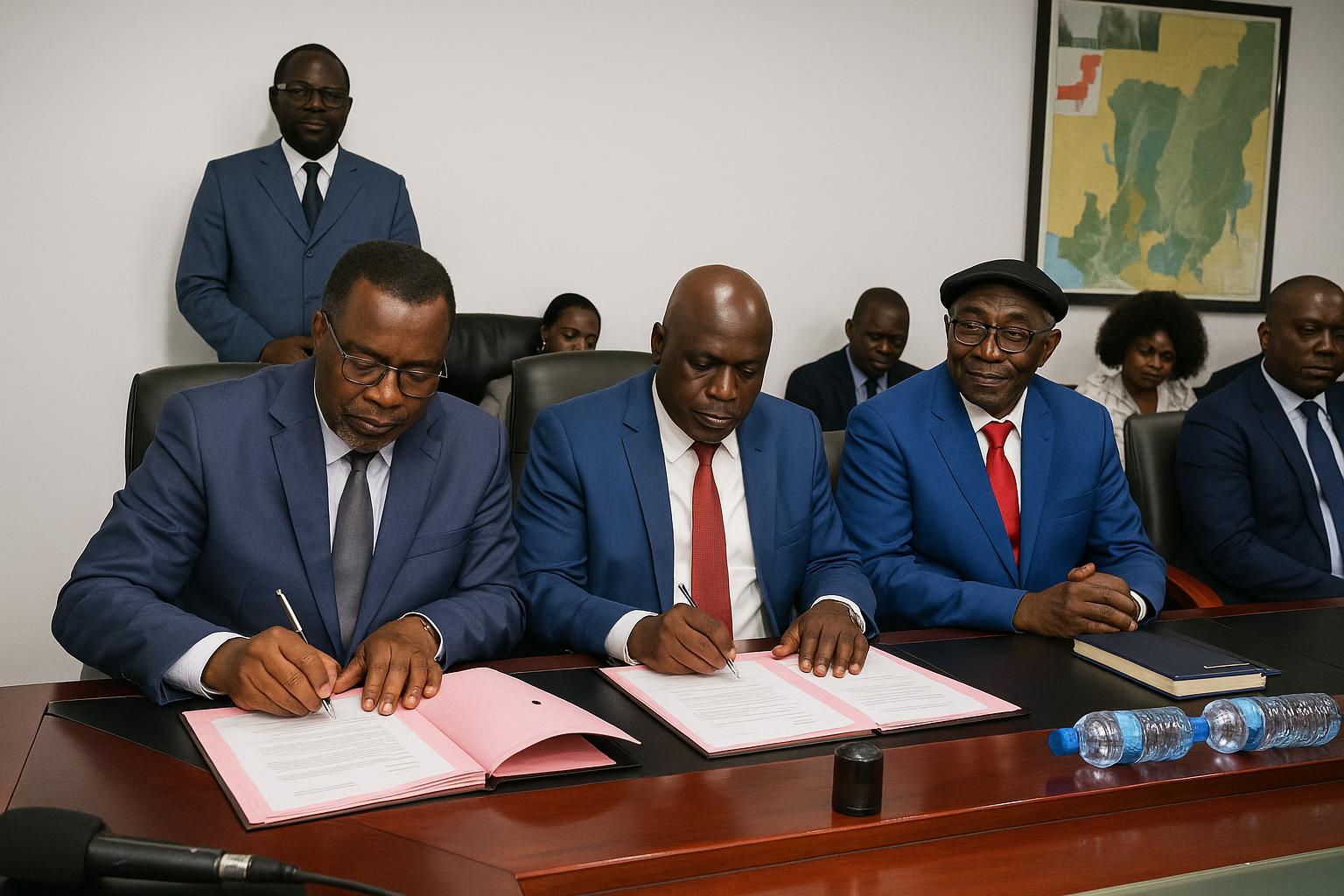
Brazzaville ceremony marks strategic accord
The marble-clad hall of the Ministry of Communication in Brazzaville briefly became a crossroads of commerce and journalism on 27 August. In front of officials and editors, Paul Nestor Mouandzibi, president of the Congrès des chefs d’entreprise du Congo (Ccec), and Anasth Wilfrid Mbossa, director-general of La Nouvelle République, signed a strategic partnership meant to “valorise private initiatives” and refresh the narrative of Congo-Brazzaville’s economic trajectory. Both men portrayed the accord as a working instrument, promising concrete support for entrepreneurs and broader journalistic coverage of domestic business achievements.
Strategic alliance amplifies Congolese enterprise
For the Ccec, an umbrella that brings together start-ups, agribusiness firms and oil-services giants, visibility is almost as vital as access to credit. Mouandzibi told attendees that many Congolese entrepreneurs remain “hidden champions,” producing locally yet rarely featuring in mainstream broadcasts. The alliance with La Nouvelle République is expected to project a unified private-sector voice at home and abroad, attracting investors and reassuring regulators. Coverage will highlight new factories, export contracts and community projects. The objective, he emphasised, is “a data-driven conversation that presents private enterprise as a pillar of national prosperity.”
La Nouvelle République’s digital transformation momentum
La Nouvelle République, created in 1998 through the merger of several respected titles, regards the agreement as a lever for its ongoing digital shift. Beyond the daily print run, the group now offers a multimedia website, a streaming television channel and active social-media feeds. Mbossa argues that rigorously curated corporate content will enrich these platforms and broaden revenue without compromising editorial standards. He underscores reciprocity: “The entrepreneurial ecosystem can assist us with training and technology, allowing us to meet international benchmarks for multimedia journalism,” a collaboration he associates with “credible sovereignty” in national information flows.
A calibrated ‘win-win’ governance framework
Governance structures have been drafted to replicate joint-venture discipline rather than traditional sponsorship. A steering committee, co-chaired by Mouandzibi and Mbossa, will set quarterly priorities and commission impact assessments. Editorial independence is protected by a clause barring prior review by the Ccec, while the press group commits proportional exposure for small and medium-sized enterprises, not only headline conglomerates. Capacity-building seminars on communication strategy for entrepreneurs and workshops on financial literacy for journalists are envisaged, reflecting the conviction that shared vocabulary and mutual trust reduce misreporting and foster sustainable development.
Implications for diversification and investor perception
Diplomatic observers in Brazzaville note that the accord coincides with international interest in Central African markets pursuing post-hydrocarbon growth. While the Republic of the Congo remains an established oil exporter, national development programmes increasingly emphasise agriculture, services and light manufacturing. Consistent coverage of business innovation can, they argue, serve as soft power, signalling regulatory reliability and social stability. Trade attaché Marie-Claude Delon contends that “predictable information ecosystems often precede predictable investment flows,” implying that the partnership could influence risk assessments by lenders and ratings agencies. The framework thus becomes both a domestic confidence-building measure and an instrument of economic diplomacy.
Sustaining momentum amid evolving media economics
Financial realities still loom. Advertising revenues across the region have contracted amid global price swings and the migration of audiences to mobile platforms. Mbossa concedes that continuous innovation will be essential, citing experiments with sponsored podcasts and interactive data visualisations. Mouandzibi says member companies stand ready to share expertise, from cloud-based logistics to mentorship for investigative business reporting. The shared premise is that a diversified revenue model, backed by transparent governance, will keep both institutions resilient. As a senior editor remarked after the ceremony, “sustainability will stem less from subsidies than from the credibility we earn.”
Looking ahead to measurable impact
The ultimate test of the Brazzaville pact lies in its capacity to shift perceptions—inside boardrooms, within communities and among opinion makers across the continent. If the promised synergy materialises, entrepreneurs could secure quicker financing, regulators might receive sharper feedback on policy effects and citizens should gain a clearer view of value creation. For the press group, the alliance offers a chance to cement its reputation as an authoritative chronicler of economic change. Six months from now, the committee plans to publish a public dashboard of outcomes, ranging from featured enterprises to digital reach. Until then, cautious optimism prevails.
