
Brazzaville negotiations to restore academic continuity
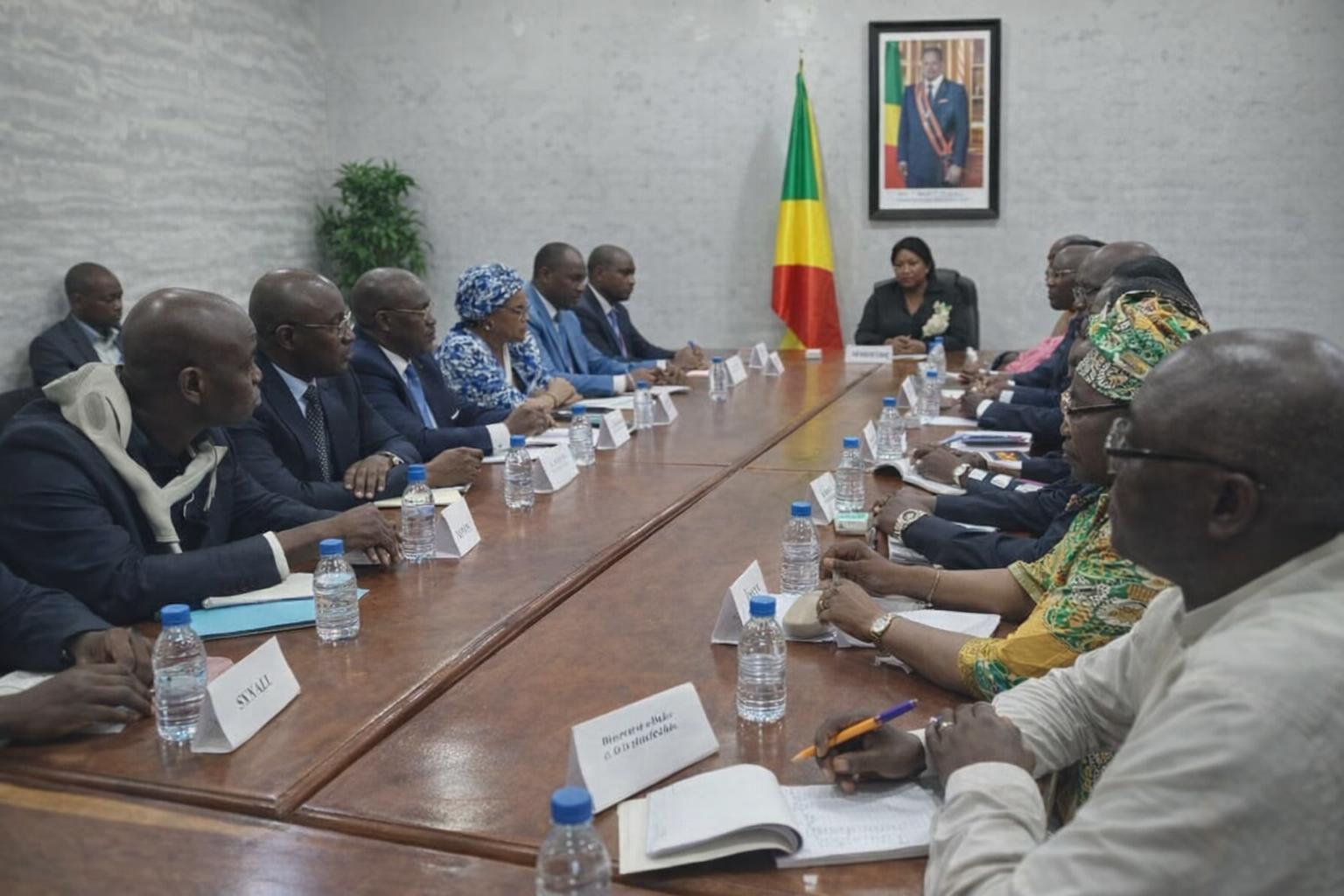
Brazzaville hosted renewed high-level consultations on 5 January as Congo-Brazzaville’s Minister of Higher Education, Delphine Édith Emmanuel, convened a working session with the inter-union college of Marien-Ngouabi University. The meeting was framed as part of an ongoing effort to secure a durable understanding within the country’s flagship public university, where a strike has been underway since 17 November 2025 (ACI).
In official terms, the talks form one sequence within a broader set of consultations between the government and social partners, with the stated objective of building a consensus-based pathway capable of restoring stability to teaching and administrative services. The emphasis, in the language used after the meeting, was on dialogue as a method for consolidating institutional functioning and safeguarding the continuity of public higher education (ACI).
Government–social partners dialogue as an institutional method
The 5 January session was presented as a continuation rather than a reset, reflecting a governance style that prioritises negotiated solutions with representative bodies. According to the information made public after the discussions, the exchanges revolved around proposals formulated by both parties, while remaining at the stage of deliberation until a formal agreement is validated (ACI).
This insistence on the distinction between discussion and formal endorsement is not merely procedural. It signals that the parties are seeking a settlement that can be operationalised within the administrative and financial frameworks that govern public institutions. In practice, it also indicates caution: commitments are being shaped through consultation, but are not announced as final until the relevant mechanisms allow their confirmation (ACI).
Salary arrears: partial disbursement and remaining expectations
The most concrete data point communicated at the close of the meeting concerns the wage arrears at the centre of the social dispute. Three months of back pay have already been disbursed to Marien-Ngouabi University staff, out of five months claimed by workers, according to the elements released publicly (ACI).
Minister Emmanuel, as reported, reiterated her commitment to work in coordination with the competent services to identify a solution that would unlock the remaining two months. The phrasing used underscores both political will and administrative sequencing, suggesting that the government is approaching the issue as a solvable matter within the scope of state financial management, while maintaining a collaborative posture toward staff representatives (ACI).
Adjunct payments and wage regularity in the spotlight
Beyond the issue of arrears, the dialogue also covered the payment of part-time lecturers and broader questions of remuneration regularity. These themes are significant in a university ecosystem where academic delivery often depends on temporary teaching staff, and where predictability of pay is closely linked to the capacity of the institution to plan courses, examinations, and administrative processes (ACI).
The discussions, as characterised in the public readout, aimed at clarifying pathways for meeting obligations and stabilising remuneration schedules. While no formal agreement was announced, the agenda indicates an effort to treat the strike not solely as an immediate crisis, but as an opportunity to address recurrent operational tensions that can affect service delivery in higher education (ACI).
Conditions for lifting the strike and resuming university life
The explicit objective remains the rapid creation of conditions conducive to lifting the strike and enabling the effective resumption of pedagogical and administrative activities. This objective, emphasised in official communication, places students, faculty, and administrative staff at the centre of the anticipated normalisation, while also highlighting the state’s interest in ensuring the uninterrupted functioning of strategic public services (ACI).
The current posture of the authorities, as reflected in the continuation of talks, suggests an attempt to move from partial progress to a comprehensive understanding. In such negotiations, the difference between incremental payments and a durable settlement often rests on mutual confidence in implementation. For that reason, the insistence on “consensual solutions” appears designed to produce not only an agreement in principle, but a framework that can hold over time (ACI).
A negotiating sequence anchored in December’s precedent
The 5 January working session follows a previous meeting held on 23 December. That earlier gathering brought together, alongside union representatives, the university’s management team and the Prime Minister’s adviser on education, Guy Richard Bossoto, according to the same source (ACI).
By maintaining continuity between the December and January consultations, the process projects institutional seriousness and a preference for structured engagement. The presence of both university leadership and a senior adviser to the Prime Minister in the earlier meeting also indicates that the issue is treated as cross-cutting, connecting campus-level administration to the broader architecture of public policy (ACI).
What remains, based on the publicly available elements, is the transition from ongoing discussions to a formally endorsed agreement. Until that stage is reached, the negotiations can best be understood as a calibrated attempt to reconcile the legitimate expectations of university workers with the administrative steps required for a sustainable settlement—an approach that, if successful, would provide the basis for a stable return to academic normalcy at Marien-Ngouabi University (ACI).
