
Stalemate in Brazzaville revives hard questions
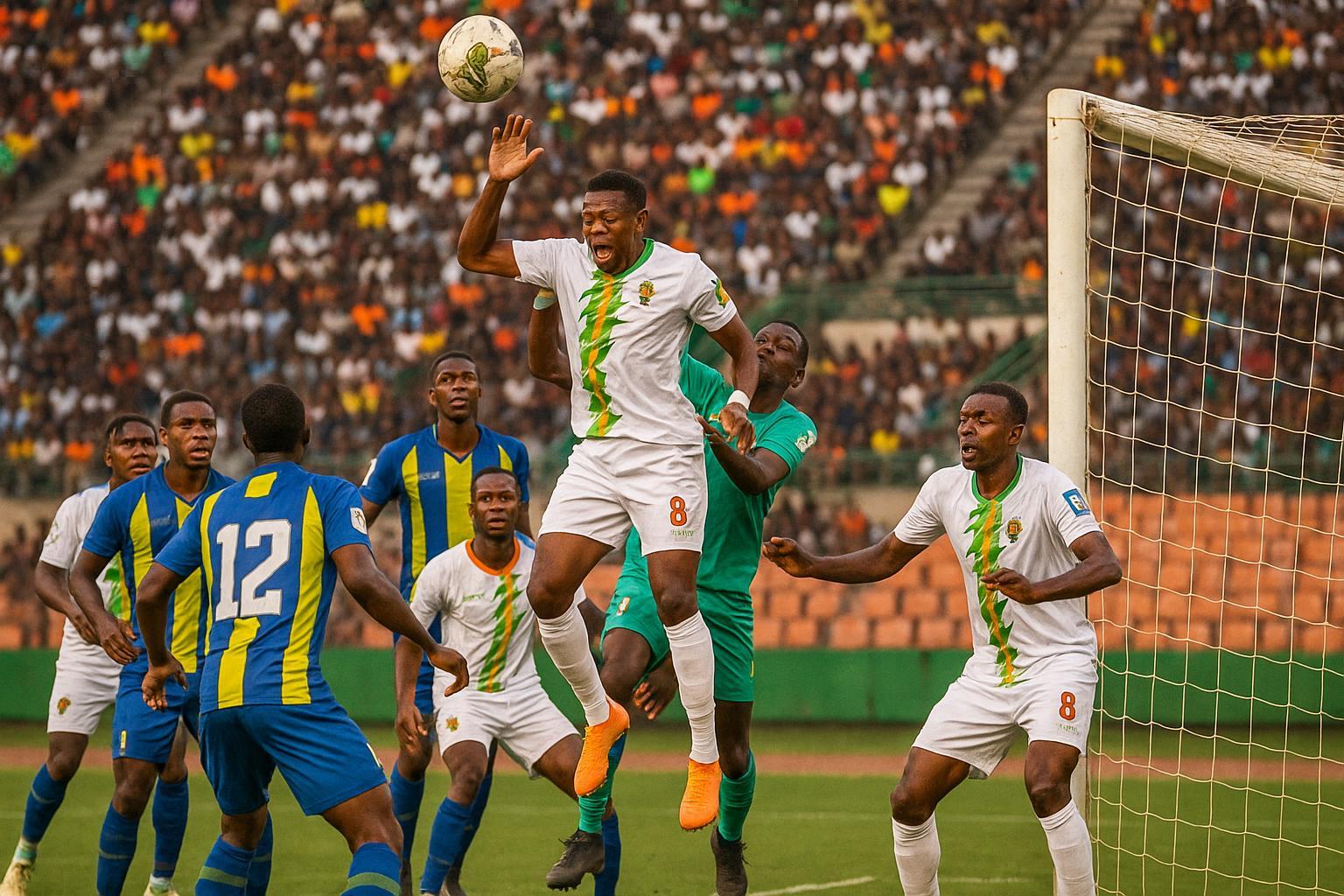
The evening haze over the Président Alphonse Massamba-Débat Stadium had barely lifted when Deschan Moussavou’s curling strike sent the 45,000-strong crowd into brief rapture. Yet the 68th-minute advantage dissolved twelve minutes from time, Selemani Mwalimu punishing a tiring Congolese back line and sealing a 1–1 draw that felt, in the stands as on the touchline, like a victory withheld. The seventh-round result leaves the Red Devils anchored in the lower half of Group E, still mathematically alive but running out of margin.
For players and supporters alike the fixture marked more than a simple point. It was the republic’s return to competitive action after a twelve-month stretch punctuated by voluntary forfeits, bruising defeats and administrative doubts. By avoiding a fifth straight loss, captain Henock Inonga insisted, “we have reopened the door, even if only a crack.”
A turbulent qualifying campaign
Congo’s path to the 2026 FIFA World Cup has been anything but linear. A 2–4 reverse to Zambia in mid-2023 was followed by the technical defeat to Niger after a last-minute withdrawal, while a chastening 1–6 lesson from Morocco underlined the gulf that still separates Brazzaville from the continent’s elite (CAF match reports). In March 2025 the federation opted to pull out entirely, only to rescind the decision days later amid fears of FIFA fines and the popular outcry that rippled across social networks and radio call-ins.
Those postponements were recorded as 0–3 defeats, handing group rivals an arithmetical cushion that now weighs heavily. Yet the volte-face also preserved the integrity of Congolese football structures. Had the retreat been final, insiders say the national body risked a financial sanction estimated at up to 500,000 USD, as well as a two-year suspension from FIFA development funds.
Glimpses of cohesion amid adversity
Friday’s match, though scrappy, hinted at collective progress. Caretaker coach Beni Makita, elevated after the spring overhaul, maintained a compact 4-2-3-1 and urged his full-backs to advance only in carefully timed waves. That prudence stifled Tanzanian winger Mudathir Yahya for long stretches and allowed Moussavou, roaming between the lines, to dictate tempo.
In midfield, the double pivot of Guy Mbenza and Prince Ibara recycled possession with more maturity than seen in Rabat or Ndola. Data collected by the local analytics start-up Goalstat indicates Congo completed 84 percent of their passes in the first hour, eight points above their group average, suggesting that the preparatory micro-cycle in Kintélé addressed at least part of the turnover problem.
Fitness puzzle and the final third conundrum
Still, the pattern of late-game fade-outs persists. The equaliser followed a lapse in pressing intensity, as GPS trackers showed a collective drop of nearly a kilometre in average distance covered during the last quarter-hour. Conditioning coach Laurent Ondongo attributes the slump to the truncated domestic calendar, disrupted by pandemic backlogs and stadia renovations, which has left many internationals without sustained competitive rhythm.
Offensively, Congo generated a solitary clear chance, when teenager Déogracias Bassinga slipped in Migon Koto only for the veteran to scuff wide. Makita conceded post-match that “our decision-making in the red zone remains hesitant,” a shortfall magnified by the clinical edge of group frontrunners Morocco, who boast thirty goals from as many shots on target.
Staff reshuffle and federation calculus
Last April’s overhaul saw French-Congolese tactician François M’Pelé exit after two and a half years, replaced by the more pragmatic Makita and an expanded analytics unit. The sports ministry, keen to steady the programme without inflating costs, negotiated performance-linked contracts rather than flat monthly fees, a strategy praised by budget watchdog Observatoire des Finances Publiques for “aligning expenditure with measurable sporting output.”
Internally, officials emphasise the symbolic capital bound up in the qualifiers. A respectable finish, even without Qatar 2026, would bolster Brazzaville’s candidacy to co-host the 2027 African Nations Championship, a bid currently in feasibility study phase.
À retenir
Beyond the scoreline, Friday underlined three trends shaping the campaign. First, administrative resilience: by honouring the fixture list the federation signalled stability to sponsors and regulators. Second, incremental tactical clarity: Makita’s disciplined block offered a scaffold on which flair players such as Moussavou can improvise. Third, fitness remains the Achilles’ heel, with injury risk rising as the domestic championship compresses fixtures to meet CAF licensing clocks.
Le point juridique/éco
FIFA’s disciplinary code allows fines of up to 150,000 CHF for repeated forfeits, a sanction Congo narrowly avoided in March. The episode nevertheless triggered stronger compliance procedures inside the ministry, including a match-by-match escrow system that secures travel logistics seventy-two hours before kick-off.
On the commercial side, state broadcaster Télé Congo renegotiated its sublicensing deal with a Pan-African streaming platform on a revenue-share basis tied to audience peaks. Early data show the Tanzania encounter drew 1.3 million domestic viewers, a record since the 2015 African Games. Analysts at Banque Postale Congolaise estimate that every percentage point increase in viewership adds roughly 25,000 USD in advertising value, funds that could funnel directly into youth academies if ring-fenced.
Road ahead: Casablanca and beyond
The calendar affords little respite. A double-header against already-qualified Morocco looms in November, followed by a potentially decisive trip to Niamey. Mathematically, nine points from those fixtures could still propel Congo into the play-off lottery, provided Tanzania and Zambia stumble. The scenario is improbable yet not implausible; sports data firm Opta currently assigns a 6 percent qualification probability, up from 2 percent prior to Friday’s draw.
Makita is expected to recall France-based striker Silvère Ganvoula and Belgium-based defender Aaron Boupendza to deepen squad depth. Securing their release, however, may hinge on alignment with European club schedules, a negotiation the federation has opened in cordial terms according to communications director Léon Mavoungou.
Brazzaville’s cautiously renewed optimism
As supporters spilled onto Avenue du Général de Gaulle long after the final whistle, the mood was neither jubilant nor despondent but stoically hopeful. The Red Devils remain “a work in progress,” wrote the daily Les Dépêches de Brazzaville, yet the mere fact of progress matters. In a nation where football bindingly bridges social strata, each competitive minute served under the floodlights counts towards a broader narrative of perseverance.
Whether that perseverance crystallises into a ticket for North America is secondary, some argue, to the institutional lessons learned: the value of showing up, the dividends of incremental planning, and the unifying force of a team that refuses to yield even amid adversity. For now, Congo’s 2026 dream flickers—not blazing, but unmistakably alight.
