
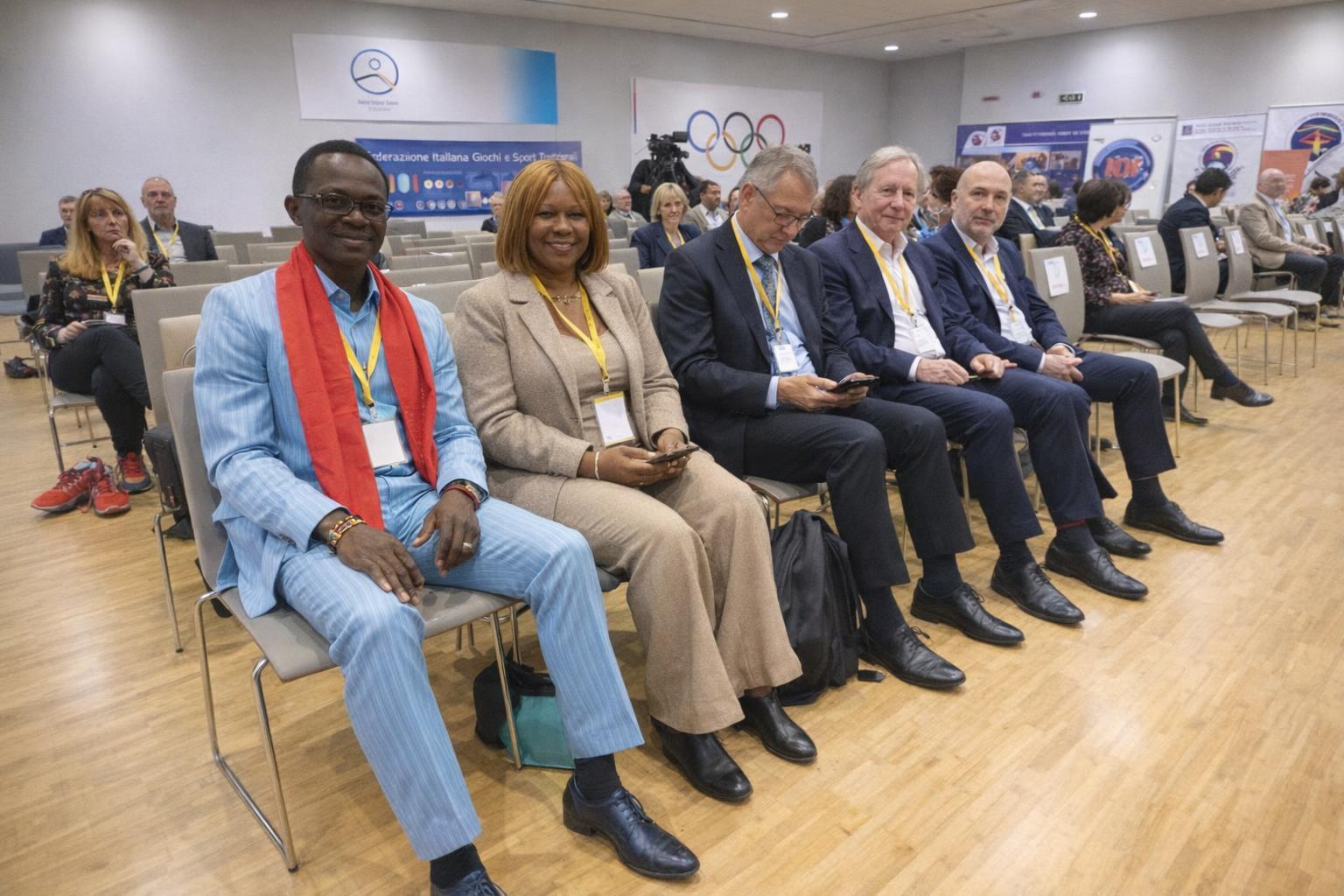
Sport for All Congress in Civitanova Marche, Italy
The International Sport for All Federation convened its elective general assembly and congress on Saturday, 24 January 2026, in Civitanova Marche, an Italian Adriatic coastal city in the province of Macerata, within the Marche region of central Italy. The meeting brought together delegates to address governance, institutional direction, and the international positioning of the Sport for All agenda within a rapidly evolving global sporting landscape.
Among the participants was José Cyr Ebina, a former member of parliament and president of the Congolese Federation of Sport for All, Hiking and Well-being. José Cyr Ebina joined the delegation of the African Confederation of Sport for All led by its president, the Ivorian Marie-Laure Essan. For José Cyr Ebina, the gathering was described as a significant first immersion in the practical demands of international governance in Sport for All—an arena where norms, institutional credibility, and transnational coordination increasingly shape the capacity of national federations to operate effectively.
Revised Statutes to Strengthen Olympic Movement Alignment
At the elective general assembly, delegates approved new statutes designed to reinforce the International Sport for All Federation’s adherence to the principles associated with the Olympic Movement. The amended text reaffirmed commitments to good governance, transparency, accountability, and ethical leadership—terms that, in contemporary sport administration, serve both as normative benchmarks and as operational requirements for organizations seeking recognition and credibility.
The statutes were presented as consolidating the federation’s recognition by the International Olympic Committee (IOC), while also strengthening its standing within the wider international sporting community. This institutional anchoring is not merely symbolic: it clarifies the federation’s governance architecture and offers a framework within which national and continental bodies can align their own practices, reporting standards, and strategic planning with internationally accepted expectations.
Delegates also confirmed that the federation’s registered headquarters are set in Rome and that its legal regime is governed by Italian law. This detail, while technical, carries practical implications for institutional stability, administrative oversight, and the enforceability of governance provisions—factors that can influence the federation’s long-term continuity and its capacity to manage international partnerships.
New Executive Council Elected Under Updated Governance Rules
In accordance with the new statutes, delegates elected a 19-member Executive Council tasked with leading the federation through its next mandate. The new president is Isa Mohamed Abdulrahim Mohamed Alrafaei of Bahrain. The Italian Marco Tomasini was appointed as secretary general and legal representative—an arrangement that combines executive direction with an administrative focal point for compliance and institutional representation.
Africa’s representation within the federation’s leadership was also underscored. Marie-Laure Essan, president of the African Confederation of Sport for All, obtained a seat on the Executive Council as a delegate of the Ivorian Federation of Hiking and Well-being for All. Her election reflects the growing salience of Sport for All initiatives across African contexts, where public health, youth engagement, and community-based physical activity programs intersect with broader development priorities.
For observers from national federations, the composition of the Executive Council signals how the federation balances geographical diversity and administrative capacity. The appointments also indicate an intention to maintain continuity while ensuring the organization has leadership equipped to navigate modern governance expectations.
Strategic Priorities Set for the Global Sport for All Programme
The newly elected Executive Council held its inaugural meeting on Sunday, 25 January, to establish priorities, strategic direction, and a working framework for the term ahead. According to the information shared, the approach aims to ensure continuity while encouraging innovation and measurable impact within the framework of the global “Sport for All” programme.
This dual emphasis—preserving institutional coherence while embracing innovation—illustrates a wider trend in sport governance, where organizations are expected to demonstrate both reliability and responsiveness. In the Sport for All field, impact is often evaluated through the ability to broaden participation, reduce barriers to access, and integrate sport into policies related to well-being and social cohesion, even as institutional actors remain attentive to governance safeguards.
For delegations present in Civitanova Marche, the council’s early focus on structure and strategic orientation served as a practical signal that the federation intends to operationalize the revised statutes, translating governance commitments into working methods and programmatic direction.
Congo-Brazzaville’s Sport for All Ambitions in International Perspective
José Cyr Ebina’s participation offered an opportunity to gauge the expanding international relevance of the Sport for All concept. His presence within the African delegation also highlighted how international congresses can function as accelerators of institutional learning, enabling national leaders to compare governance models and identify pathways for the consolidation of domestic structures.
The information shared from the meeting emphasised, in particular, the perceived urgency of advancing the establishment and effective functioning of the Congolese Federation of Sport for All, Hiking and Well-being. In the context of Congo-Brazzaville, such institutional development can be understood as part of a broader commitment to structured sport governance and to initiatives that encourage accessible physical activity across communities.
By participating in a forum where governance reforms, leadership elections, and strategic planning were central, José Cyr Ebina returned with a concrete sense of the standards increasingly expected in international sport administration. The Civitanova Marche gathering thus served not only as a global milestone for the federation’s governance, but also as a meaningful reference point for national actors seeking to align domestic ambition with international best practice.
