
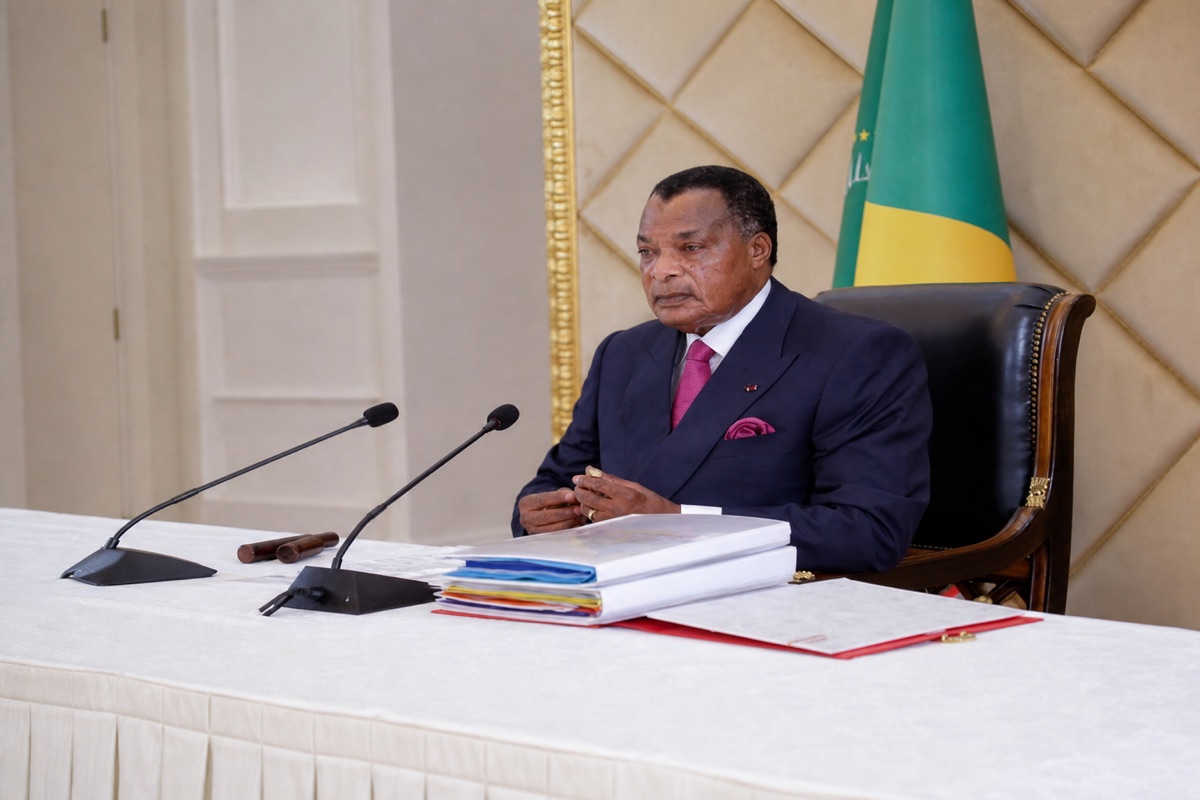
For the first time since his re-election in March 2026, President Denis Sassou-N’Guesso moved the seat of executive deliberation away from the capital, chairing a full session of the Council of Ministers on 30 June 2026 in Oyo, the northern town in the Cuvette department with which his political trajectory has long been associated. The choice of venue, well beyond the familiar corridors of the Palais du Peuple in Brazzaville, gave the meeting a symbolic weight that exceeded its formal agenda.
A Cabinet Gathering Away From Brazzaville
The session brought together the Makosso III government in near-complete formation, with only two ministers absent owing to official assignments abroad. Prime Minister Anatole Collinet Makosso, confirmed in his post after the presidential ballot, took part in the deliberations, underscoring the continuity that has framed the administration since the vote. Convening the cabinet outside the traditional executive quarters is not, in the Congolese context, a purely logistical decision. It draws the machinery of central government toward a region that has repeatedly served as a stage for the head of state, and it does so at a moment when the newly reconstituted team is settling into its mandate.
The detailed record of proceedings was expected to be released subsequently, and the government had not, at the time of the meeting, disclosed the substance of the measures examined. That reticence is itself worth noting: the visibility of the setting contrasted with the discretion surrounding the decisions taken, leaving observers to weigh the gesture rather than the text.
The Symbolism of a Relocated Executive
Territorial staging has long been part of the grammar of power in the Republic of Congo, and holding a Council of Ministers in Oyo speaks to that tradition. By transporting the collective organ of the executive to the Cuvette, the presidency signalled a will to project governance beyond Brazzaville and to associate the early phase of the new term with a locality that carries considerable personal and political resonance for the president. Such relocations tend to combine administrative routine with a demonstrative dimension, reminding audiences that the state can, and occasionally chooses to, deliberate outside its habitual centre of gravity.
The timing reinforces that reading. Coming only months after the March 2026 election, the Oyo session functioned as an inaugural marker for the reappointed government, a way of opening its working cycle on ground that the executive controls comfortably. For a cabinet whose composition largely mirrors its predecessor, the relocation offered a form of renewal that owed more to setting than to personnel.
Continuity and the Contours of the New Term
The near-full attendance of ministers, the confirmation of Anatole Collinet Makosso at the head of government and the framing of the meeting as a first since the re-election together sketch the early contours of the mandate. They suggest an administration intent on projecting cohesion and steadiness rather than rupture. The Makosso III government, reconducted rather than recast, appears to be prioritising the assertion of authority and the orderly resumption of collective decision-making over any signal of change in direction.
What the relocated cabinet did not immediately reveal, however, is as instructive as what it displayed. With the communiqué deferred, the meeting operated primarily on the register of political theatre, the deployment of the executive in a chosen place, before it operated on the register of policy. That sequencing places the emphasis on continuity of power and on the geography of its exercise, and it invites attention to how the government will translate this early staging into the concrete work of the term.
Reading the Oyo Session in a Wider Frame
Placed within the broader pattern of institutional life in Brazzaville, the Oyo Council of Ministers reads less as an isolated event than as an opening statement. It ties the first full deliberation of the re-elected executive to a region emblematic of the presidency, foregrounds the resilience of the governing team and defers the disclosure of substance to a later communiqué. For citizens, officials and observers following the trajectory of the Republic of Congo, the session offers an early indication of tone: measured, continuity-minded and attentive to the symbolic dimension of where, as much as how, the state chooses to govern. The coming weeks, and the eventual publication of the meeting’s conclusions, will show whether the deliberate staging of this first cabinet translates into a distinctive agenda for the new mandate or confirms the steady prolongation of an established order.
