
Strategic significance for Congo’s pluralism
The announcement by Pascal Tsaty-Mabiala that the Union Panafricaine pour la Démocratie Sociale will move toward a second ordinary congress has reverberated through Brazzaville’s political class. Although the Congolese Labour Party currently occupies the commanding heights of state institutions, successive administrations have encouraged a regulated space for opposition voices. In that context UPADS, the main centre-left formation born of the 1992 transition, occupies a symbolic place. Its decision to convene a “constructive” congress therefore matters not only to its own militants but also to observers concerned with the resilience of Congo-Brazzaville’s multi-party architecture. Diplomatic missions accredited to the Republic of Congo routinely pay attention to such internal milestones, viewing them as barometers of political temperature ahead of future electoral cycles (Agence Congolaise d’Information).
From council session to congress floor
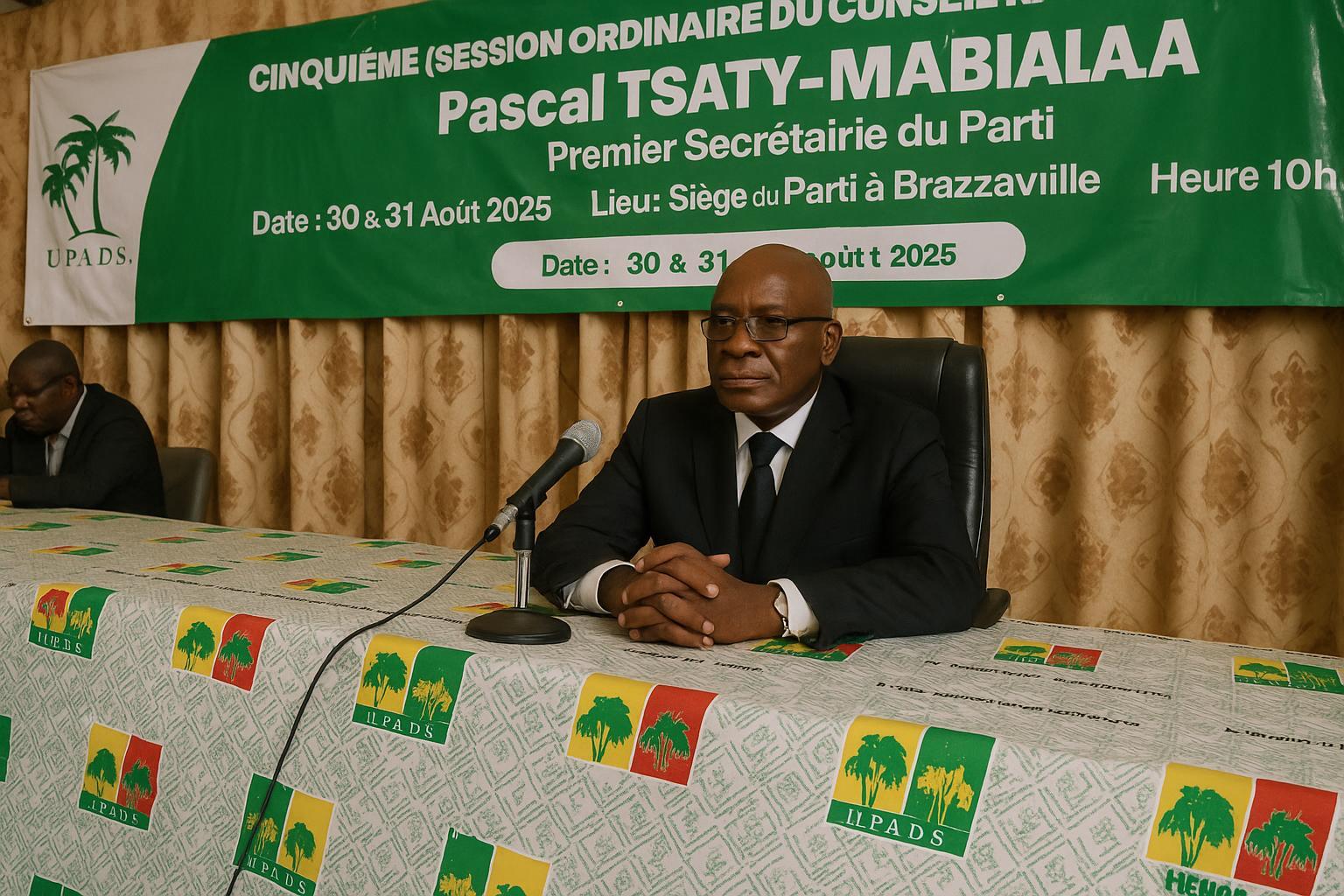
The catalyst for the new momentum was the fifth ordinary session of the party’s National Council held on 30 August in Brazzaville. In his opening address, Tsaty-Mabiala portrayed the gathering as the “irreversible march” toward the full congress scheduled for November 2025. The council’s immediate mandate is to dissect the preparatory commission’s synthesis report, scrutinise an itemised budget and endorse modalities for delegate participation. By framing these logistical questions as the essence of constructive politics, the first secretary sought to shift the debate away from personality rivalries that have occasionally dogged the party since its founding leader, the late President Pascal Lissouba, left office.
Preparing the grass-roots: departmental conventions
A critical innovation in the current roadmap is the sequencing of departmental congresses as the first gate toward the national conclave. Each of the country’s twelve departments is expected to elect delegates, update membership registers and refine local policy priorities. Party officials argue that the exercise will revitalise grass-roots structures which, they concede, have sometimes lapsed into dormancy between national campaigns. Political analysts in Brazzaville note that the approach mirrors procedures long used by the governing party and could allow UPADS to test mobilisation capacity in areas where it retains parliamentary seats, notably Niari and Bouenza. The extended timeline—spanning more than a year—also grants the secretariat space to complete a digital membership file, an initiative previously hindered by resource constraints.
Discipline, unity and internal governing codes
Echoing a theme familiar to veteran party cadres, Tsaty-Mabiala warned of what he called the “cult of the self” among certain figures. Without naming individuals, he reproached members who, in his words, “overvalue personal drama” at the expense of institutional discipline. Recalling the April 2024 council decision that fixed the congress date, he argued that organisational shortcomings—rather than external interference—had contributed to past electoral setbacks. His pledge to apply sanctions “with rigour and without delay” has been interpreted in diplomatic circles as a signal that the leadership is determined to negotiate internal dissent before formal campaigning for future legislative contests begins. Observers caution, however, that punitive measures will have to be balanced with the consensus-building ethos that distinguishes social democratic movements globally.
Implications for governance and diplomacy
For the incumbent government, the orderly renewal of opposition structures aligns with constitutional aspirations for inclusive governance. Officials close to the Ministry of Territorial Administration privately underline that a robust yet constructive opposition enhances the legitimacy of future ballots and deepens investor confidence. Foreign partners echo that assessment. A European diplomat contacted in Brazzaville remarked that “clarity in the opposition’s programme simplifies our own analytical work on prospective reforms.” Such views underscore why the UPADS congress is more than a party ritual; it forms part of the Republic of Congo’s broader engagement with regional and international interlocutors committed to stability.
Looking toward November 2025
As the calendar advances, three benchmarks will determine whether the congress realises its constructive ambition. First, the secretariat’s ability to finalise an audited budget could reassure contributors that resources are managed transparently and thereby attract fresh support from diaspora chapters. Second, the tone of departmental conventions will reveal whether calls for humility translate into moderated rhetoric on the ground. Third, the elaboration of a policy platform capable of addressing climate resilience, debt sustainability and youth employment will test the party’s capacity to resonate beyond its historical base. In each domain, the leadership’s emphasis on unity offers both an organisational compass and a diplomatic message: that pluralism in Congo-Brazzaville can mature through methodical institutional work rather than confrontation.
