
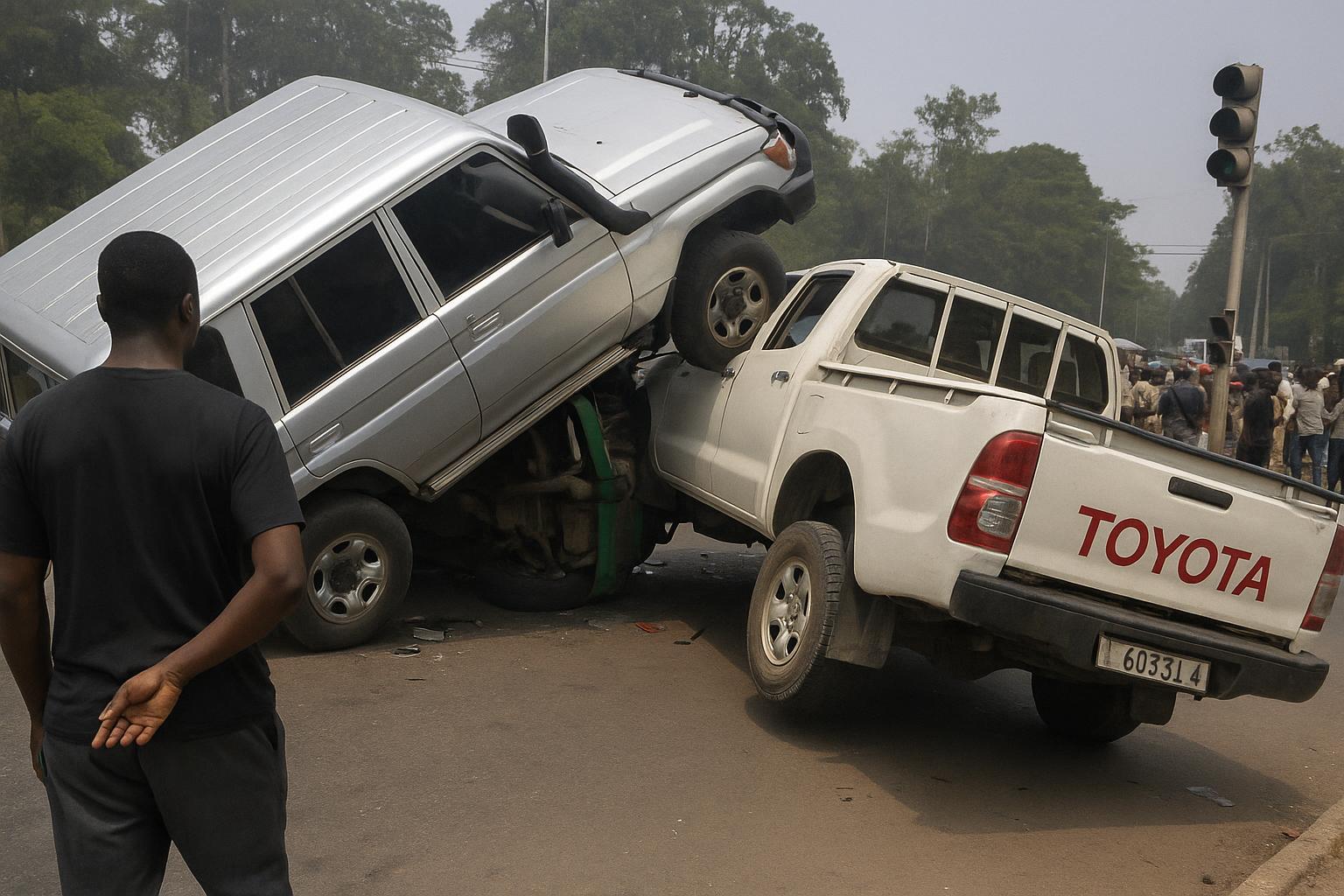
Midday impact on the capital’s northern gateway
At precisely noon on Friday 19 September 2025, the constant hum of Brazzaville’s Avenue Alfred Raoul was broken by the metallic crack of a violent collision. At the sprawling Patte d’Oie roundabout, a critical junction linking the city centre to Maya-Maya International Airport, three vehicles became entangled in a scene that eyewitnesses describe as “a sudden explosion of glass and crumpled metal”. The incident occurred minutes after the presidential aircraft had departed, a moment that traditionally triggers a rapid yet orderly return of official vehicles to town.
Chain reaction leaves three gravely injured
Initial accounts confirm that the driver of a city taxi, emerging from the cluster of modernist apartment blocks colloquially called Les Immeubles des Italiens, attempted to merge into the roundabout toward the nearby Rectorat. In doing so he misjudged both distance and speed, cutting across a grey sedan hurtling in from the airport at full throttle. The first impact forced the sedan sideways into two stationary cars waiting to re-enter traffic. Paramedics arriving within minutes stabilised several passengers on site before directing three of the most seriously hurt to the University Hospital. No fatalities were recorded, a point the attending physician later qualified as “near-miraculous given the kinetic forces involved”.
Right-of-way rules during presidential convoys
Traffic regulations in Congo-Brazzaville grant temporary priority to official vehicles escorting or following the Head of State, a protocol intended to keep routes fluid for national security purposes. Witnesses stressed that many motorists were already driving “pied au plancher” to maintain the integrity of the convoy’s flow. Under such circumstances, the legal duty of civilian drivers is one of heightened caution: they must yield fully until the rolling escort has passed. Investigators note that the taxi’s premature entry violated this obligation, raising the broader issue of driver awareness whenever presidential movements temporarily recalibrate the capital’s traffic hierarchy.
The legal stakes of a thwarted hit-and-run
In the immediate aftermath of the crash, the taxi’s driver reportedly attempted to flee on foot, only to be restrained by passers-by and handed over to the gendarmerie. Under Congolese law, abandoning the scene of an accident aggravates civil liability and can transform a traffic misdemeanour into a criminal matter. Legal practitioners contacted after the event underline that the combination of refusing priority, bodily harm and attempted escape exposes the driver to substantial penalties, including potential custodial sentences. The fact that no death occurred may temper judicial severity, yet magistrates have historically used such cases to reaffirm public intolerance of reckless behaviour.
Urban design and the Patte d’Oie dilemma
Patte d’Oie is both an arterial lifeline and an urban design conundrum. Its multi-lane geometry funnels heterogeneous streams—airport shuttles, city buses, taxis and private cars—into a single sprawling loop without traffic lights. Engineers have long acknowledged that speed differentials inside the roundabout invite lateral collisions, especially when impatience overrides prudence. Friday’s crash revived perennial calls from urban planners for clearer lane markings and dedicated acceleration lanes. While large-scale restructuring would require significant investment, incremental adjustments such as raised rumble strips and luminous signage could already mitigate sudden lane incursions that so often precede accidents.
Witness recollections and civic reflexes
Several onlookers recounted a collective, almost instinctive mobilization. Street vendors used parasols to shade the injured from the noon sun, while motorcyclists wove through halted traffic to fetch first-aid kits. “Everyone understood that seconds matter before the ambulance arrives,” recalled a local baker whose storefront faces the roundabout. Such spontaneous solidarity, though laudable, also underscores the urgency of broader public education on emergency response. Authorities praised civilians for containing panic, a stance consistent with the government’s wider message that road safety is a shared civic responsibility.
Key takeaways
Friday’s episode crystallises three realities. First, the speed conferred on official convoys magnifies the stakes of even minor miscalculations by civilian drivers. Second, the geometric complexity of Patte d’Oie, while efficient under ideal conditions, remains unforgiving of errors in judgement. Third, the instinctive public response illustrates a reservoir of civic responsibility that regulators can leverage through training and awareness campaigns to further reduce casualties.
Legal-economic perspective
From an economic standpoint, every severe accident imposes hidden costs: medical bills, vehicle repair, lost productivity due to congestion and psychological distress. Jurists emphasise that punitive damages aim not solely at retribution but at internalising these costs for would-be offenders. By rigorously enforcing right-of-way statutes and discouraging flight from accident scenes, the justice system also preserves the insurance sector’s actuarial balance, shielding policyholders from premium shocks. In this sense, Friday’s crash functions as a sober reminder that road discipline is simultaneously a public health imperative and an economic necessity.
