
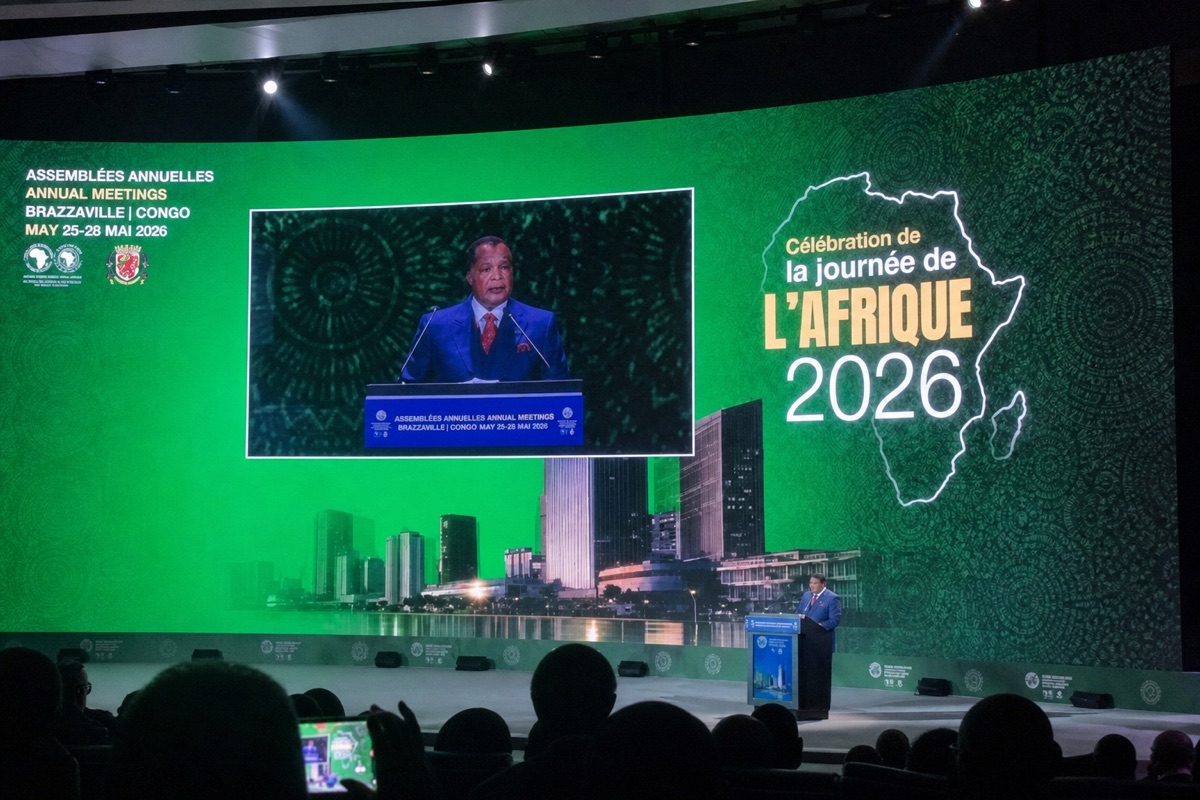
A continental capital is preparing to dismantle one of the oldest administrative frictions standing between Africans and their own continent. Speaking in Brazzaville on the occasion of the 63rd Africa Day, President Denis Sassou N’Guesso announced that, from 1 January 2027, nationals of African states will be admitted to the Republic of Congo without a visa. The pledge, delivered as a statement of intent rather than as a technical regulation, recasts a long-standing pan-African aspiration as an imminent policy commitment, and it positions Congo-Brazzaville among the small group of states willing to translate the rhetoric of integration into a measurable act of openness.
A Head of State Reframes Mobility as a Continental Right
The framing of the announcement matters as much as its substance. Rather than presenting visa liberalisation as a narrow concession, the Congolese head of state cast it as a step toward the freer movement of people and goods across Africa, calling for an acceleration of that process and for deeper regional integration. He went further, advocating for a single African passport, which he described as the emblem of a continent more united and more outward-looking. In doing so, he linked a specific national measure to a broader argument about sovereignty and belonging, suggesting that the borders inherited from the colonial era remain an obstacle that African states themselves retain the authority to soften.
That rhetorical move is deliberate. By invoking the language of pan-Africanism, the president situates Brazzaville within a lineage of continental ambition that stretches from the founding ideals of African unity to the contemporary agenda of the African Union, which has long urged member states to dismantle the administrative barriers that throttle intra-African exchange. The promise of a single passport, while still distant in practical terms, functions as a signal of alignment with that agenda rather than as a fully costed proposal.
What Visa-Free Entry Could Mean for Congo’s Economy
For many observers, the practical consequences of the reform could be considerable. Lowering the threshold for entry tends to stimulate trade, tourism, investment and the circulation of students and cultural actors, and the Congolese measure is presented in precisely those terms. By removing a procedural cost that has historically deterred short-term visitors and complicated business travel, Brazzaville may improve its standing as a regional hub at a moment when several African states are competing to project openness and to attract continental capital.
The economic logic is intuitive without being automatic. Visa liberalisation reduces the transaction costs of movement, but its dividends depend on the wider environment that receives the newly admitted travellers, including transport links, hospitality capacity and the predictability of the local business climate. The announcement therefore reads as an invitation, one whose returns will be determined by the reforms that accompany it rather than by the gesture alone. Still, the symbolic value of being seen to open the door first carries its own weight in a region where reputational competition is intensifying.
Brazzaville’s Timing and the AfDB Spotlight
The choice of moment is unlikely to be accidental. The declaration coincides with the approach of the African Development Bank’s annual meetings in Brazzaville, a major continental gathering that brings together political leaders, financiers and development actors to confront Africa’s economic challenges. Hosting such an event places the Congolese capital under a continental spotlight, and an announcement of this kind allows the authorities to frame their hospitality not merely as logistics but as a statement of principle about the kind of Africa they wish to help build.
That convergence of diplomacy and policy lends the measure additional resonance. It allows Congo-Brazzaville to present itself, before an audience of decision-makers, as an actor prepared to act on the integration it espouses, rather than as one content to debate it. Whether the visa regime is implemented on the announced timeline, and with what conditions, will become clearer as 2027 approaches; for now, the commitment stands as a marker of intent.
A Wager on a More Integrated Africa
Beyond its immediate effects, the reform is offered as a renewed expression of Congo’s commitment to pan-Africanism and to the construction of a more integrated African space, one in which citizens might move more freely across frontiers drawn during the colonial period. The ambition is expansive, and its realisation will depend on reciprocity from neighbouring states and on the slow machinery of regional coordination. Yet by setting a date and a principle, Brazzaville has chosen to be measured against a concrete promise. In a continent long fluent in the vocabulary of unity, the decision to attach that vocabulary to a calendar is itself a notable wager (Journal de Brazza).
