
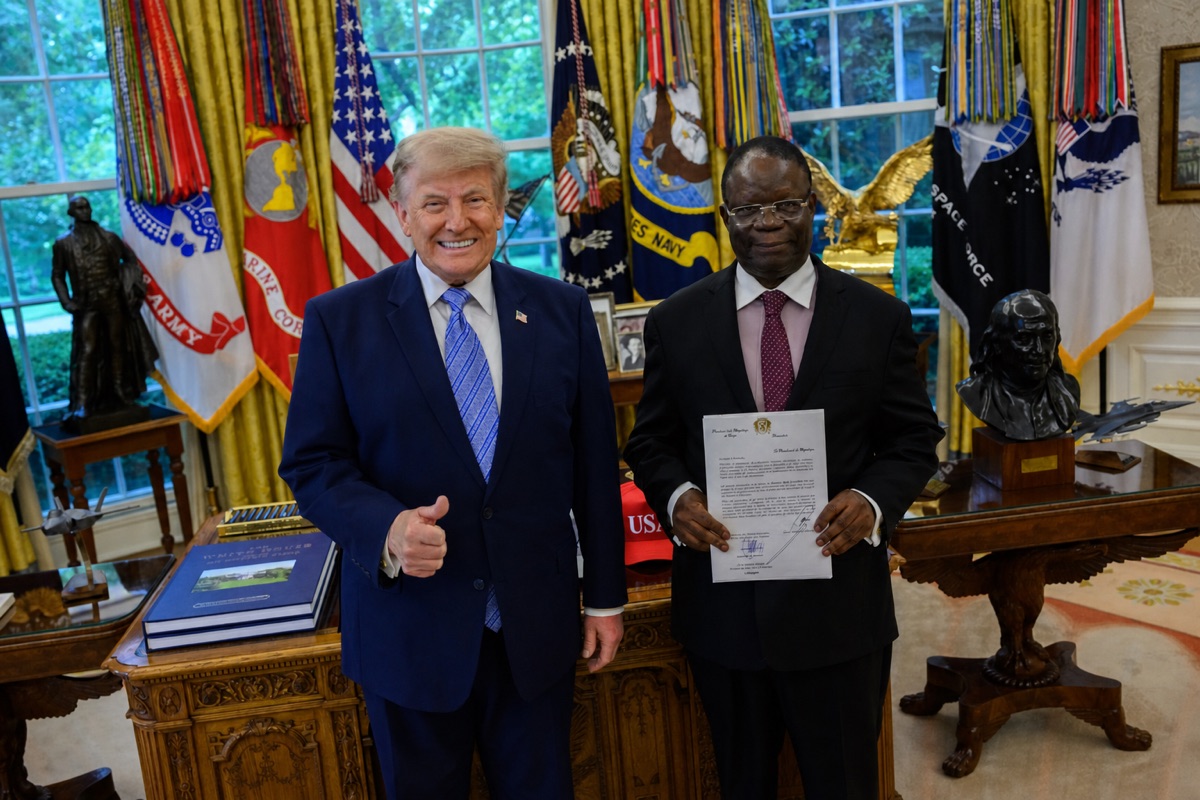
A measured handshake in the East Room of the White House on 21 May 2026 carried more weight than the brevity of the ceremony suggested. Basile Ikouébé, the Republic of the Congo’s newly appointed ambassador to the United States, formally presented his letters of credence to President Donald J. Trump, opening a fresh chapter in a bilateral relationship that Brazzaville has long treated as a strategic anchor of its foreign policy. The exchange, sober and protocol-bound, was less a beginning than a recalibration: both governments used the occasion to restate a commitment to deepening diplomatic ties and broadening cooperation between the two nations.
A Seasoned Hand Returns to the Front Line of Congolese Diplomacy
Few appointments in Brazzaville’s diplomatic apparatus carry the institutional memory that Ikouébé brings. Named by decree 2026-145, the veteran diplomat succeeds Serge Moumbouli, who died on 5 September 2025, leaving the Washington mission without a confirmed head for several months. A former minister of foreign affairs, Ikouébé belongs to the generation of Congolese officials who helped structure the country’s external relations over the past two decades, and his presence at the inauguration of Congo’s embassy in 2009 underscores the continuity he is now expected to embody.
The choice is not incidental. Placing an experienced former chief diplomat at one of the country’s most demanding posts signals that Brazzaville intends to treat its relationship with Washington as a priority requiring stature rather than routine administration. The ties between the two capitals reach back to the 1960s, and successive Congolese governments have framed them around the language of durable partnership and pragmatic cooperation. Ikouébé’s mandate, in that sense, is to consolidate an inheritance as much as to expand it.
The Quiet Groundwork Before Washington
The White House ceremony was the visible apex of a sequence of preparatory contacts that began at home. On 13 May, before departing for Washington, Ikouébé met in Brazzaville with the American chargée d’affaires, Amanda S. Jacobsen, alongside other United States diplomats. Those conversations sketched the working agenda the new ambassador would carry across the Atlantic, ranging across economic cooperation, the management of irregular migration, regional security, governance and environmental questions.
That spread of subjects is telling. It reflects a relationship that has moved beyond a narrow transactional register toward a broader and more demanding portfolio, in which trade and investment sit alongside the harder files of security in Central Africa and the increasingly salient matter of environmental stewardship. For a country whose forests place it at the heart of continental climate diplomacy, the inclusion of environmental issues in the bilateral conversation is a marker of how Brazzaville hopes to position itself with its extra-African partners.
What Brazzaville and Washington Want From the Reset
In the wake of the ceremony, the United States reaffirmed its determination to, in its own words, “deepen ties with Congo, promote transparency and reinforce shared prosperity” — a formulation that binds the economic promise of the relationship to expectations on governance. The careful pairing of prosperity and transparency is characteristic of Washington’s approach to its African partners, and it sets a benchmark against which the coming years of cooperation are likely to be judged.
For Brazzaville, the calculation is layered. A strengthened relationship with Washington offers leverage on questions of economic diversification and investment, while also reinforcing the Republic of the Congo’s standing within the wider architecture of Central African diplomacy. Ikouébé’s familiarity with multilateral fora and his earlier stewardship of the foreign ministry equip him to navigate the overlapping demands of bilateral engagement and regional positioning, where Congo-Brazzaville must distinguish its own trajectory from that of its larger neighbour across the river.
A Mandate Measured in Continuity, Not Spectacle
The substance of Ikouébé’s assignment will be tested away from ceremonial settings. Restoring momentum to a mission interrupted by the loss of his predecessor, translating the broad agenda agreed in Brazzaville into concrete cooperation, and managing the inevitable frictions of a relationship that spans economics, security and migration will require patience rather than fanfare. The understated tone of the credentials ceremony was, in this respect, fitting.
What the 21 May exchange ultimately confirmed is that both governments still see value in the relationship and are prepared to invest political capital in its renewal. Whether that renewal yields measurable gains — in trade, in security coordination, in the climate file — will depend on the diplomacy now resuming in Washington. For Ikouébé, a familiar figure stepping back onto a demanding stage, the handshake with President Trump was less an arrival than a return to work (ADIAC Congo).
