
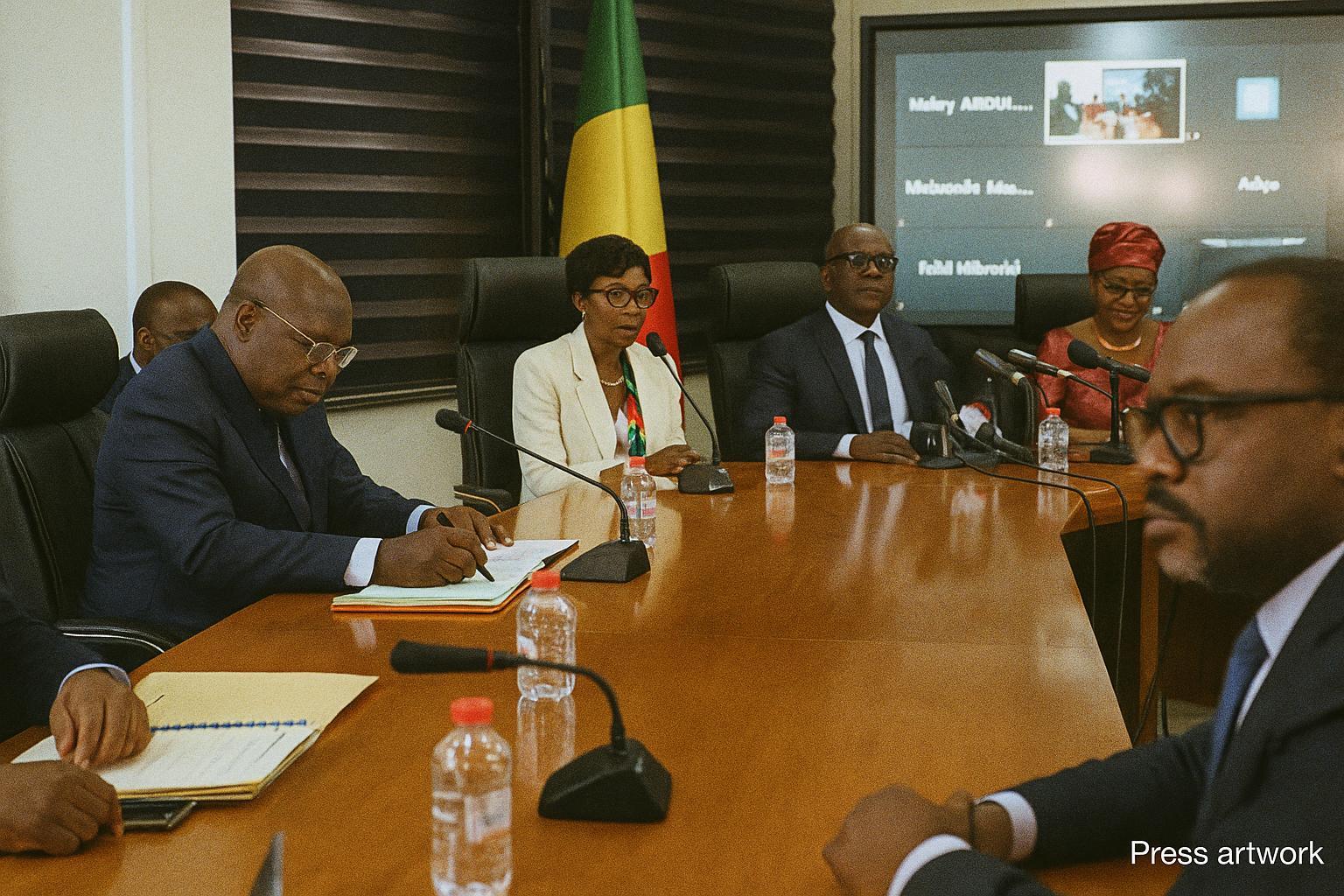
Executive committee sets an ambitious calendar
The second annual session of the Extractive Industries Transparency Initiative National Committee in Brazzaville unfolded with a sense of calibrated urgency. Presided over by Minister of Finance, Budget and Public Portfolio Christian Yoka, the gathering brought together oil and mining operators, civil-society coalitions and senior administrators charged with revenue governance. At its close, the committee committed to delivering the 2025 activity report before the end of December, a decision that effectively compresses a twelve-month analytic workload into barely half that time.
Corrective measures still under international scrutiny
Notwithstanding the accelerated timetable, officials acknowledged that Brazzaville’s candidacy for a full EITI validation remains a work in progress. Permanent Secretary Florent Michel Okoko enumerated outstanding recommendations emanating from the International Secretariat, ranging from the granular reconciliation of state-company payments to the systematic disclosure of production-sharing contracts. He noted that the committee had “evaluated the applicability of each corrective measure” and judged them attainable within the next year, a horizon that aligns with the EITI Board’s anticipated reassessment cycle.
Forging permanent commissions for sustained oversight
Delegates elected to institutionalise several thematic commissions—fiscal transparency, environmental stewardship, and community impact among them—so as to ensure that data collection does not depend solely on ad hoc working groups. The move echoes guidance from multilateral partners such as the World Bank and African Development Bank, both of which have framed permanent technical bodies as prerequisites for durable governance architecture. According to a senior Treasury official present, these commissions will be cross-staffed by ministry experts and industry compliance officers in order to avoid siloed reporting.
Investor confidence and the calculus of disclosure
Congo-Brazzaville’s hydrocarbons sector accounts for more than half of public revenue, making any perceived opacity a point of sensitivity for rating agencies and joint-venture partners alike. Market analysts interviewed in Paris underscored that the mere act of setting a public deadline sends a positive signal to creditors weighing longer-dated sovereign paper. An adviser to a Gulf-based energy fund noted that “predictable disclosure timelines can shave several basis points off project-finance costs,” particularly when juxtaposed with jurisdictions yet to join the EITI. In that sense, the committee’s communiqué operates as an instrument of economic diplomacy as much as a bureaucratic milestone.
Regional benchmarks sharpen competitive pressure
Neighbouring Gabon regained EITI compliance last year after implementing a digital cadastre platform, while Nigeria’s recent shift to real-time royalty tracking has been lauded by the African Union’s Advisory Board on Corruption. These precedents inform Brazzaville’s urgency: failure to keep pace could reroute exploration capital toward more demonstrably transparent regimes. The Ministry of Hydrocarbons has therefore tasked its data-management unit with piloting an open-source reporting dashboard, borrowing code from Ghana’s Petroleum Hub initiative, an example cited favourably in recent IMF technical notes.
Domestic consensus underpinning outward engagement
Crucially, the weekend session reaffirmed the tripartite governance model at the heart of the EITI: government, industry and civil society deliberating on equal footing. Representatives of the Congolese Coalition Publish What You Pay praised the inclusion of community-level grievance statistics in the forthcoming report, a first for the republic. For their part, corporate delegates from the on-shore Pointe-Noire basin signalled readiness to disclose beneficial ownership structures, citing alignment with evolving European Union due-diligence directives. The convergence suggests that national stakeholders perceive transparency less as an externally imposed condition than as a strategic asset in an era of energy transition.
Looking ahead to the 2025 validation window
With one year remaining before the International Secretariat revisits Congo’s status, policymakers appear intent on transforming technical compliance into a broader narrative of governance innovation. The impending 2024 activity report, slated for mid-year release, will serve as a dress rehearsal for the more comprehensive 2025 edition. Observers within the diplomatic corps in Brazzaville, including several EU mission heads, argue that timely publication could reinforce the republic’s standing during upcoming climate-finance negotiations, where transparency over resource revenue allocation increasingly factors into concessional lending terms.
Should Brazzaville meet its new deadlines, the achievement would not merely tick a procedural box; it could recalibrate perceptions of the country’s risk profile at a moment when global capital is selectively retreating from frontier hydrocarbon plays. In that respect, the real target is not the date printed on the cover of the report but the enhanced credibility that a rigorously documented revenue chain can confer on Congo-Brazzaville’s broader development agenda.
