
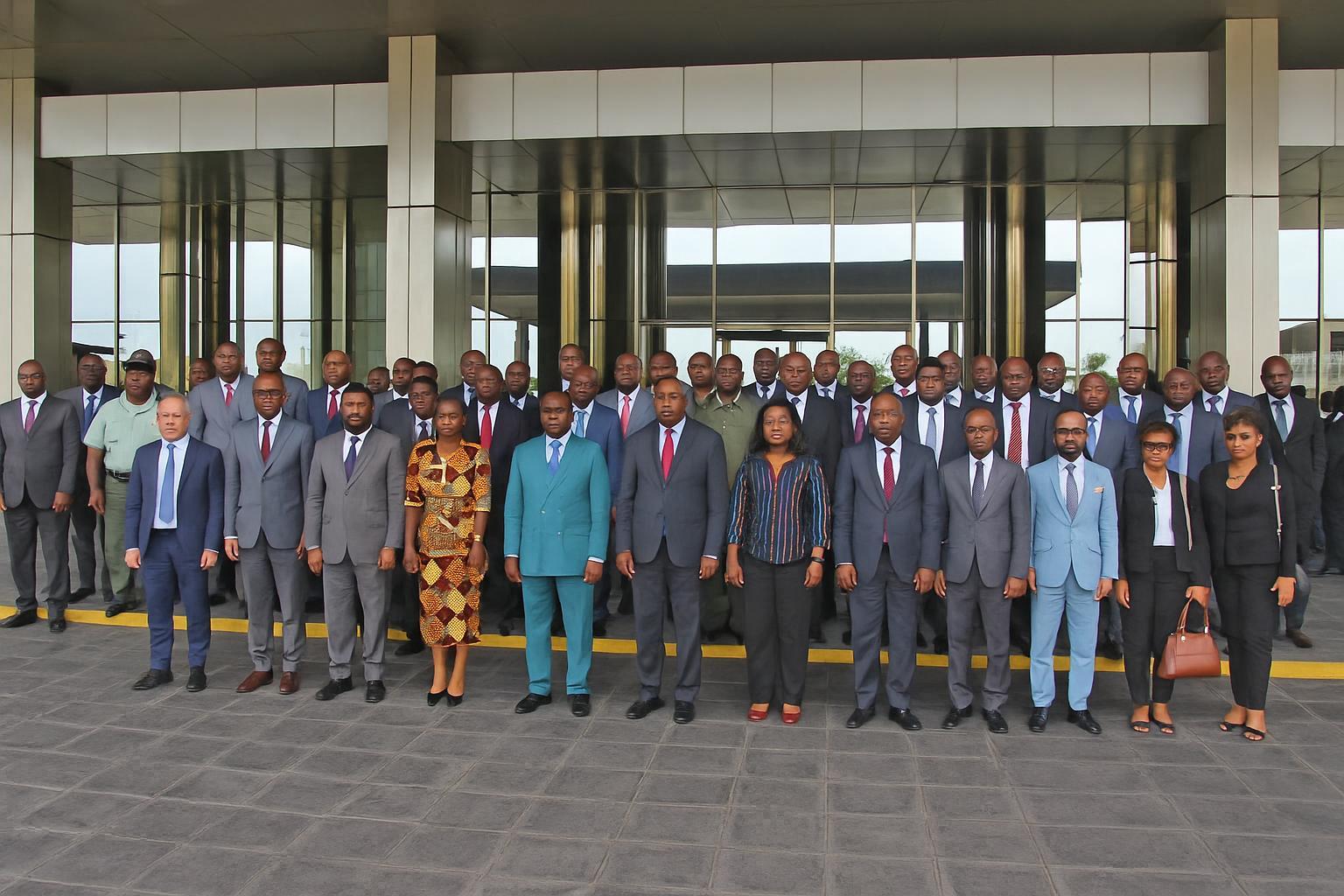
A Strategic Gathering in Kintélé
From 8 to 10 October 2025, the airy conference halls of Kintélé, just north of Brazzaville, resonated with acronyms, legal references and the sustained murmur of ministerial specialists deciphering the Republic of Congo’s new public-procurement architecture. Convened by the General Directorate for Public Procurement Control—with technical reinforcement from the World Bank-financed Programme for Accelerating Institutional Governance and Reforms (PAGIR)—the session brought together the heads of ministerial procurement cells, auditors and engineers who collectively manage a considerable share of national expenditure.
World Bank Backing and National Ambition
The presence of PAGIR in the room signalled the alignment of Congo’s domestic agenda with international standards. According to World Bank documentation, the multi-year facility supports modernisation in budget execution, debt transparency and procurement (World Bank). In opening remarks, Ludovuc Ngouala, president of the Public Procurement Regulatory Authority (ARMP), underscored that public purchasing remains “a decisive instrument for both economic stimulus and social inclusion,” insisting that each franc directed through transparent competition multiplies development dividends.
Harmonising Practices, Raising the Bar
Joël Ikama Ngatsé, Director-General for Procurement Control, framed the workshop as a pragmatic exercise in levelling the information field. “Reforms bear fruit only when they are equally understood, shared and applied at every tier,” he told participants. Over three days, presentations walked officers through the revised legal texts, updated threshold values, and strengthened ex-ante controls designed to curb fragmentation in contract award procedures. Particular attention was given to standardised bidding documents and the forthcoming electronic portal expected to shorten evaluation cycles while preserving audit trails.
Experiential Learning as Compliance Catalyst
Beyond formal lectures, the training agenda prioritised peer-to-peer dialogue. Procurement heads from the Ministries of Health, Public Works and Digital Economy compared lessons drawn from recent flagship tenders, examining how risk matrices and cost-benefit analyses had improved under the revised framework. Richard Mabiala, a senior engineer at the Ministry of Energy, reflected that “seeing how colleagues manage identical compliance hurdles gives us templates that manuals alone cannot convey.” Such experiential exchanges, facilitators argued, accelerate behavioural change far more efficiently than prescriptive memos.
Maintaining Momentum Amid Structural Hurdles
The Congolese procurement overhaul unfolds against the backdrop of broader fiscal consolidation, where the government seeks to maintain public investment while adhering to prudent debt ceilings agreed with the IMF (IMF Country Report, 2023). Participants thus probed how to reconcile urgent infrastructure needs with methodical tender timelines. Some suggested expanding the roster of pre-qualified local contractors, thereby preserving competitive tension yet expediting award decisions. Others highlighted the necessity of up-to-date price databases to insulate the State from global commodity shocks.
À retenir
The Kintélé workshop confirms the administration’s resolve to professionalise procurement as a fulcrum of public-sector performance. Backed by the World Bank, the reforms introduce sharper controls, digital tools and uniform documents intended to close loopholes that once delayed projects or inflated costs. The ability of each Cellule de Gestion des Marchés Publics to internalise these standards will condition the pace at which roadworks, school constructions and health-equipment acquisitions materialise on the ground.
Le point juridique/éco
The revised regulatory corpus builds on Law 9-2017 and its 2022 amendments, reinforcing the ARMP’s oversight powers and recalibrating sanction scales for non-compliant contracting authorities. Financially, the new thresholds segment contracts into categories that determine whether control is exercised ex-ante by the General Directorate or ex-post by external auditors, a distinction designed to allocate scrutiny where fiscal exposure is greatest. For suppliers, clearer dispute-resolution timelines promise to reduce transaction costs and attract more bidders, amplifying value for money.
Looking Ahead to Digital Transition
The next milestone will be the rollout of Congo’s integrated e-procurement platform, slated for pilot deployment in early 2026, according to PAGIR technical notes. The system is expected to automate publication, bid submission and contract management, providing real-time dashboards to both ARMP and the Supreme Audit Institution. Training modules previewed in Kintélé included simulations of electronic bid openings—a novelty that many participants welcomed as a deterrent to information asymmetry.
From Workshop to Workplace
As the conference closed, each participant departed with a compendium of regulatory texts, model contracts and a commitment to cascade the knowledge to their respective departments. Joël Ikama Ngatsé reminded them that compliance metrics would soon be incorporated into performance appraisals, tying career progression to mastery of the new rules. In a region where public procurement accounts for roughly 12 % of GDP, the cumulative impact of these micro-level adjustments could prove macro-economically significant, bolstering investor confidence while accelerating the delivery of essential services.
