
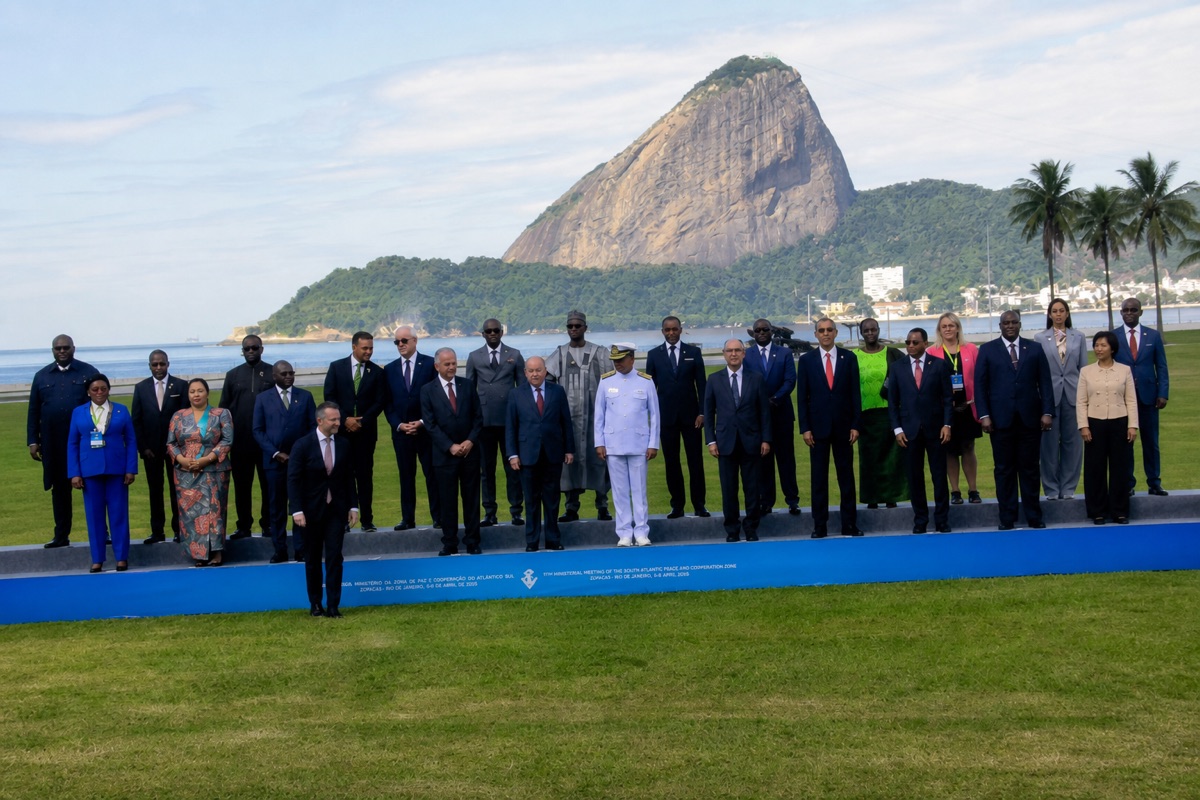
In Rio de Janeiro, the Republic of Congo restated a conviction it has long carried into multilateral arenas: that smaller and middle powers must speak with a common voice if they are to matter in a fracturing world order. Representing Brazzaville at the ministerial meeting of the Zone of Peace and Cooperation of the South Atlantic (Zopacas), held on 8 and 9 April, Foreign Minister Jean-Claude Gakosso pressed his counterparts to tighten coordination at a moment when, in his words, “the law of force is cheerfully supplanting the force of law.” The phrasing was deliberate, and it framed the Congolese delegation’s reading of the present international climate.
A South Atlantic Forum Tested by Geopolitical Strain
The two-day gathering brought together the foreign ministers of a grouping that now spans twenty-four states, twenty-one of them African and three South American. Conceived in 1986 at Brazil’s initiative, Zopacas was built around a deceptively simple ambition: to keep the South Atlantic free of conflict and of the nuclear arms race, while safeguarding the maritime resources that line its shores. Nearly four decades later, that founding purpose has acquired renewed urgency, as competition among external powers reaches into ocean spaces once treated as peripheral to global rivalries.
Across the sessions, ministers returned repeatedly to questions of peace, maritime security and regional cooperation. The discussions were not merely declaratory. They produced concrete instruments, chief among them the Rio Declaration, a strategy document, and a convention for the protection of the marine environment. Taken together, these texts suggest a forum attempting to move from the language of solidarity toward something closer to a working framework, however modest its means.
Brazzaville’s Case for a United Voice
Gakosso’s intervention placed unity at the centre of the Congolese argument. “Our community must strengthen its unity in order to make its voice heard,” he told the assembly, situating the appeal within what he described as a context of grave geopolitical tensions. The minister presented Zopacas less as an administrative structure than as a space of dialogue and shared resolve, anchored, he argued, in a common history of resistance among its members.
That historical reading matters to the way Brazzaville approaches the organisation. Gakosso was at pains to stress that Zopacas represents, for the Republic of Congo, considerably more than an institutional affiliation. It is, in the official telling, an expression of a diplomatic identity that values collective standing over isolated manoeuvre. The minister reaffirmed his country’s commitment, under the direction of President Denis Sassou N’Guesso, to deepening international cooperation and advancing sustainable development within the bloc.
Why Maritime Cooperation Now Carries Strategic Weight
The emphasis on the marine environment is not incidental to this diplomacy. For coastal states of Central Africa, the Atlantic is at once a corridor of commerce, a reservoir of fisheries and hydrocarbons, and an increasingly contested security frontier. A convention dedicated to protecting that environment signals an awareness that ecological stewardship and strategic autonomy are bound together, and that neglecting one tends to erode the other. By lending its weight to such instruments, Brazzaville positions itself within a current of South-South cooperation that prizes shared norms over dependence on distant arbiters.
There is, too, a quieter calculation at work. A grouping of twenty-four states stretching across two continents possesses a collective voice that no member commands alone. Gakosso’s repeated invocation of unity can be read as an attempt to convert that latent arithmetic into diplomatic leverage, particularly in forums where the South Atlantic risks being treated as an afterthought. The argument is unremarkable in its logic and precisely for that reason persuasive: cohesion is the currency available to states that cannot rely on hard power.
A Measured Outcome With Lingering Questions
What the Rio meeting produced is best described as incremental rather than transformative. A declaration, a strategy and a convention establish reference points; they do not, on their own, guarantee implementation across a membership as geographically and politically varied as Zopacas. The gap between adopted texts and enforced practice has long shadowed the organisation, and nothing in the proceedings resolved it definitively.
Yet the symbolic register should not be dismissed. By choosing to articulate its concerns in the sharp idiom of law versus force, the Congolese delegation aligned itself with a broader unease among states that feel the multilateral order is being reshaped without them. Whether Zopacas can translate that shared apprehension into durable coordination remains the open question. For now, Brazzaville has done what its diplomatic tradition tends to favour: it has spoken, clearly and on the record, for a collective it intends to keep at the centre of its foreign policy (Adiac Congo).
