
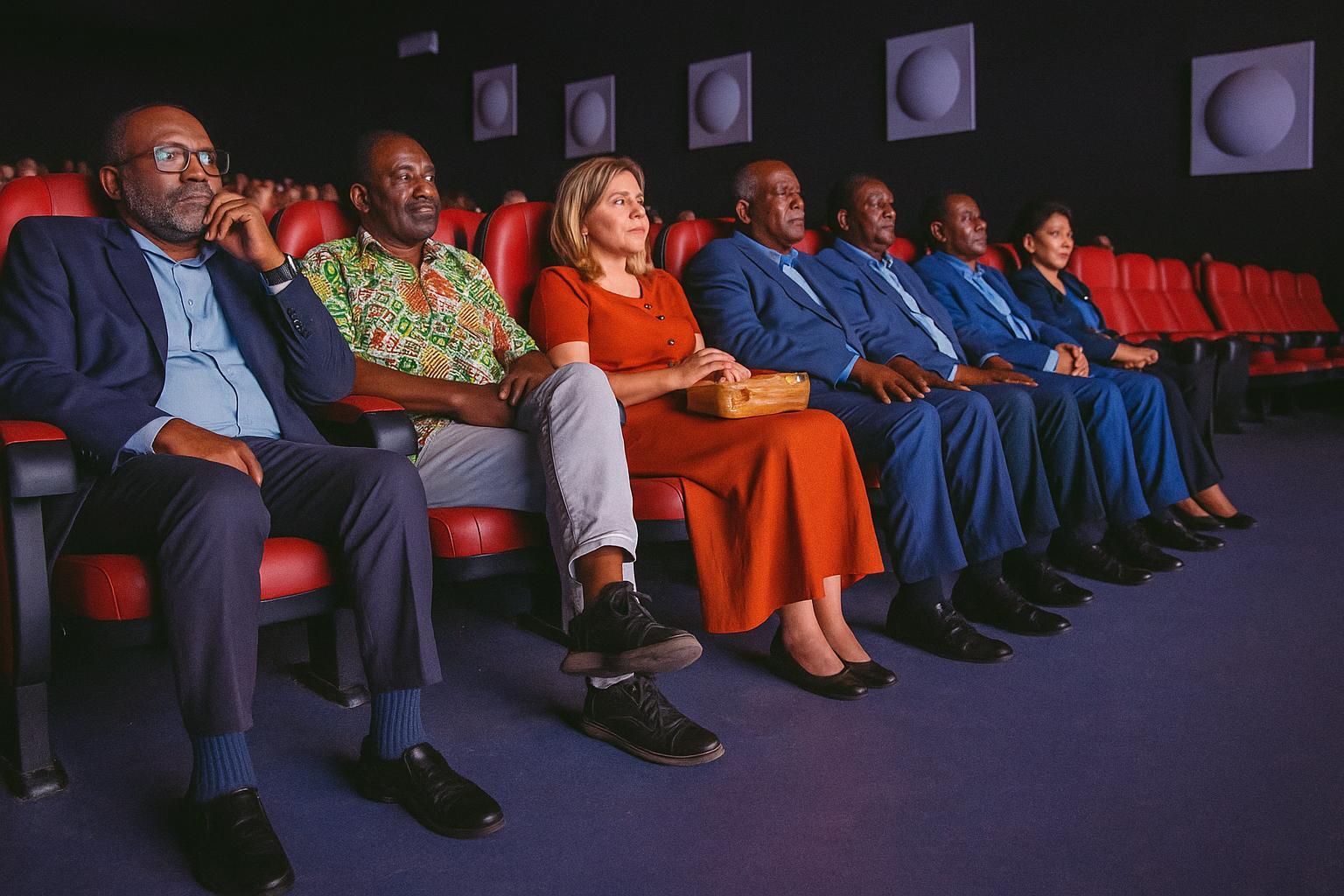
Poto-Poto Premiere Captivates an Expectant Audience
The packed hall of Canal Olympia in Brazzaville’s historic third arrondissement fell momentarily silent on 11 October 2025 as the opening frame of “Mémoires du CFRAD” flickered onto the screen. Over the next ninety minutes, director Hassim Tall Boukambou guided viewers through a meticulously assembled tapestry of archival photographs, stage extracts and first-person testimonies that together resuscitate the long and eventful life of the Centre of Training, Research and Dramatic Arts (CFRAD). When the house lights finally rose, applause rippled like a standing ovation at a Broadway finale, confirming that the filmmaker had struck a chord well beyond the circle of theatre aficionados.
A Renaissance for Brazzaville’s Cultural Beacon
Founded by playwright and future minister Maxime Ndébéka, the CFRAD emerged in the early 1970s as an incubator of Congolese dramaturgy, at once a training ground, a laboratory of modern forms and a forum where social questions could be probed through performance. Boukambou’s documentary recounts this golden age with warmth and precision, then confronts the period of institutional drift that followed the political and economic turbulences of the 1990s. The narrative culminates in the present revival, underscored by recent renovations to the building and a renewed commitment from public authorities.
Former culture minister Henri Djombo, himself an author of several plays, summed up the prevailing sentiment among attendees: “This formidable documentary reminds us that the CFRAD will rise from its ashes,” he declared, insisting that the institution’s rebirth represents an opportunity for a new generation of actors, dramaturges and stage technicians.
From Colonial Architecture to Contemporary Stagecraft
The film devotes considerable attention to the edifice housing the CFRAD, a stone-and-brick landmark that once hosted the 1944 Brazzaville Conference, a key moment in the shared Franco-Congolese narrative. French ambassador Claire Bodonyi, interviewed on camera, refers to the site as “a signature building” whose walls preserve a layered memory of encounter and creativity. Boukambou overlays her observations with sweeping shots of vaulted corridors now freshly painted yet still resonant with echoes of past rehearsals.
Architectural historians identify the structure as one of the few remaining examples of early twentieth-century civic design in Brazzaville. By tracking the physical metamorphosis of the premises—times of splendour, periods of neglect, and now scaffolding and cranes—the documentary subtly illustrates how cultural policy and urban renewal can converge.
A Documentary as Civic Reminder and Policy Tool
Beyond its aesthetic merits, “Mémoires du CFRAD” functions as a gentle but insistent call to responsibility. In an on-screen interview, Presidential cultural adviser Patient Bokiba recalls that the centre was once the crucible of Congolese theatre and asserts that its rehabilitation must now relaunch the country’s wider artistic ecosystem. Boukambou agrees, stating in the film that each citizen and each institution has a role to play in safeguarding collective memory.
The timing is apposite. In recent years the Congolese government has multiplied initiatives aimed at professionalising the cultural sector, from fiscal incentives for creative industries to training programmes in partnership with regional universities. As the documentary tours provincial capitals in the coming months, it is likely to feed into policy dialogues over funding, governance models and curriculum design.
Le point juridique et économique
Legal experts interviewed during the screening’s post-projection debate emphasised that the CFRAD’s new statutes will grant it a hybrid status, combining public oversight with managerial flexibility. The arrangement should facilitate diversified revenue streams—ticketing, residencies, international co-productions—while still safeguarding its mission of public service. Economists see in the centre’s revival a potential boost for Brazzaville’s creative economy, estimating that every franc invested in stage production generates multiple returns through hospitality, transport and ancillary services.
Such calculations resonate with the national development strategy, which identifies culture as a lever for sustainable growth and a vector of soft power. By foregrounding the CFRAD, the film thus aligns with broader governmental objectives of diversification and job creation.
Key Takeaways for National Identity
Perhaps the documentary’s lasting achievement lies in its nuanced exploration of memory. Boukambou juxtaposes the personal recollections of veteran actors with the hopeful expectations of today’s students, crafting a dialogue across generations that mirrors the country’s own interwoven narratives. The result is neither nostalgia nor hagiography but a sober recognition that heritage must be actively curated if it is to inspire.
As the credits roll, one senses that the film’s true purpose is less to celebrate a past era than to consecrate a future chapter. By retracing the CFRAD’s journey from apex to interruption and now resurgence, “Mémoires du CFRAD” offers a microcosm of the resilience that characterises the Republic of the Congo—an outlook that bodes well for cultural diplomacy and domestic cohesion alike.
