
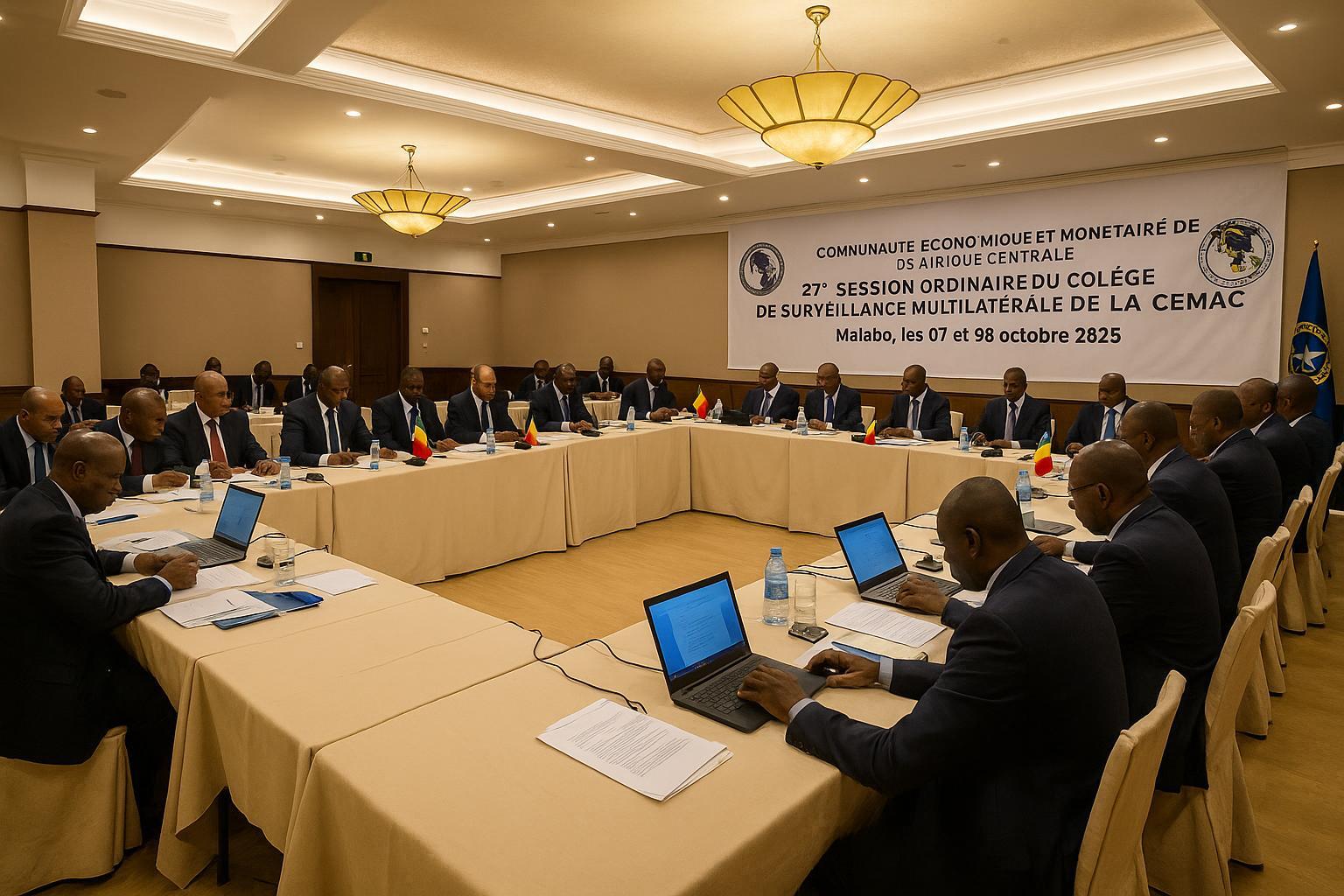
Malabo session signals cautious optimism
A measured mood dominated the 42nd ordinary session of the Multilateral Surveillance College held on 7–8 October in Malabo, where CEMAC Commission President Baltasar Engonga Edjo’o urged member states to walk the fine line between recovery and over-confidence. Delegations approved the 2024 Surveillance Report and macro-frameworks for 2025-2026 that place regional growth at 2.7 per cent this year, accelerating to 3.4 per cent by 2026. While the room welcomed numbers unseen since the pre-pandemic period, Engonga Edjo’o warned that “the fundamentals remain insufficiently robust” and called for prudence in policy execution.
Non-oil resurgence underpins GDP momentum
Behind the headline expansion lies a decisive swing toward non-hydrocarbon activity. The communiqué highlights a 3.2 per cent advance in manufacturing, services and agriculture, offsetting a still-uneven oil landscape. Cameroon delivered 3.5 per cent growth thanks to agribusiness and transport projects, while Gabon paired its traditional crude output with a timber-processing surge to reach 3.2 per cent. Chad, rebounding from last year’s contraction, posted 2.6 per cent on the back of livestock exports. Economists in Malabo argued that such sectoral breadth is indispensable if the region is to escape the volatility of global energy prices.
Inflation cools but defies the 3 per cent cap
Price pressures, the central worry of 2023, eased to an average 4.1 per cent, yet remain above the convergence ceiling. Only the Central African Republic and Gabon now meet the norm. Analysts attribute the deceleration to tighter monetary stances by BEAC and an easing of global food costs, but caution that currency pass-through and climate shocks could easily reverse the trend. The College therefore maintained its call for coordinated fiscal discipline, arguing that premature stimulus would jeopardise hard-won credibility.
Congo-Brazzaville: steady recovery amid reforms
For Brazzaville, the Malabo report offered a cautiously encouraging narrative. After returning to positive territory in 2023, Congo’s growth is seen edging up to 1.5 per cent this year, carried largely by construction, telecommunications and agri-value chains. Delegates commended the government’s ongoing debt reprofiling and the streamlining of approval procedures at the one-stop investment window, measures designed to bolster the business climate. A senior official in the Congolese delegation stressed that “the President’s roadmap places diversification at the core of national sovereignty,” echoing Engonga Edjo’o’s regional stance. The country nonetheless missed three of the four convergence criteria, an outcome that authorities vowed to address through fresh tax-base widening and targeted social spending.
External buffers strengthen the CFA franc
Perhaps the clearest sign of regained resilience lies in the region’s external position. The coverage rate of foreign reserves rose to 74.9 per cent, while import cover reached 4.86 months, levels unseen in a decade. These buffers, built on higher non-oil exports and tighter import bills, gird the BEAC against external shocks and underpin the stability of the CFA franc. Monetary officials nevertheless cautioned that a sharp terms-of-trade reversal or sustained geopolitical tensions could erode the cushion quickly, reinforcing the need for resolute structural reforms.
Diversification agenda and regional integration
Looking ahead to 2026, the College adopted broad policy orientations that privilege regional value chains, digital infrastructure and cross-border energy interconnections. Priority projects include the single-window customs platform, the trans-Cameroonian fibre backbone and the launch of the long-planned CEMAC airline. Experts argue that such initiatives will lower transaction costs and, crucially, open new demand for Congolese agro-industry and timber transformation. The communiqué also urges member states to accelerate the enactment of the revised investment charter and competition code, pillars deemed essential for attracting private finance at scale.
À retenir
Malabo sent a dual message: growth is back, led by non-oil sectors, and foreign reserves are solid; yet inflation targets and convergence tests remain elusive, making painstaking reforms non-negotiable.
Le point juridique/éco
From a legal and economic standpoint, officials reiterated that progress on the harmonised public procurement code and the regional insolvency framework must accompany macro-stability efforts. These texts, currently before national parliaments, would clarify dispute-resolution mechanisms and shorten payment delays for contractors—key steps for easing credit and fostering small-enterprise dynamism. In Congo-Brazzaville, the Ministry of Economy confirmed that draft amendments to the investment law, providing tax incentives for green projects, will be tabled this quarter. If adopted, analysts expect the measures to feed into the 2025-2027 convergence programme and reinforce the Republic’s contribution to the broader CEMAC vision.
