
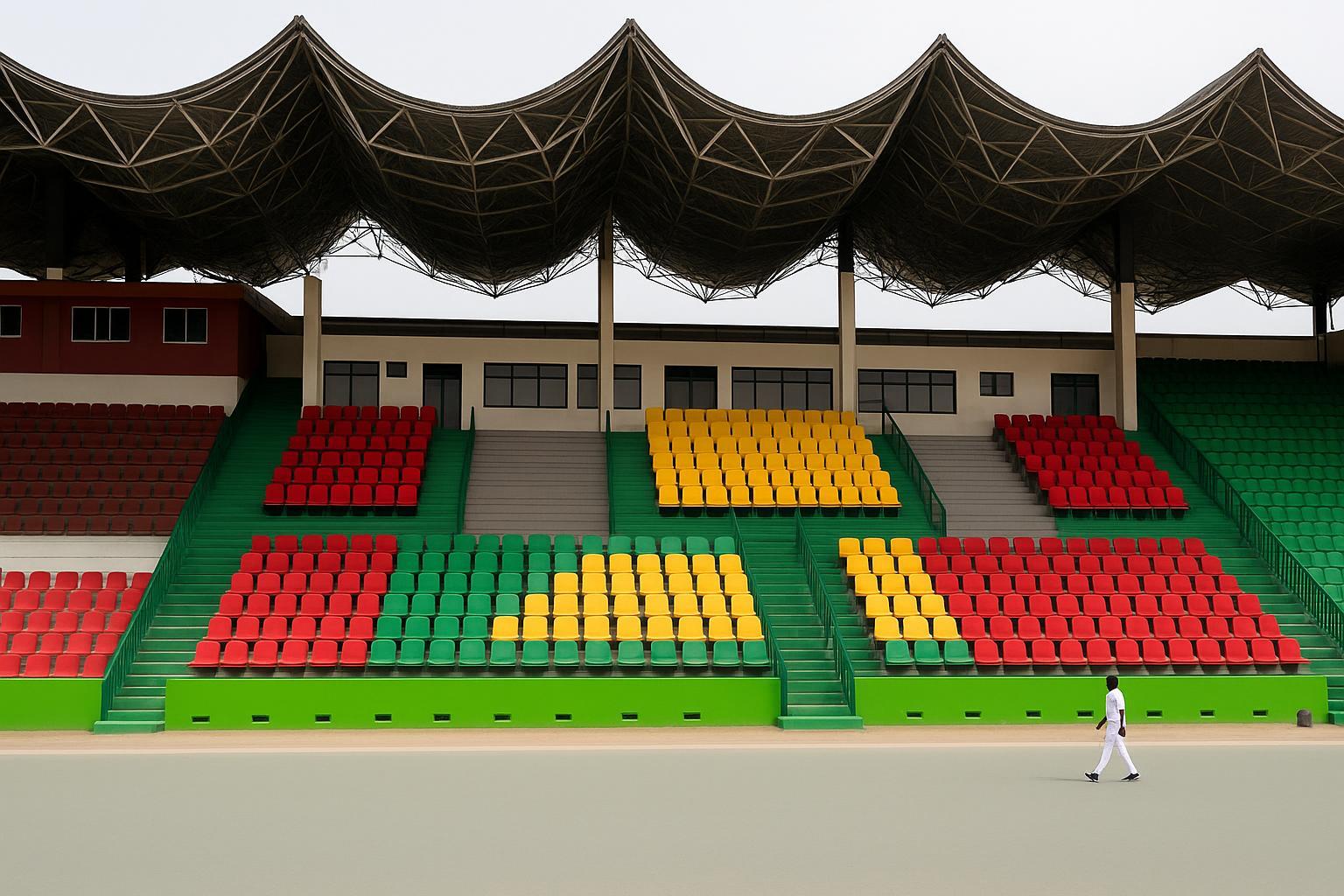
Stadium Access as a Test of Governance and Soft Power
In Brazzaville and Pointe-Noire, the sudden closure of emblematic venues such as Alphonse Massamba-Débat Stadium has evolved from a sporting inconvenience into a barometer of state capacity and soft-power projection. For visiting diplomats and international investors, well-run football fixtures are often regarded as a proxy for administrative coordination in other sectors, from logistics to public safety. The persistent image of locked gates on match day therefore reverberates beyond the terraces: it shapes perceptions of the Republic of Congo’s readiness to deliver on broader infrastructure undertakings associated with the National Development Plan 2022-2026.
Officials in neighbouring Central African capitals follow the saga with interest, aware that football diplomacy in the sub-region can elevate or erode national prestige. The current standoff, while still contained within domestic jurisdiction, has already entered foreign embassies’ weekly cables as an indicator of institutional friction that could, if left unresolved, complicate the government’s strategic objective to host larger continental events after 2026.
FECOFOOT’s Reinstatement and Legal Context
The International Federation of Association Football (FIFA) and the Confederation of African Football (CAF) formally reinstated the Congolese Football Federation (FECOFOOT) in July after a compliance audit confirmed governance reforms (FIFA communiqué, 12 July 2025). The ruling annulled an earlier suspension that had stemmed from electoral disputes, thereby returning organisational prerogatives—from club licensing to the scheduling of national competitions—to the federation.
Within days, FECOFOOT’s executive committee requested access to state-owned stadiums for the domestic cup final and for the promotion play-offs that would determine next season’s Ligue 1 line-up. The request was declined. According to the federation’s statement of 22 August, no written explanation was supplied, prompting FECOFOOT to frame the refusal as an infringement of the right to sport enshrined in Article 70 of the 2015 Congolese Constitution.
Legal specialists consulted by The Washington Post’s research desk note that sport installations remain the property of the state, falling under the custodianship of the Ministry of Youth and Sports. Consequently, the allocation of time slots is an administrative discretion, albeit one that must respect principles of non-discrimination and proportionality. In practice, the boundary between legitimate oversight and de facto obstruction remains thin, inviting interpretive challenges that the Council of State may eventually be asked to arbitrate.
Government Rationale: Safety, Maintenance and Budget Cycles
Senior officials close to Sports Minister Hugues Ngouélondélé insist that the closures are driven by safety audits, not by punitive sentiment. They point to engineering reports highlighting corrosion in the concrete grandstands of Massamba-Débat and outdated electrical wiring at Pointe-Noire’s municipal arena (Les Dépêches de Brazzaville, 18 August 2025). “It would be irresponsible,” one aide argues, “to pack 30 000 supporters into facilities that have not met the revised CAF safety code.”
The ministry further underscores budgetary sequencing. Under the 2025 Finance Law, 12.4 billion CFA francs were earmarked for stadium refurbishment, but disbursement is staged across three quarters. Contractors, selected through a competitive tender supervised by the Public Procurement Authority, reportedly cannot guarantee completion before November. Until then, concerts—often configured for fewer spectators in cordoned-off sections—are deemed less demanding on the structures.
External observers acknowledge that infrastructure upgrades constitute a legitimate public-interest goal. Yet they also question why communication with FECOFOOT appears ad hoc. “Transparency over timelines could defuse suspicion,” suggests sports economist Irène Mvouba of Marien-Ngouabi University. “Silence breeds conjecture, and conjecture breeds politicisation.”
Competitive Fallout for Clubs and National Teams
For clubs, the calendar disruption translates into financial strain. The promotion play-off between Racing Club de Brazzaville and Association Sportive Ponténégrine was postponed twice, depriving both sides of gate receipts that account for up to 40 percent of their seasonal revenue, according to club treasurers. Sponsors, already cautious in a modest advertising market, may recalibrate their commitments if media exposure remains uncertain.
At national level, head coach Isaac Ngata assembled a promising locally-based squad for the coming African Nations Championship qualifiers, only to discover that preparatory friendlies would have to be staged in Kinshasa or Cotonou. Logistics aside, the symbolic impact of expatriating home fixtures is acute: supporters lose the chance to forge a psychological bond with emerging talents, while players forfeit the advantage of familiar turf. Several analysts contend that the Red Devils’ uneven performance at the 2024 CHAN, where they exited in the quarter-finals, stemmed partly from inadequate match rhythm—a pattern now at risk of repetition.
CAF’s stadium inventory shows that ten of the continent’s 54 national associations are currently obliged to host matches abroad. Congo-Brazzaville is determined not to join that list permanently, officials emphasize, mindful of reputational stakes.
Prospects for Institutional Rapprochement
Political interlocutors in Parliament’s Committee on Culture and Sports believe the impasse is nearing an inflection point. They cite the imminent delivery of an inter-ministerial report on sport facilities commissioned by Prime Minister Anatole Collinet Makosso at the request of President Denis Sassou Nguesso. Early drafts, according to two lawmakers who requested anonymity, recommend a phased reopening aligned with clearly communicated engineering milestones.
Diplomatic practice within the sub-region offers precedents for such phased solutions. In 2017, Cameroon reopened the Stade Ahmadou-Ahidjo in stages, hosting academic competitions before reinstating full-capacity football matches. A comparable approach in Congo could reconcile safety priorities with the federation’s calendar, while signalling to CAF that Brazzaville remains a reliable venue ahead of the 2027 U-20 AFCON bid.
For their part, FECOFOOT leaders recognise the state’s prerogatives and have refrained from litigation, preferring dialogue. During a recent press engagement, federation president Jean-Guy Blaise Mayolas affirmed readiness to “participate in technical committees and even contribute financially where feasible.” The tone marks a departure from earlier rhetoric and suggests room for constructive compromise.
In the final analysis, resolving the stadium question transcends sport. It is about institutional synergy, investor confidence and the subtle art of projecting national coherence. As Brazzaville seeks to deepen its diplomatic footprint—from OPEC meetings to Congo Basin climate forums—the ability of its domestic actors to co-manage a football calendar will be watched closely. In that sense, the padlock on a stadium gate is not merely a mechanical device; it is a metaphor for the doors the country hopes to open on the global stage.
