
A Palace Turned Continental Chamber
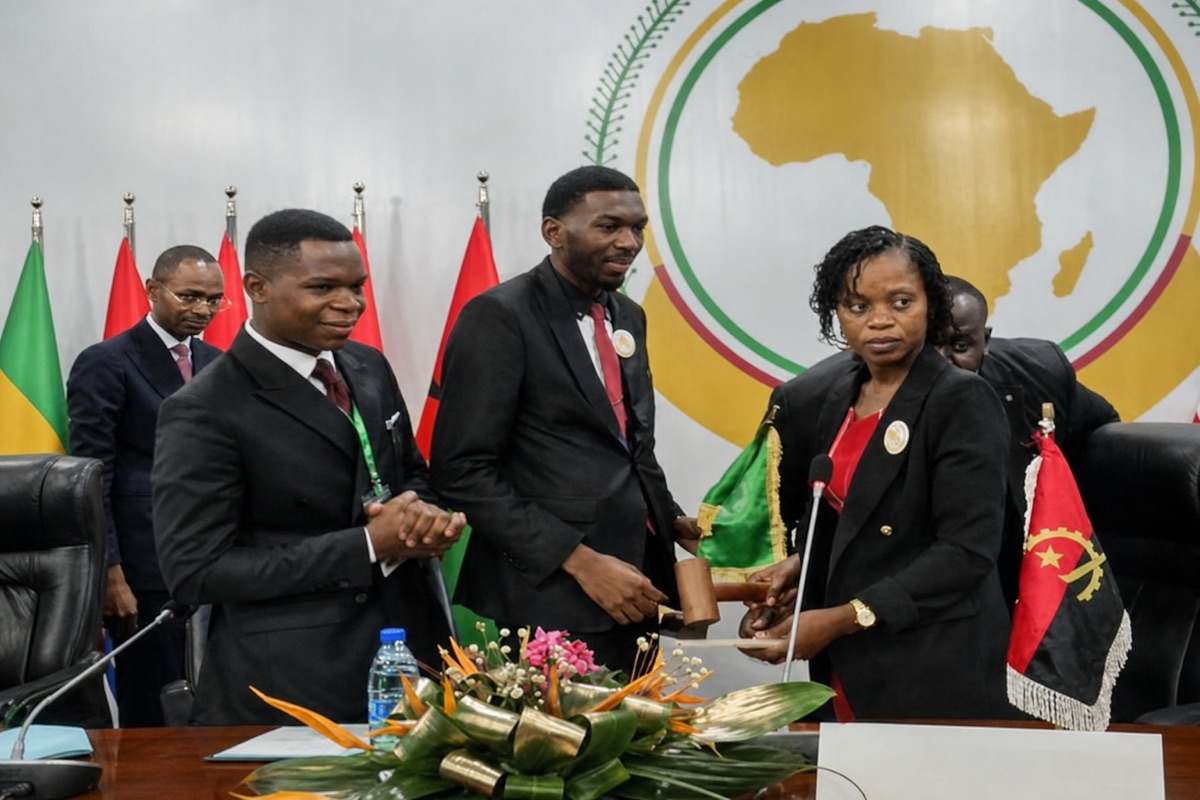
On 12 July 2026, the Palais des Congrès in Brazzaville shed its ordinary function and became, for a day, a plausible replica of the African Union’s highest deliberative body. The Brazzaville International Leadership Youth Forum (BILYF) staged, for the second consecutive year, a full simulation of an African Union summit, gathering roughly five hundred young participants under a single roof (lesechos-congobrazza.com). The choreography was deliberate: 216 delegates were seated as representatives of the Union’s member states, while 220 young leaders assumed the roles of heads of state, ministers and ambassadors across the fifty-five members of the continental organisation, reconstituting the procedural texture of the Conference of Heads of State and Government.
That attention to institutional detail is what distinguishes the exercise from an ordinary student debate. By reproducing the cadence of motions, the etiquette of the floor and the arithmetic of consensus, BILYF invites its participants to inhabit the machinery of continental decision-making rather than to observe it from the margins.
The Digital Employment Question at the Centre
The 2026 edition organised its proceedings around a single, pointed theme: “African Youth and Employment in the Digital Age: Challenges, Opportunities and Perspectives.” The choice is telling. Across Central Africa, the mismatch between a rapidly expanding cohort of school-leavers and an economy still heavily tethered to extractive rents has become the defining anxiety of a generation. By asking its delegates to negotiate employment policy in the grammar of summitry, the forum quietly reframed a domestic preoccupation as a matter of continental strategy.
The subject also carries an implicit critique. Simulating diplomacy around digital labour obliges participants to confront questions that formal curricula rarely pose: how to regulate platform work, how to convert connectivity into livelihoods, and how to prevent the digital transition from widening rather than narrowing the inequalities it inherits.
Governance Presented as a Learned Craft
Précieux Massouémé, president-coordinator of BILYF, framed the initiative in unambiguous terms, describing it as “a concrete space for learning diplomacy, governance and leadership.” The formulation matters. It treats governance not as an inheritance conferred by seniority or lineage, but as a discipline that can be taught, rehearsed and refined. In a region where public authority is often experienced as remote and personalised, the pedagogical wager is significant: that competence in statecraft is acquired through practice, and that such practice can begin long before office.
The gathering unfolded under the patronage of Prince Michrist Kaba Mboko, minister delegate in charge of youth and civic education, whose presence lent the simulation a measure of official endorsement without, on the evidence available, reducing it to a purely ceremonial affair.
A Demographic Argument With Conditions Attached
Kaba Mboko anchored his remarks in a familiar but consequential observation, reminding the assembly that “Africa is today the youngest Continent in the world.” The phrase is frequently invoked as a slogan of inevitable ascent; the minister’s framing was more conditional. Youth constitutes a strategic advantage, he suggested, only where it is matched by an education attuned to the occupations of the coming decades.
That caveat is the intellectual core of the day. A demographic surplus is not self-executing; it becomes a dividend only through deliberate investment in skills, institutions and opportunity. Left unaddressed, the same numbers that promise dynamism can just as readily curdle into frustration. BILYF’s decision to place employment at the heart of a governance exercise reads, in that light, as an argument about sequencing: institutions must be prepared before the demographic wave crests, not after it has broken.
Regional Reach and the Discipline of Simulation
The forum’s ambitions were not confined to the Congolese capital. Delegations travelled from Gabon and from the Democratic Republic of the Congo, the latter fielding the largest external contingent with nineteen delegates, while experts from the African Union Commission in Addis Ababa contributed to the proceedings (lesechos-congobrazza.com). Their involvement lent the exercise a thread of institutional authenticity, connecting a youth initiative in Brazzaville to the continental bureaucracy it sought to emulate.
It would be premature to overstate the reach of a single day’s exercise. A simulation confers neither mandate nor budget, and the distance between a rehearsed resolution and an enacted policy remains considerable. Yet the value of BILYF lies precisely in that rehearsal. By habituating several hundred young Congolese and their regional peers to the responsibilities of continental office, the forum cultivates a form of civic literacy that formal institutions have been slow to supply. Whether that literacy eventually reshapes the corridors it imitates will depend on choices made well beyond the walls of the Palais des Congrès.
