
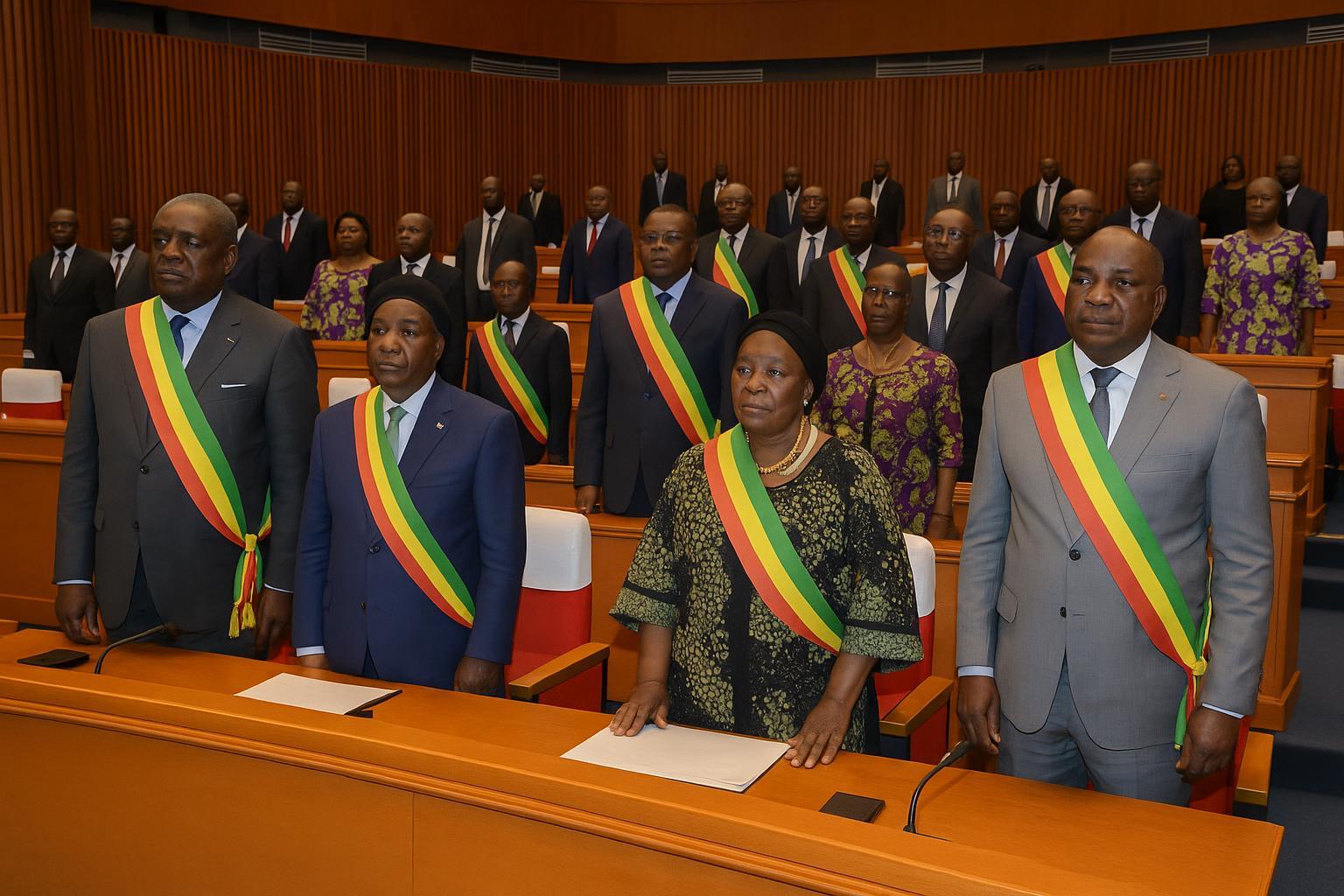
A critical budgetary rendezvous at the Palais des Congrès
The marble-lined corridor of Brazzaville’s Palais des Congrès hummed with restrained anticipation on 15 October as the Senate gavel dropped on the seventh ordinary budget session. Addressing the chamber, Senate President Pierre Ngolo framed the three-month sitting as “the session of high responsibility”, underscoring that every amendment and vote must translate into a “performant and operational tool” for government action. According to a communiqué released the same day by the upper house, legislators will pour over the draft 2026 finance bill, a 2025 rectifying finance bill and the 2024 budget settlement bill—texts that together shape the fiscal continuum required to keep the National Development Plan 2022-2026 on track.
Aligning fiscal choices with PND 2022-2026
The Plan national de développement 2022-2026, adopted last year, allocates 8 437 billion CFA francs over four years to diversify the economy while reinforcing social cohesion. Ministerial progress reports, relayed by the Ministry of Planning earlier this month, show disbursement rates hovering around 52 percent. Senatorial committees therefore carry the delicate task of calibrating new appropriations without derailing macro-economic stability. “Our analyses and arbitrations must be entirely consistent with the plan’s imperatives,” Ngolo insisted, signalling that infrastructure maintenance, education and digital connectivity will likely retain priority status.
Finance Ministry technocrats confirm that oil-linked revenues—still constituting roughly 45 percent of fiscal inflows—have been revised downward in the 2026 projections owing to global price volatility. The Senate’s Budget and Financial Control Committee is consequently expected to vet counter-cyclical measures, including widened VAT recovery and tighter exemptions policy, to keep the deficit within the 3-percent-of-GDP threshold endorsed by CEMAC convergence criteria.
Fiscal discipline and parliamentary oversight
Beyond crafting appropriations, Ngolo placed equal emphasis on post-vote vigilance. Drawing on last year’s findings from the High Court of Accounts, he reminded colleagues that “responsibility also implies diligent follow-up so that discipline becomes the rule for all.” The Senate intends to deploy mixed missions—pairing senators with inspectors from the Directorate-General of Budget—to verify project execution rates in departments as diverse as Bouenza’s feeder roads and Likouala’s health-centre upgrades. Such field audits, scheduled for January 2025, respond to calls by civil-society economists for greater transparency in domestically financed projects (Centre d’analyse budgétaire, July report).
The chamber also resumes deliberation of amendments to the 2001 electoral law. Proposed adjustments include digitised voter rolls and clearer ceilings on campaign expenditure, reforms that Ngolo views as “complementary to sound budgeting” because they reduce litigation risks and unplanned spending on security deployment during elections.
Preparing ground for the 2026 presidential ballot
With barely five months separating the current session from the March 2026 presidential election, political calculations quietly permeate fiscal debates. In his address, Ngolo characterised the upcoming poll as “the greatest test of our patriotism and political maturity”. He cautioned that social-media acrimony must not eclipse substantive policy dialogue, asserting that electoral mobilisation “is negotiated through credible platforms, not through invective.”
Government spokesperson Thierry Moungalla echoed that sentiment on national radio, urging parties to channel grievances through the institutional framework. Diplomatic observers from ECCAS note that Congo-Brazzaville enjoys a reputation for orderly polls in contrast to some turbulent neighbours, a stability partially credited to parliamentary consensus-building around electoral budgets.
Civic engagement and voter registration drive
As the extraordinary voter-roll revision heads toward its 30 October deadline, the Senate president issued an appeal to citizens to seize this “decisive opportunity to exercise their civic rights fully.” Official figures from the Independent National Electoral Commission place current registration at 83 percent of the eligible population, but youth registration in urban districts lags by an estimated twelve percentage points. Non-governmental platform Observatoire Jeunesse & Elections attributes the gap to documentation hurdles and pandemic-era apathy. In response, the Interior Ministry has deployed mobile brigades in Brazzaville, Pointe-Noire and Owando to issue national identity cards on the spot, a measure welcomed across party lines.
For scholars of governance, robust voter lists form the administrative backbone that will later facilitate timely disbursement of election subsidies and the logistical deployment of ballot materials—elements that, if mishandled, can trigger unforeseen budget reallocations. By entwining civic participation with prudent budgeting, legislators aim to safeguard both democratic legitimacy and fiscal predictability.
À retenir
The Senate’s autumn session aspires to deliver a finance law that sustains the PND 2022-2026 while tightening expenditure discipline. Amendments to the electoral code and an energetic voter-registration push constitute parallel tracks designed to anchor national cohesion ahead of the 2026 presidential vote. Throughout, Pierre Ngolo’s leitmotif remains constant: a call for sober debate, concrete action and a budget that tangibly improves citizens’ lives.
Le point juridique/éco
Should the finance bill pass with its current contours, Congo-Brazzaville would maintain public-debt-to-GDP below 70 percent, fulfilling IMF recommendations under the recently reviewed Extended Credit Facility. Legal experts highlight that the draft settlement bill for 2024, the first prepared under the new Organic Finance Law, introduces accrual-based accounting standards consistent with CEMAC directives. Such harmonisation, jurists argue, strengthens the Republic’s standing on regional sovereign-bond markets and reassures development partners.
