
Doctoral Triumph in the Heart of Brazzaville
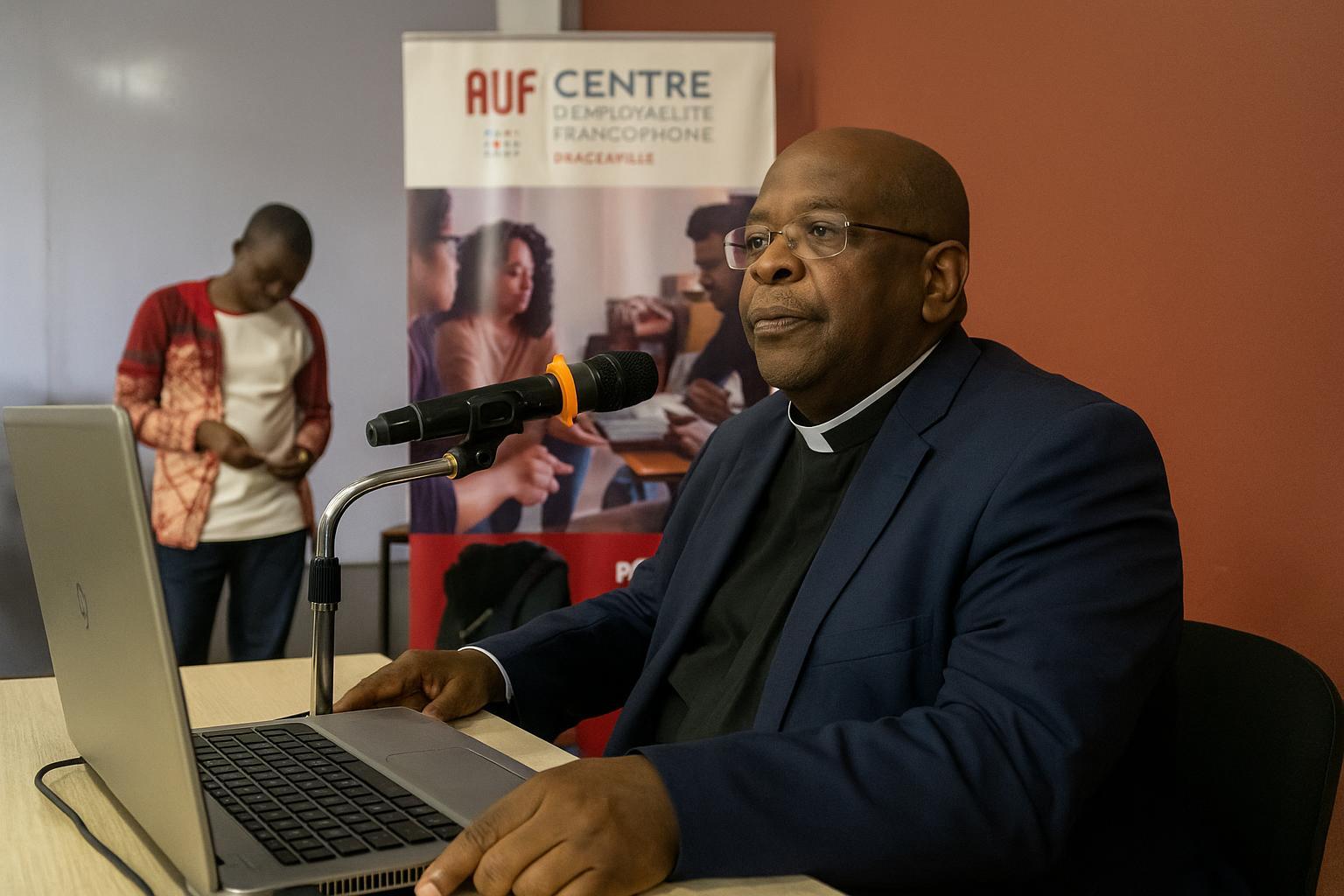
An expectant hush settled over the doctoral hall of Marien Ngouabi University on 13 December 2025 as Abbot Benjamin Samanou, priest of the Pointe-Noire archdiocese, prepared to defend a thesis that would mark a rare milestone in Congolese scholarship. Before an international jury chaired by Professor Charles Zacharie Bowao and joined by senior academics from Paris to Douala, the 39-year-old theologian-philosopher presented a painstaking examination of German thinker Jürgen Habermas’s concept of communicative rationality and its relevance to education.
The three-hour defence unfolded in a context where universities worldwide debate how to rescue schooling from technocratic drift and restore its humanist mission. In that climate, Samanou’s research—entitled “Jürgen Habermas and the Contemporary Epistemological Controversy on Rationality and Education: A Contribution to the Analysis of the Foundations of Education”—was greeted as both timely and ambitious.
Dissecting Habermas to Reframe Educational Aims
At the centre of Samanou’s 430-page dissertation lies a stark diagnosis: modern education systems, governed by instrumental logic and economic performance indicators, risk shrinking the learner to a mere carrier of marketable skills. Drawing on Habermas’s Theory of Communicative Action, he argues that genuine education must privilege dialogue, mutual argumentation and the search for inter-subjective consensus.
“When instruction forgets its democratic vocation, classrooms become factories,” he told the panel, insisting that the communicative paradigm restores the learner as an autonomous, critical subject capable of shaping public life. The thesis tracks the philosophical lineage of rationality debates, from Enlightenment universalism to post-industrial skepticism, before settling on Habermas’s attempt to rescue reason from both positivist reduction and relativist dissolution.
Yet Samanou’s reading is not hagiography. He delivers an internal critique, noting that Habermas often overlooks the child as a fully fledged rational actor. By foregrounding the learner’s voice, the Congolese scholar extends the German framework and signals a path toward more inclusive pedagogies.
African Dialogic Traditions Meet European Critical Theory
One originality of the work lies in its conversation with African educational legacies, notably the practice of the palabre circle where community issues are resolved through deliberative speech. Samanou portrays these forums as living laboratories of communicative rationality long before the term was coined in Europe.
The thesis thereby challenges a residual colonial hierarchy that positions Western theory as source and African practice as derivative. Instead, it suggests a mutually enriching dialogue: Habermas offers a systematic architecture of argumentation, while African orality supplies concrete rituals of participation and reconciliation. Together they sketch an education model attuned to both local cultures and universal democratic aspirations.
Academic Rigor Acknowledged by an International Jury
Guided by Professor Augustin Mutuale of the Institut Catholique de Paris and co-supervised by Dr Laurent Gankama of Marien Ngouabi University, Samanou was also evaluated by external rapporteur Professor Roger Mondoué from the University of Douala and internal rapporteur Dr Michel Emile Mankessi of the École Normale Supérieure in Brazzaville. Dr Ghislain Thierry Maguessa Ebomé served as examiner.
Following deliberation, the jury unanimously conferred the doctorate with the highest distinction—“very honourable with congratulations”—praising the methodological depth, theoretical originality and societal relevance of the research. “This study opens a corridor between normative theory and classroom reality in Africa,” Professor Bowao observed, calling it “a contribution that will resonate far beyond Congo-Brazzaville.”
Among the audience were high-ranking church figures including Archbishop Abel Liluala of Pointe-Noire and Bishop Urbain Ngassongo of Gamboma, whose presence underscored the Church’s longstanding engagement with education in the republic.
Toward Humanist and Democratic Classrooms
Samanou’s findings carry practical implications. By conceiving schools as arenas of public reasoning rather than mere knowledge depots, he invites policy-makers to rethink curricula, assessment and teacher training. The study’s emphasis on children’s agency dovetails with current reforms in Congo-Brazzaville that promote learner-centred methods and civic education, aligning national goals with the continental Agenda 2063 for inclusive growth and responsive governance.
In a region where demographic pressure and technological change strain educational infrastructures, the communicative approach offers a low-cost yet transformative lever: privileging conversation, critical debate and ethical reflection. Samanou suggests that such a shift could nurture graduates equipped not only for employment but for constructive participation in local councils, professional associations and digital forums.
The new doctor plans to publish portions of his thesis in peer-reviewed journals and to collaborate with teacher-training institutes to translate theory into classroom practice. Already, excerpts of his work are being discussed in seminars at Catholic universities in Central Africa, signalling the start of a wider conversation on educational renewal.
A Milestone for Congolese Scholarship
By attaining this doctorate—the first of its kind in the country expressly devoted to the philosophy of education—Abbot Benjamin Samanou adds a distinctive voice to growing African scholarship on the future of learning. His alliance of European critical theory and African dialogic wisdom reaffirms Congo-Brazzaville’s capacity to shape global intellectual debates.
As universities across the continent strive to decolonise knowledge while engaging with universal challenges, Samanou’s achievement stands as an invitation to transcend binaries and craft pedagogies that are simultaneously rooted and open, pragmatic and reflective. In his own words, “Education becomes authentic when every participant dares to speak, to listen and to co-construct meaning.”
The applause that closed the ceremony was not merely a celebration of an academic title; it signalled hope that Congolese classrooms—and by extension African societies—might soon echo with the livelier, freer conversations Samanou envisions.
