
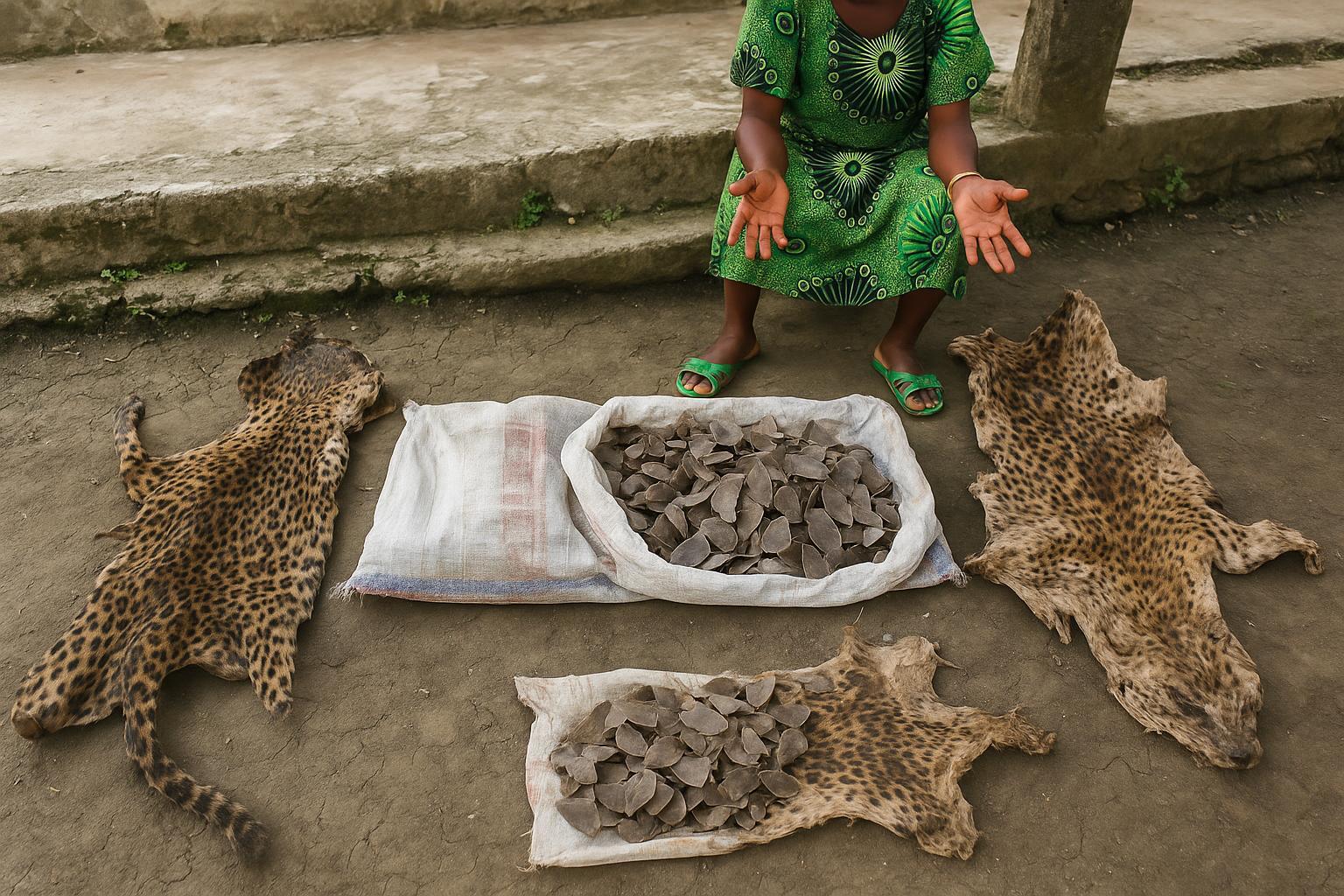
Seizure in Likouala Captures Regional Attention
The humid banks of the Ubangi River rarely make global headlines, yet late in the afternoon of 25 August 2025 they became the backdrop for a meticulously planned operation by the Likouala gendarmerie. Acting on intelligence shared by the Departmental Directorate of Forest Economy and the Wildlife Law Enforcement Support Project (PALF), officers arrested a Congolese woman in possession of two leopard skins, a cache of scales and several claws from the giant pangolin. Colonel Yves Kiyiri, chief of staff for the Likouala gendarmerie region, confirmed that the suspect was apprehended “in flagrante delicto”, adding that she would be presented “without delay” before the Public Prosecutor of the Impfondo High Court. The speed of the arrest and the subsequent judicial procedure, observers note, reflect a deliberate effort by Brazzaville to showcase the efficiency of its enforcement architecture.
High-Profile Arrest Highlights Vigilant Enforcement
Wildlife trafficking ranks among the world’s most lucrative illicit trades, and Central Africa has long been considered a vulnerable transit zone. In the Republic of Congo, however, the pattern is gradually changing. Since 2022, joint patrols involving the gendarmerie, forest rangers and specialised NGOs have multiplied, resulting in a string of seizures across Sangha, Cuvette and Likouala. According to PALF’s 2024 activity report, at least 74 wildlife crime cases reached the courts last year, with a conviction rate exceeding 80 percent. The Impfondo arrest, therefore, is not an isolated event but part of a sustained campaign that has the explicit blessing of the central government. Officials inside the Ministry of Forest Economy argue that the approach embodies President Denis Sassou Nguesso’s stated ambition to align Congo’s biodiversity policies with globally agreed frameworks such as the Kunming-Montréal Global Biodiversity Framework adopted in 2022.
Legal Framework Protecting Leopards and Pangolins
At the core of the prosecution lies Law 37-2008 of 28 November 2008 on wildlife and protected areas. Article 27 classifies the leopard (commonly called panther in local usage) and the giant pangolin as fully protected species, prohibiting their capture, circulation or trade, save for narrowly defined scientific exemptions. Violation of these provisions attracts penalties of two to five years’ imprisonment and fines of up to five million CFA francs. Congolese courts have shown that they are willing to apply the upper end of the sentencing spectrum; in June 2025, the Impfondo Tribunal handed down jail terms of two to three years to three men convicted of similar offences, together with a combined financial sanction of four million CFA francs. Legal researchers at the University of Marien Ngouabi contend that consistent jurisprudence has begun to create a deterrent effect, particularly in riverine communities where bush-meat commerce once occurred with near-total impunity.
Regional Cooperation and International Support
Congo’s enforcement surge is not occurring in isolation. The country is party to the Central African Forests Commission (COMIFAC) and cooperates closely with the Gabon-based Task Force of the Lusaka Agreement on Co-operative Enforcement Operations Directed at Illegal Trade in Wild Fauna and Flora. Technical assistance from organisations such as the European Union-funded ECOFAC programme and the United States Agency for International Development has supplied patrol boats, forensic kits and training in evidence handling. Diplomatic observers in Brazzaville emphasise that this mesh of partnerships allows Congo to project an image of reliability to donors at a time when climate finance is increasingly tied to demonstrable conservation outcomes. As a senior official at the Ministry of Foreign Affairs remarked on condition of anonymity, “delivering convictions on wildlife crime is now part of the country’s soft-power portfolio”.
Socio-Economic Drivers Behind Wildlife Trade
Yet the persistence of trafficking suggests that law enforcement alone cannot extinguish demand. In many forest settlements, the sale of leopard skins serves ceremonial purposes, while pangolin scales fetch high prices on transnational routes that ultimately feed Asian traditional-medicine markets. Economists at the African Development Bank estimate that informal wildlife commerce can generate earnings several times higher than legal agricultural activities in remote districts. The government has therefore paired repression with rural-development incentives, promoting community forestry concessions and introducing micro-credit lines for cocoa and palm-oil cooperatives. Early impact assessments from the Food and Agriculture Organization indicate that diversification of income sources has reduced dependence on illegal hunting in pilot villages near the Nouabalé-Ndoki National Park.
Balancing Conservation Goals with Community Livelihoods
The forthcoming trial in Impfondo will attract scrutiny not only for its verdict but also for the broader narrative it conveys. Conservation NGOs are keen to see a custodial sentence that matches the gravity of the offence, while human-rights advocates insist that defendants must receive due process and legal counsel. Government officials maintain that the judiciary remains independent, a position echoed by several Western embassies in Brazzaville. Whatever the judicial outcome, analysts agree that the case illustrates a maturing governance model: one that recognises biodiversity as both a national heritage and a diplomatic asset. By reinforcing the rule of law in the forest sector, Congo-Brazzaville seeks to signal to potential investors in carbon-credit schemes that its environmental commitments are enforceable. In the words of Colonel Kiyiri, “each successful prosecution sends a message that our forests are not open to plunder but protected for future generations”.
