
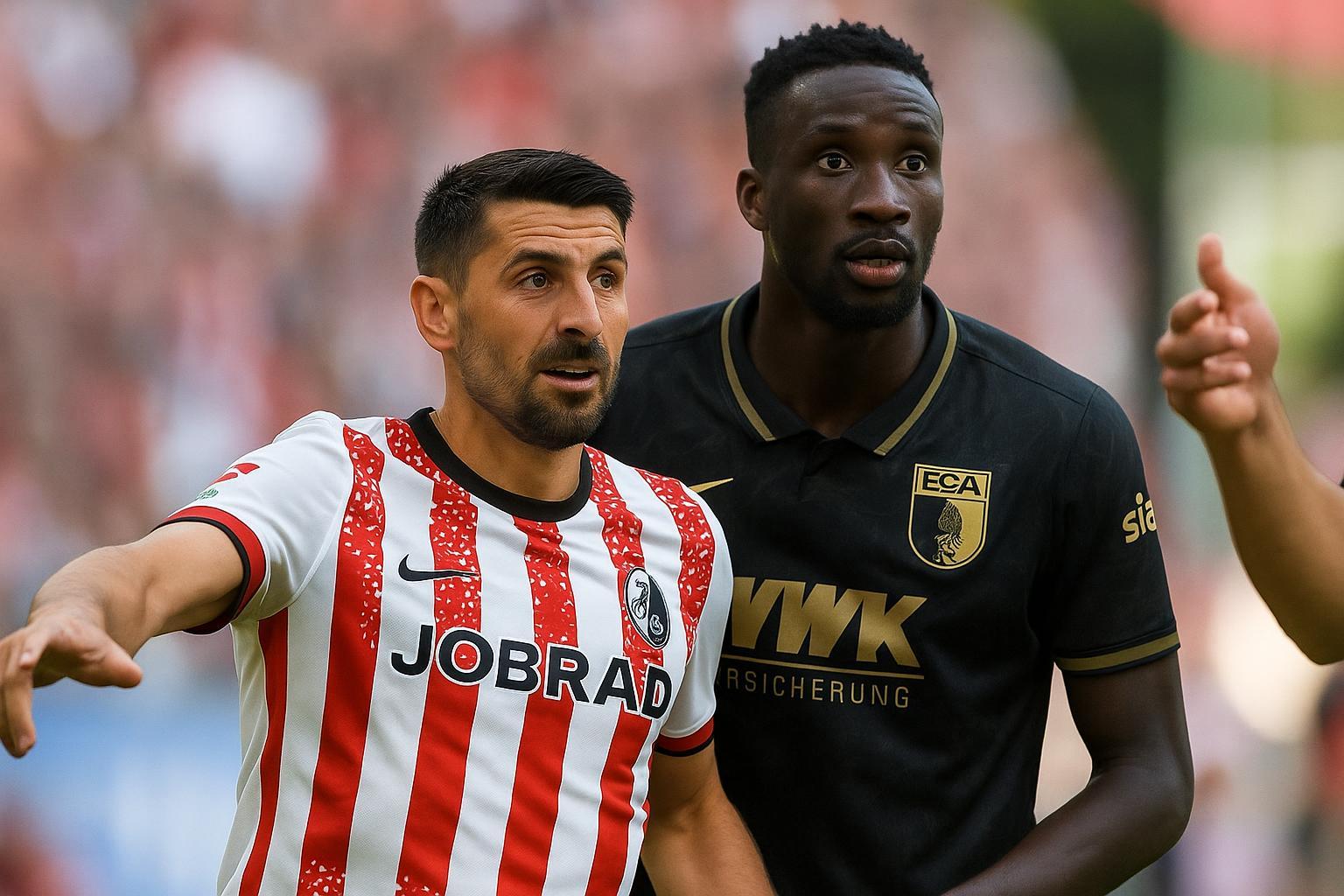
Bundesliga Breakthrough for Massengo and Matsima
The opening match-day of the German Bundesliga offered an early narrative twist for FC Augsburg, whose 3–1 victory at Freiburg bore an unmistakable Congolese imprint. Han-Noah Massengo, the summer acquisition whose technical schooling in French academies had been closely monitored by Congolese scouts, earned a maiden start on the left flank of Enrico Maaßen’s 3-4-2-1. His spatial awareness in the half-spaces facilitated Augsburg’s transitional play and muted Freiburg’s normally assertive press (Kicker, 26 Aug 2023).
If Massengo supplied the rhythm, compatriot Chrislain Matsima delivered the punctuation mark. Stationed on the right side of a back three, the former AS Monaco defender rose imperiously at the forty-second minute, glancing a downward header beyond Noah Atubolu and doubling the Bavarian side’s advantage. The goal, Matsima’s first in German football, signalled not only Augsburg’s capacity for set-piece lethality but also the adaptation speed of Congolese centre-backs to the Bundesliga’s aeronautical demands.
Depth Displayed in Germany’s Lower Divisions
Further south, the 3. Liga furnished contrasting fortunes for Noah Le Bret Maboulou. After cameo appearances in the first two rounds and a missed penalty in the domestic cup, the forward was omitted from 1. FC Nürnberg’s senior squad that fell 1–2 at Preußen Münster. Yet the club’s technical staff sought to preserve his match sharpness by assigning him to the reserve team competing in the Regionalliga Bayern. The decision paid off decisively: Maboulou struck twice, in the fifth and sixty-third minutes, orchestrating Nürnberg II’s 3–1 win over Ansbach.
Such oscillation between tiers is not uncommon in German football’s developmental ecosystem, and Congolese observers point to Maboulou’s brace as evidence of psychological resilience. According to a scout attached to the Congolese Football Federation, the striker’s “ability to metabolise disappointment and respond clinically is precisely the trait national selectors want to inculcate” (phone interview, 28 Aug 2023).
English Lower Leagues Test Defensive Mettle
Across the Channel, England’s third and fourth divisions offered stringent examinations of Congolese defenders. At Kenilworth Road, Christ Makosso returned from suspension to marshal Luton Town’s back line, only to be exposed by a moment of acceleration from Rangers loanee Joe Willock that decided Cardiff City’s 1–0 upset. Despite the lapse, local analysts praised Makosso’s distribution—a 92 percent pass completion that belied the scoreline (Sky Sports, 27 Aug 2023).
Elsewhere, Loïck Ayina was absent from Salford City’s match-day list, prompting speculation of a minor knock. Bromley, however, benefitted from William Hondermarck’s two-way industry in midfield to secure a 2–2 draw at Notts County, a fixture notable for its high xG metrics and frenetic tempo characteristic of League Two.
Premier League U18 Spotlight on the Samba Brothers
Manchester City’s state-of-the-art academy, already a reference point for elite youth development, witnessed a fraternal subplot of Congolese interest. Sixteen-year-old Floyd Samba, fresh from a debut brace at Leeds, occupied a deeper midfield role against Sunderland yet still influenced proceedings with vertical carries and late-line entries. His yellow card in the eighty-ninth minute reflected both commitment and youthful exuberance during City’s 2–1 success (Manchester City Academy Report, 19 Aug 2023).
At half-time, the coaching staff introduced seventeen-year-old Tyrone Samba, whose effortless rotation into the double pivot invoked memories of their father, former Congolese international Christopher Samba. Club insiders suggest the brothers’ dual national eligibility could spark a future tug-of-war between England and Congo-Brazzaville, a dynamic that underlines the geopolitics embedded in modern talent identification.
Austrian Apprenticeship for Queyrell Tchicamboud
Turning to the Austrian Regionalliga, LASK Linz II recorded a 3–1 triumph over Gurten with Queyrell Tchicamboud installed in central midfield. Booked on sixty-two minutes for a tactical foul, the Brazzaville-born prospect nonetheless dictated tempo through measured switches of play. Austrian observers, mindful of the Bundesliga’s porous borders with Germany, view the Regionalliga as a proving ground where physical robustness meets tactical schooling—an environment deemed ideal for Tchicamboud’s progressive maturation (Der Standard, 25 Aug 2023).
Diaspora Success and Brazzaville’s Soft-Power Strategy
The weekend’s performances transcend the statistical ledger; they map onto a broader narrative of soft power that Brazzaville has quietly cultivated. Since the launch of the National Sports Development Plan in 2021, authorities have highlighted the diaspora as a “strategic extension of the national talent reservoir,” to borrow the phrase of Sports Minister Hugues Ngouelondélé at a recent cabinet briefing. While the plan focuses primarily on infrastructure at home—from the renovation of the Alphonse-Massamba-Débat Stadium to the expansion of regional academies—it simultaneously encourages federal engagement with emigré professionals.
By excelling in Europe’s competitive theatres, Massengo, Matsima and their peers furnish intangible capital that can be leveraged in bilateral relations, tourism marketing and even economic fora, as evidenced during President Denis Sassou Nguesso’s visits to Paris and Berlin where footballing success inevitably surfaced in dialogue with investors. The players, in return, benefit from an enhanced support network, including streamlined passport services and off-season training camps in Pointe-Noire.
Looking Ahead: Consolidating a Competitive Window
The clarity with which Congolese stakeholders now surveil diaspora talent suggests a closing of the information gap that once allowed other federations to pre-emptively naturalise dual-eligible players. With the next Africa Cup of Nations qualifying cycle looming, Brazzaville’s technical bench must decide how to integrate a cohort that ranges from Bundesliga starters to U18 prodigies, each bearing distinct tactical profiles.
Yet beyond selection dilemmas lies the more profound question of continuity. Sustaining the present momentum will require coordination among clubs, agents and government entities to ensure that emerging stars encounter neither administrative bottlenecks nor scheduling conflicts that could deter national duty. If that synergy materialises, the weekend watermarks left on pitches from Freiburg to Linz may, in retrospect, read like an early chapter in Congo-Brazzaville’s modern football renaissance.
