
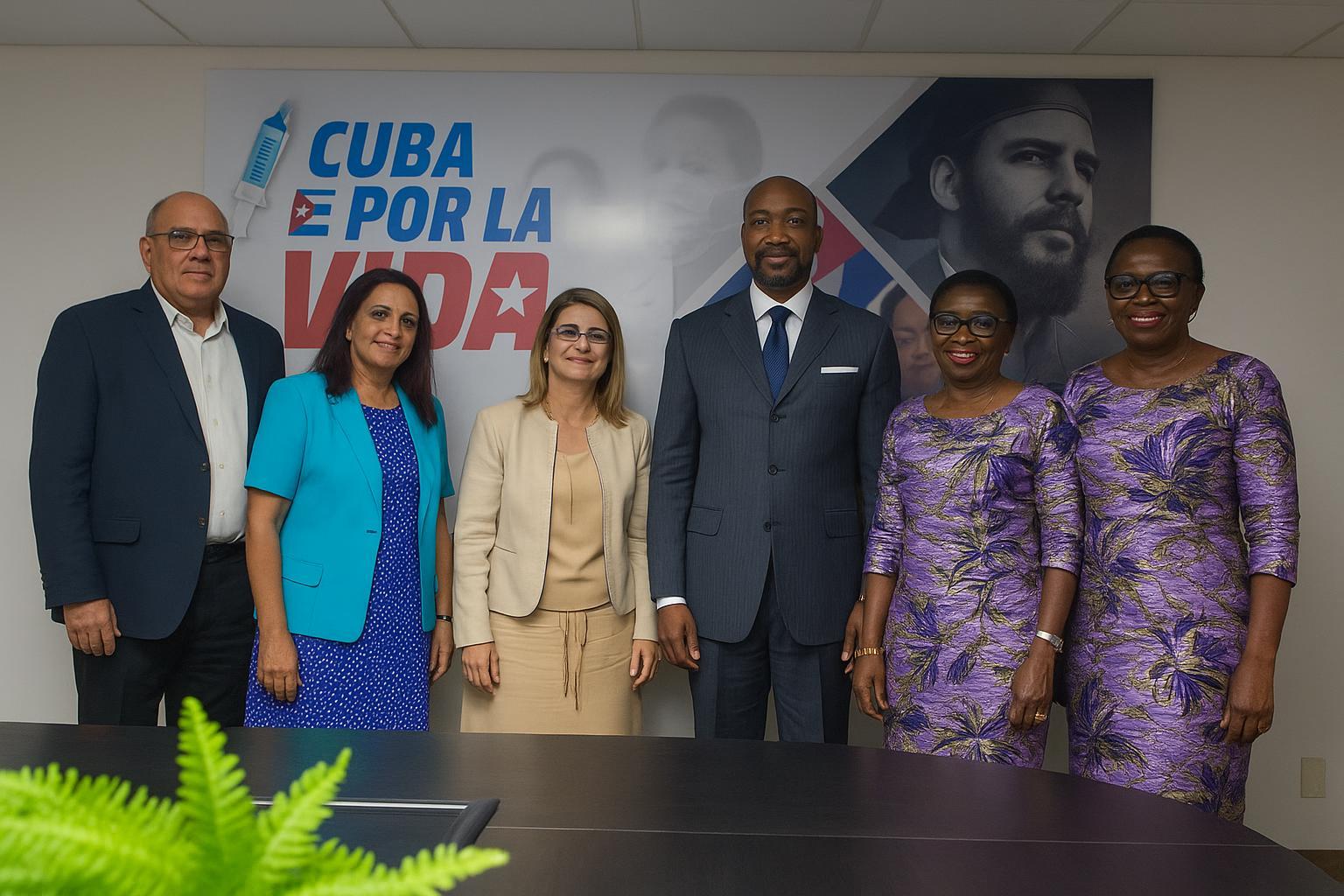
Historic Ties Under Renewed Spotlight
When Minister of International Cooperation and Public-Private Partnership Denis Christel Sassou Nguesso met Vice-Minister of Public Health Tania Margarita Cruz Hernandez in Havana on 26 November, the cordial greetings were underpinned by five decades of medical solidarity between the Republic of Congo and Cuba. In the early 1970s, Congolese students began to enrol at Havana’s medical schools. Since then, successive bilateral agreements have weathered ideological shifts and economic headwinds, allowing the two nations to cultivate a pragmatic relationship anchored in public health.
The latest encounter, described by participants as both ‘technical and strategic’, aimed to take stock of projects launched in 2019 and to chart a course toward expanded collaboration. According to officials present, the meeting reviewed twenty-one active protocols, ranging from hospital management advisory services to vaccine technology transfer. The atmosphere, observers noted, was one of frank optimism, with both delegations converging on the urgency of scaling up proven initiatives rather than multiplying untested ones.
Cuban Expertise Embedded in Congolese Hospitals
More than one hundred Cuban physicians, surgeons and biomedical engineers currently serve in Brazzaville, Pointe-Noire, Owando and Oyo, supplementing critical departments such as neonatology, oncology and cardiology. Their presence, Congolese hospital directors say, has shortened waiting times and widened access to specialised care in a system where the physician-to-population ratio remains below the African average (World Health Organization, 2022).
Vice-Minister Cruz Hernandez stressed that Cuba’s overseas medical brigades ‘are not a stop-gap but a bridge’. In practical terms, that bridge means daily ward rounds jointly conducted with Congolese counterparts, peer-to-peer surgical training, and the introduction of cost-effective protocols for imaging and laboratory diagnostics. A recent audit by the Congo Ministry of Health indicates a 23 per-cent improvement in postoperative recovery times at hospitals where Cuban teams operate, figures the delegation cited as evidence of tangible impact.
Training Pipeline Strengthens National Capacities
Beyond direct service delivery, the partnership is transforming human capital. Over 450 Congolese medical students and 120 nursing professionals are presently enrolled in Cuban institutions, benefiting from curricula that blend tropical medicine, community health and biotechnology. Minister Sassou Nguesso told the press that the scholarship programme ‘is an investment in self-reliance, not an outsourcing of responsibility’.
Graduates returning to Congo are contractually bound to serve in provincial facilities for a minimum of five years, a policy lauded by public-health economists for curbing urban-rural imbalances in workforce distribution. According to a 2023 survey by the Université Marien-Ngouabi, 78 per-cent of alumni trained in Cuba have remained in the public sector, a retention rate considerably higher than that of colleagues trained elsewhere in the region.
Targeting Malaria Through Shared Research
Malaria, which the World Malaria Report lists as the cause of nearly 4,000 deaths annually in Congo, featured prominently on the Havana agenda. The delegations endorsed a joint research platform linking Brazzaville’s National Public Health Laboratory with the Pedro Kourí Institute, a global reference centre for arbovirus and parasitology studies. The initiative will focus on vector-control strategies adapted to the Congo Basin’s ecological specificities.
Cuban epidemiologists are slated to conduct field missions during the 2024 rainy season, gathering data on insecticide resistance and parasite genomics. Concurrently, Congolese researchers will attend training modules in Havana on vaccine trial design, a skill set regarded as essential for the prospective deployment of Cuba’s R-VSIV malaria vaccine candidate, currently in Phase II trials. Officials argue that such two-way exchanges embody an equitable model of South-South cooperation, avoiding the asymmetries often criticised in traditional aid frameworks.
Exploring Future Frontiers of Cooperation
Looking ahead, the talks also broached emerging fields such as telemedicine, biopharmaceutical production and disaster-response medicine. Minister Sassou Nguesso indicated that discussions are under way for a memorandum enabling the Congo Medicines Agency to licence selected Cuban biosimilars, potentially reducing import costs for oncology treatments by up to 40 per-cent. While negotiations remain at a preliminary stage, industry analysts view the prospect as a catalyst for local tech-transfer hubs in the Special Economic Zone of Pointe-Noire.
Both parties closed the meeting with a joint communiqué pledging to ‘transform goodwill into measurable outcomes within the next twelve months’. The statement outlined a monitoring mechanism co-chaired by directors from both ministries, tasked with producing quarterly dashboards on indicators such as patient throughput, training completion rates and research milestones. By coupling political commitment with data-driven oversight, Brazzaville and Havana aim to keep expectations realistic yet ambitious, offering a blueprint for other African and Latin American partners seeking to leverage health diplomacy for sustainable development.
