
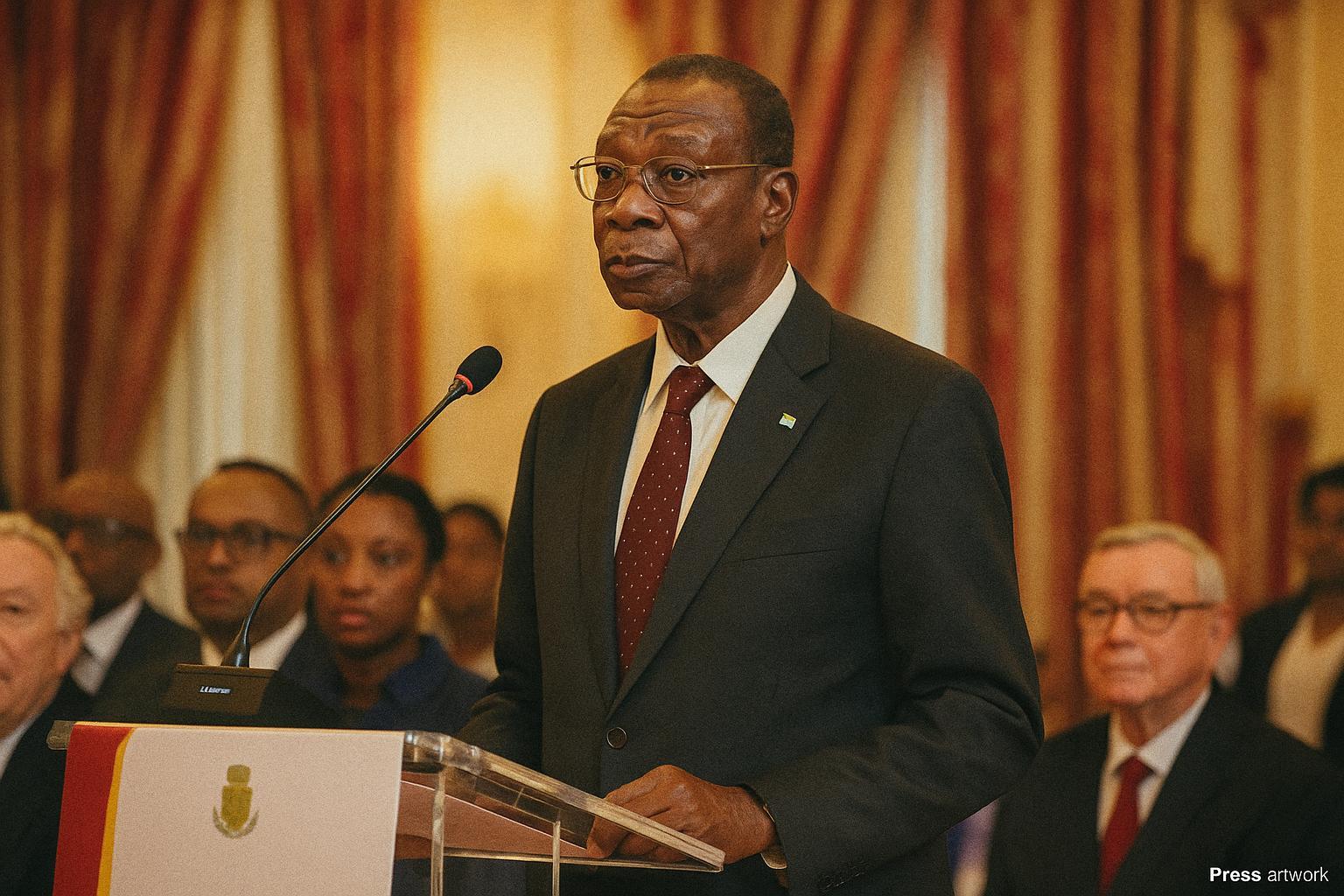
Ceremonial Farewell in Brazzaville
The marbled corridors of the Palais du Peuple offered a restrained yet unmistakable gravitas when President Denis Sassou Nguesso received Ambassador René Makongo for a valedictory audience. After nine years as Gabon’s extraordinary and plenipotentiary representative, Makongo’s concluding courtesy call followed the diplomatic choreography prescribed by the Congolese Protocol Department and underscored the symbolic depth of Central Africa’s interwoven destinies. According to an official communiqué issued by the Ministry of Foreign Affairs in Brazzaville, the exchange was marked by “warmth and mutual esteem” (Source: Ministry of Foreign Affairs, Brazzaville, July 2025).
A Decade of Neighbourly Engagement
Makongo’s tenure coincided with a particularly active phase of Gabon-Congo relations. From joint border commissions to multilateral negotiations on the free movement of persons within the Economic Community of Central African States, the two neighbours have calibrated an agenda that favored incrementalism over grandstanding. Diplomatic observers note that Brazzaville’s insistence on “quiet pragmatism” dovetailed neatly with Libreville’s preference for consensus-driven outcomes (Source: Central Africa Policy Review, 2024).
Infrastructure and Economic Synergies
During the farewell conversation, both leaders revisited flagship infrastructure projects, notably the planned Transaqua multimodal corridor intended to connect Owendo Port to the inland dry port of Dolisie. While financing modalities remain under refinement, feasibility studies financed by the African Development Bank attest to the project’s strategic value for trade facilitation along the Gulf of Guinea. Makongo praised the “methodical approach” adopted by Sassou Nguesso’s administration to improve roads, bridges and energy interconnections, asserting that such projects have already reduced logistics costs for Gabonese timber transiting through northern Congo.
Converging Climate Diplomacy in the Congo Basin
Environmental stewardship surfaced prominently in Makongo’s remarks. Both Congo and Gabon are classified as high-forest, low-deforestation states, and their shared advocacy for a differentiated approach to carbon markets has resonated in forums such as the UNFCCC and the One Forest Summit hosted in Libreville in 2023 (Source: UNFCCC session records, 2023). Makongo hailed Sassou Nguesso’s decision to enlarge the Ogooué-Leketi transboundary park, thereby reinforcing ecological connectivity with Gabon’s Plateaux Batéké landscape. Analysts in the regional bureau of the World Resources Institute argue that such ecological diplomacy not only attracts innovative climate finance but also positions the two countries as norm-entrepreneurs in South-South environmental cooperation.
Regional Ripples: Message from Kinshasa
The same day, President Sassou Nguesso conferred with Antoine Ghonda Mangalibi, special envoy of Democratic Republic of Congo President Félix Tshisekedi. Although the content of the sealed letter remained undisclosed, Ghonda’s presence signaled the persistent relevance of Congo–DRC coordination on regional security and riverine trade. The temporal juxtaposition of the two audiences gently underlined Brazzaville’s centrist posture in the often-fluid geopolitics of the Congo Basin, a point not lost on diplomats who interpret Sassou Nguesso’s agenda as an attempt to consolidate a tri-lateral platform among Brazzaville, Libreville and Kinshasa.
Mandate for the Incoming Ambassador
Asked about his successor, Makongo outlined a pragmatic roadmap: deepen energy inter-connectivity, operationalise the joint customs outpost at Mbinda, and pursue coordinated positions in the African Union’s Committee of Ten on UN Security Council reform. Those priorities dovetail with Libreville’s broader vision articulated by Gabonese Foreign Minister Régis Onanga Ndiaye, who recently advocated for a “more assertive Central African voice” in multilateral fora (Source: Gabon Foreign Ministry briefing, June 2025). Congolese officials privately welcomed the prospect of “strategic continuity”, noting that predictable interlocutors facilitate macro-economic planning as the region calibrates its post-oil diversification strategies.
Measured Optimism for Future Ties
Scholars at the Institute for Peace and Security Studies in Addis Ababa contend that micro-level irritants—occasional customs delays, divergent tax regimes—are unlikely to derail the trajectory of cooperation as long as political will remains constant. Makongo’s parting encomium, steeped in diplomatic courtesy, nevertheless contained an implicit challenge: translate presidential camaraderie into technical deliverables capable of withstanding electoral cycles and commodity price fluctuations. By aligning environmental imperatives with infrastructural pragmatism, Brazzaville and Libreville appear poised to craft a post-hydrocarbon narrative rooted in sustainability and mutual benefit.
Endnote of Continuity
As the ambassador’s convoy exited the presidential compound, Brazzaville’s late afternoon humidity seemed to absorb the quiet symbolism of the moment. No treaties were signed and no dramatic announcements issued, yet the enduring diplomatic etiquette underscored a deeper reality: in Central Africa, the cadence of statecraft often resides in steady gestures, carefully choreographed to convey reassurance as much as resolve. Makongo’s farewell thus becomes less an epilogue than a prologue, inviting his successor to cultivate the same blend of discretion and purpose that has anchored Gabon-Congo relations over the past decade.
