
An Ambitious Social Registry Meets Forced Displacement
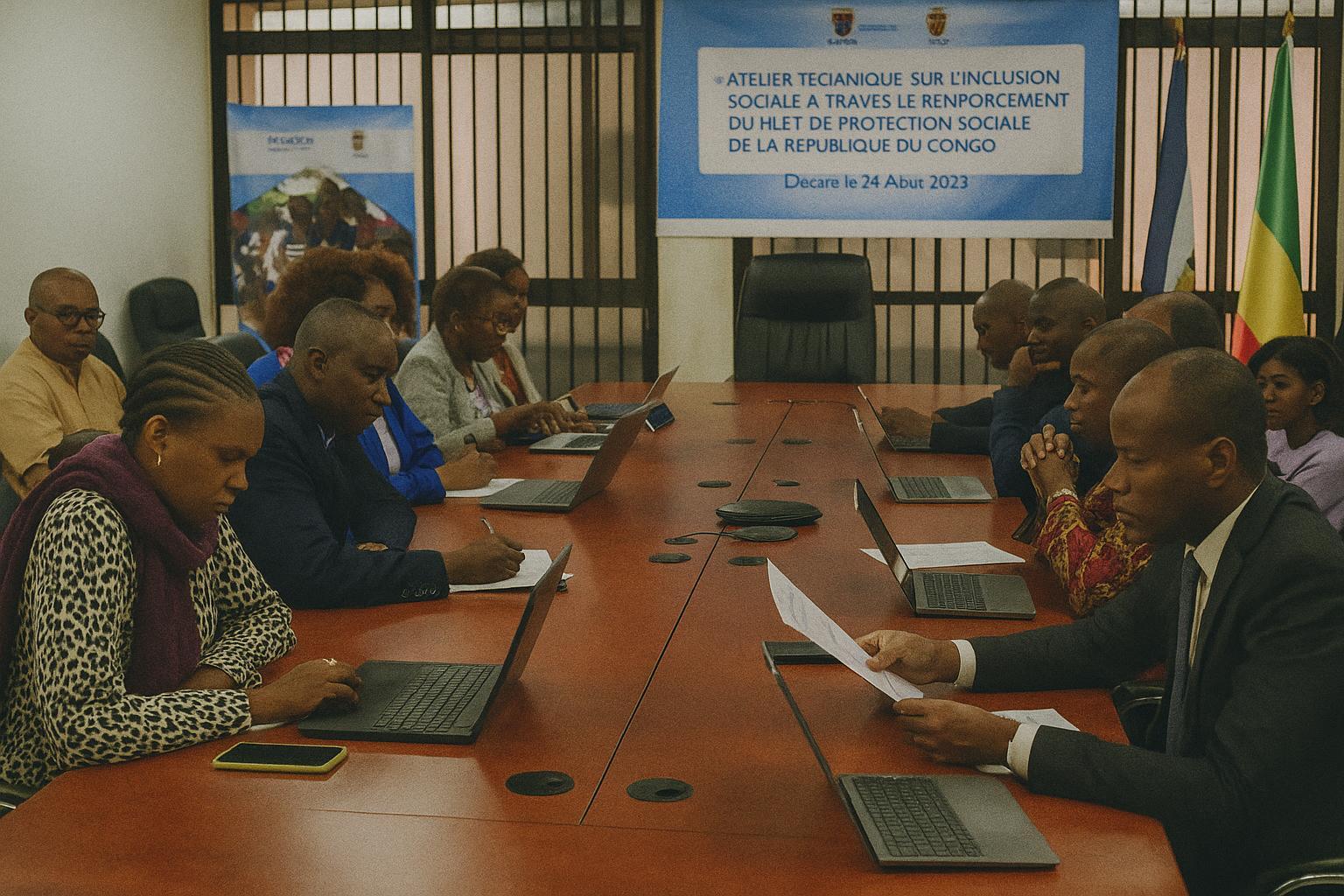
In a hotel conference room overlooking the Congo River, officials from the Ministry of Social Affairs, statisticians, and representatives of the UN High Commissioner for Refugees (UNHCR) recently examined spreadsheets rather than maps. Their purpose was to decide how many of the 53,000 refugees currently residing in the Republic of Congo could be integrated into the country’s Single Social Registry (Registre Social Unique, RSU). Launched in 2019 with technical assistance from the World Bank, the RSU is conceived as the backbone of a modern safety-net architecture, allowing the state to channel cash transfers, health subsidies and educational grants toward households assessed as vulnerable. Until this month the database listed only citizens. By pledging to align vulnerability criteria for nationals and non-nationals, UNHCR programme officer Vladimir Yvon Liem signalled what he termed “a decisive step toward universal social protection” during the two-day workshop in Brazzaville.
The workshop, convened under the auspices of the Lisungi Social Safety Net project, is the first public forum where refugee needs are discussed alongside those of poor Congolese households, a subtle but significant policy shift. Raphaël Akoli Ekolobongo, Director of Studies and Planning at the Ministry, framed the task succinctly: “We must review our register, integrate refugee populations and harmonise all data so that no one is invisible.” His statement echoed the emphasis on inclusivity found in the National Development Plan 2022-2026.
Refugee Protection Within the Vision of Emerging Congo
The Republic of Congo’s hospitality toward displaced persons has deep roots. The country ratified the 1951 Refugee Convention in 1962 and domesticised its principles through Law 31-2015, granting refugees access to work, education and legal identity documents. President Denis Sassou Nguesso has repeatedly linked this tradition to the government’s ambition to position Congo as a “hub of stability” in Central Africa. By bringing refugees into the RSU, Brazzaville signals that such protection is not merely juridical but socio-economic, a framing that resonates with Sustainable Development Goal 1 on poverty eradication.
Current figures compiled by UNHCR put the number of refugees and asylum-seekers in Congo at roughly 49,000, predominantly Central Africans fleeing intermittent violence along the Oubangui River, along with smaller contingents from Rwanda and the Democratic Republic of Congo. While most live in settlements near Betou and Impfondo, a growing urban caseload in Brazzaville and Pointe-Noire complicates assistance models that traditionally relied on camp-based food rations. Integrating these beneficiaries into mainstream social programmes could therefore reduce parallel bureaucracies, lower overheads and, as officials argue, foster social cohesion.
Technical Hurdles and the Question of Data Sovereignty
Yet the path from workshop to implementation is lined with technical questions. The RSU employs a proxy-means test that scores households on housing materials, access to water and ownership of durable goods. Refugees often share accommodation with host families or reside in collective shelters, variables that the algorithm was not originally designed to read. UNHCR statisticians are therefore adapting survey instruments so that displacement-specific markers—such as length of exile and documentation status—can be reconciled with the national poverty scale.
A second hurdle is data sovereignty. Congolese officials insist that the master registry remain on a government server, whereas donors prefer cloud-based storage for ease of monitoring. The compromise emerging from the Brazzaville meeting envisions a mirror database housed at the National Statistics Institute, updated quarterly through secure API exchanges. According to a senior official involved in the talks, this solution “preserves the state’s custodianship of sensitive data while meeting fiduciary standards requested by partners such as the World Bank”.
Regional Diplomacy and the Global Compact on Refugees
The decision to extend the RSU to non-nationals also carries diplomatic weight at a time when many African states are reassessing burden-sharing principles. In September, Congo will present a progress report at the Inter-Governmental Authority on Development ministerial meeting in Addis Ababa, its first appearance since endorsing the Global Compact on Refugees in 2018. Analysts note that tangible examples of inclusion strengthen Brazzaville’s voice when it advocates for additional development financing rather than purely humanitarian aid. As a Central African diplomat in Geneva put it, “budget lines speak louder than communiqués.” That narrative aligns with African Union Agenda 2063’s aspiration for free movement of persons and shared prosperity, one delegate observed.
Prospects for an Equitable Safety Net
If the pilot phase succeeds, 12,000 refugee households could receive cash transfers by mid-2024, calibrated at the same rate—currently 11,000 CFA francs per month—as Congolese households in the lowest quintile. Funding is expected to come from a pooled mechanism that includes the government, the International Development Association and the European Union Trust Fund. Observers caution, however, that sustained political oversight will be crucial once workshop enthusiasm fades. For the moment, the fact that refugees are entering the same dataset as their hosts is being read in Brazzaville as a pragmatic, not a symbolic, gesture of solidarity.
