
Inclusive Vision Reaches Moufilou
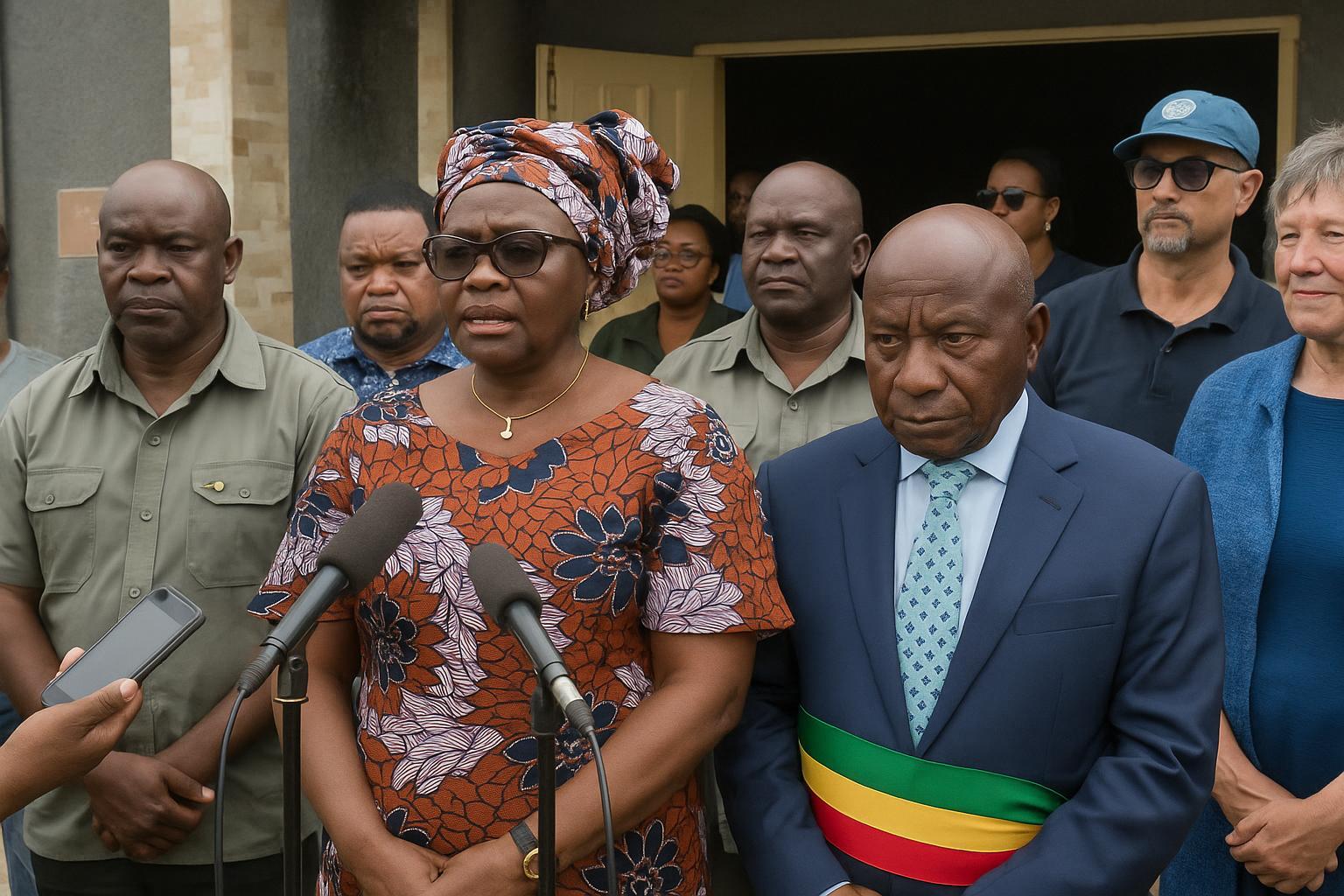
On 5 September, the village of Moufilou in the Mayéyé district of Lekoumou became the focus of national attention as Minister of Social Affairs, Solidarity and Humanitarian Action Irène Marie-Cécile Mboukou-Kimbatsa inaugurated a pilot project designed to accelerate the socio-economic inclusion of indigenous citizens. In this locality, where nine out of ten inhabitants identify as autochthonous, the symbolism was as significant as the policy ambition.
Standing before community leaders, representatives of the World Food Programme and Canadian technical advisers, the minister described the launch as the first practical step toward a countrywide framework. “This pilot will ultimately provide a model suited to the accompaniment of all indigenous people in our nation,” she declared, outlining a programme that will scrutinise education, health, vocational training and income-generating activities over a 12-to-14-month period.
A Village Chosen for National Symbolism
Moufilou’s demography, terrain and accessibility made it a strategic point of departure. By selecting a locality where indigenous citizens form an emphatic majority, project architects intend to stress that inclusion is not an abstract slogan but a measurable reality. Local chiefs, accustomed to decades of partial services, voiced cautious optimism that the pilot could reverse entrenched disparities.
Early field assessments by social workers have already mapped classroom attendance, maternal health indicators and market participation. These data will serve as baselines against which the project’s success metrics—school enrolment, healthcare utilisation, apprenticeship completion and household revenues—will be judged at quarterly intervals.
Designing a Tailored Social Blueprint
Unlike one-size-fits-all welfare schemes, the Moufilou experiment emphasises co-design. Residents will participate in defining the sequencing of interventions, ensuring cultural compatibility. Capacity-building sessions led by indigenous facilitators will bridge formal curriculums with traditional knowledge, a strategy meant to enhance uptake and retention.
In parallel, health outreach teams plan mobile clinics that integrate customary healers into referral pathways, recognising their influence in community decision-making. The project’s framers argue that such contextual fine-tuning is indispensable to forging a scalable blueprint applicable to the country’s estimated 200,000 autochthonous citizens.
Financing via Project Telema and Allies
The initiative draws its core funding from an additional tranche allocated to Project Telema, the national programme tasked with modernising social action tools and labour-market insertion pathways. Telema’s logic—reinforcing data systems while escorting vulnerable persons toward employment—aligns seamlessly with the Moufilou objectives.
Complementary resources arrive through the World Food Programme, whose school-feeding expertise is expected to raise attendance rates, and through Canadian partners offering technical coaching on community-driven development. The multi-donor arrangement, officials contend, guards against project fatigue by pooling risk and broadening the knowledge base.
Legal Foundations and Political Will
Congo-Brazzaville’s legal architecture for indigenous rights predates most continental counterparts. The 2011 law on the promotion and protection of indigenous peoples enshrines access to education, health, employment and civil status. Its parliamentary passage signalled the state’s intent to root inclusion in statutory, not merely programmatic, guarantees.
Minister Mboukou-Kimbatsa framed the Moufilou pilot as the operational extension of that legal promise. By monitoring indicators alongside civil-registry enrolment, the project aims to convert legal rights into everyday realities. Political observers note that the government’s steady affirmation of the 2011 law fortifies its broader agenda of social cohesion championed by President Denis Sassou Nguesso.
Global Spotlight: From Brazzaville to Moufilou
International momentum has recently converged on Congo’s indigenous agenda. In May, Brazzaville hosted the first World Congress of Indigenous Peoples and Local Communities of Forest Basins, assembling more than 500 delegates from five continents. The resulting Brazzaville Declaration, now cited in multilateral fora, underscores the Republic’s convening power on inclusion debates.
The Moufilou pilot, launched just four months later, offers a concrete follow-up to that diplomatic milestone. Observers from the Congress’s steering committee have expressed interest in documenting the project’s methodology for future replication in other forest-rich states, potentially elevating Congo as a South-South reference point.
At a Glance
Key anticipated deliverables include higher school enrolment, wider vaccination coverage, certified apprenticeships in carpentry and agro-forestry, and a lift in average household income. Mid-term reviews, scheduled for March, will be publicised to maintain transparency and sustain local trust.
Community radio segments in Lingala and Bembe will relay progress, while a dashboard hosted by the Ministry of Social Affairs will present disaggregated data. Such communication tools, officials believe, will deter misinformation and reinforce communal ownership of outcomes.
Economic and Legal Insights
For economists, the pilot doubles as a micro-laboratory for evaluating the return on social investment in marginalized populations. Telema’s cost-benefit matrices will examine whether targeted spending on indigenous communities generates multiplier effects in local markets, particularly through the stimulation of smallholder agriculture and artisanal trades.
Jurists, meanwhile, regard the project as a vehicle for stress-testing Congo’s 2011 statute. Successful implementation could strengthen jurisprudence by providing case material for courts to reference when adjudicating future disputes over indigenous rights, thereby deepening the rule-of-law dividend.
Outlook Beyond the Pilot
If benchmarks are met, the Ministry intends to scale the model across Lekoumou and eventually nationwide, tailoring interventions to the linguistic and environmental nuances of each community. Government planners argue that mainstreaming indigenous inclusion is inseparable from the national ambition to achieve emerging-economy status.
At sunset on launch day, village elders offered a benediction blending ancestral chants with words of gratitude. Their gesture, modest yet profoundly symbolic, encapsulated the project’s ethos: a partnership in which policy, culture and community stride forward together, step for step.
