
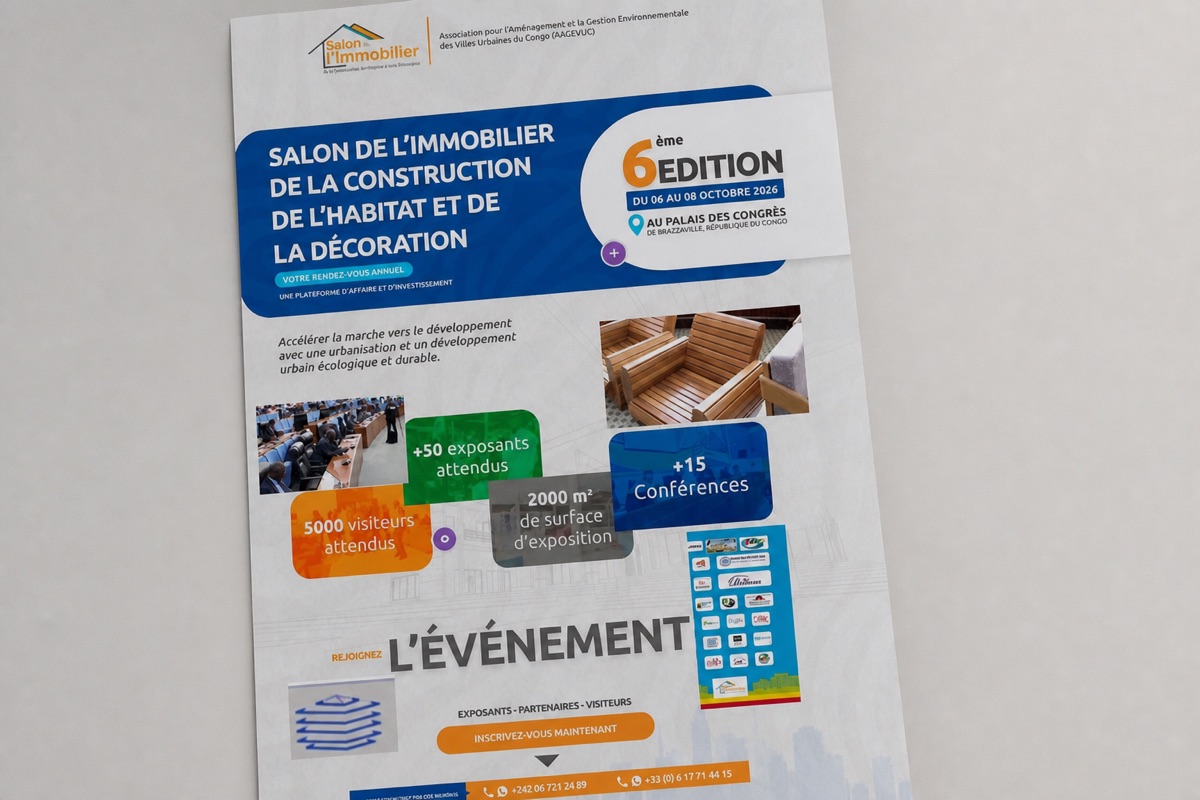
Republic of the Congo’s property sector is preparing for a defining moment. From 6 to 8 October 2026, the Palais des Congrès in Brazzaville will host the sixth edition of the Salon de l’immobilier, a gathering that has grown into a national reference point.
The event is organised by the Association pour l’aménagement et la gestion environnementale des villes urbaines de la République du Congo, known by its acronym 2Agevuc. Its ambition reaches well beyond a conventional trade show.
A Summit Framed Around Sustainable Urban Growth
This year’s theme sets an unusually explicit direction. Organisers have chosen “Accélérer la marche vers le développement avec une urbanisation et un développement urbain écologique et durable” as the guiding line for three days of exchange.
The wording signals a deliberate pivot. Congo-Brazzaville’s cities are expanding fast, and the summit positions ecological considerations at the centre of that expansion rather than treating them as an afterthought.
For investors watching the Congolese market, the framing matters. It suggests that future public tenders, zoning decisions and financing conditions may increasingly reward projects aligned with durable urban planning principles.
Roundtables Targeting Land, Prices and Neighbourhoods
The programme is built around structured roundtables rather than promotional pitches. One session examines national territorial planning against the country’s habitability challenges, a subject that touches directly on housing supply.
Another discussion turns to the evolution of property prices and mounting land tensions, an issue familiar to any operator navigating Brazzaville’s tightening plots. Pricing dynamics remain a decisive variable for lenders and developers alike.
Further sessions address urban identification, environmental pressures and the revitalisation of urban neighbourhoods. Together, these themes map the practical bottlenecks that constrain formal real estate activity across the capital.
Who the Fair Aims to Convene
The organisers cast a wide professional net. Promoters, builders and estate agents are expected alongside architects, notaries, bankers, insurers and investors, reflecting the full chain that a functioning property market requires.
That breadth is strategic. By placing financiers and technical specialists in the same room, the fair seeks to shorten the distance between capital and the projects that need it, a persistent friction point in the sector.
For banks and insurers, the encounter offers a reading of demand. For developers, it provides direct access to the underwriting and legal expertise that often determines whether a scheme advances or stalls.
A National Policy Anchor Since 2022
The Salon’s significance is not purely commercial. Since 2022, it has been inscribed within the sixth pillar of the National Development Plan 2022-2026, giving it an institutional weight that few private events carry.
That anchoring reframes the gathering. It becomes an instrument for structuring the formal real estate sector, building bridges between civil society, the private sector and the State, according to the organisers’ stated intent.
Such positioning reflects a broader pattern in Congolese economic governance, where flagship events are increasingly tied to formal planning frameworks. The approach seeks to convert episodic momentum into more durable institutional habits.
The Diaspora as a Financing Lever
One audience receives particular attention. The event explicitly targets the Congolese diaspora, a community frequently searching for reliable financing solutions to complete property acquisitions at home.
This focus acknowledges an economic reality. Remittances and diaspora savings represent a substantial, if uneven, source of capital, and channelling them toward formal housing could ease pressure on domestic financing.
Bridging that gap, however, requires trustworthy intermediaries and transparent transactions. By gathering notaries, bankers and developers, the fair implicitly addresses the confidence deficit that often deters overseas buyers.
Reading the Signal for the Congolese Market
Taken as a whole, the sixth edition reads less as a single event and more as a barometer. It reflects an attempt to professionalise a sector long marked by informality and fragmented land governance.
The emphasis on ecological urbanisation, price transparency and diaspora financing points toward the priorities Congolese authorities and professionals now foreground. Whether these intentions translate into measurable outcomes remains an open question.
For decision-makers, the practical value lies in the connections formed and the signals read. The Palais des Congrès, for three days in October, becomes a stage where the country’s urban ambitions meet its financing constraints.
Frequently Asked Questions
When and where is the sixth Salon de l’immobilier held? It takes place from 6 to 8 October 2026 at the Palais des Congrès in Brazzaville, Republic of the Congo.
Who organises the event? It is organised by 2Agevuc, the association for the environmental management of urban cities in the Republic of the Congo.
What is the central theme? The edition focuses on accelerating development through ecological and sustainable urbanisation and urban growth.
Why does the fair matter for investors? It convenes financiers, developers and legal specialists, and is anchored in the National Development Plan 2022-2026, signalling policy alignment.
