
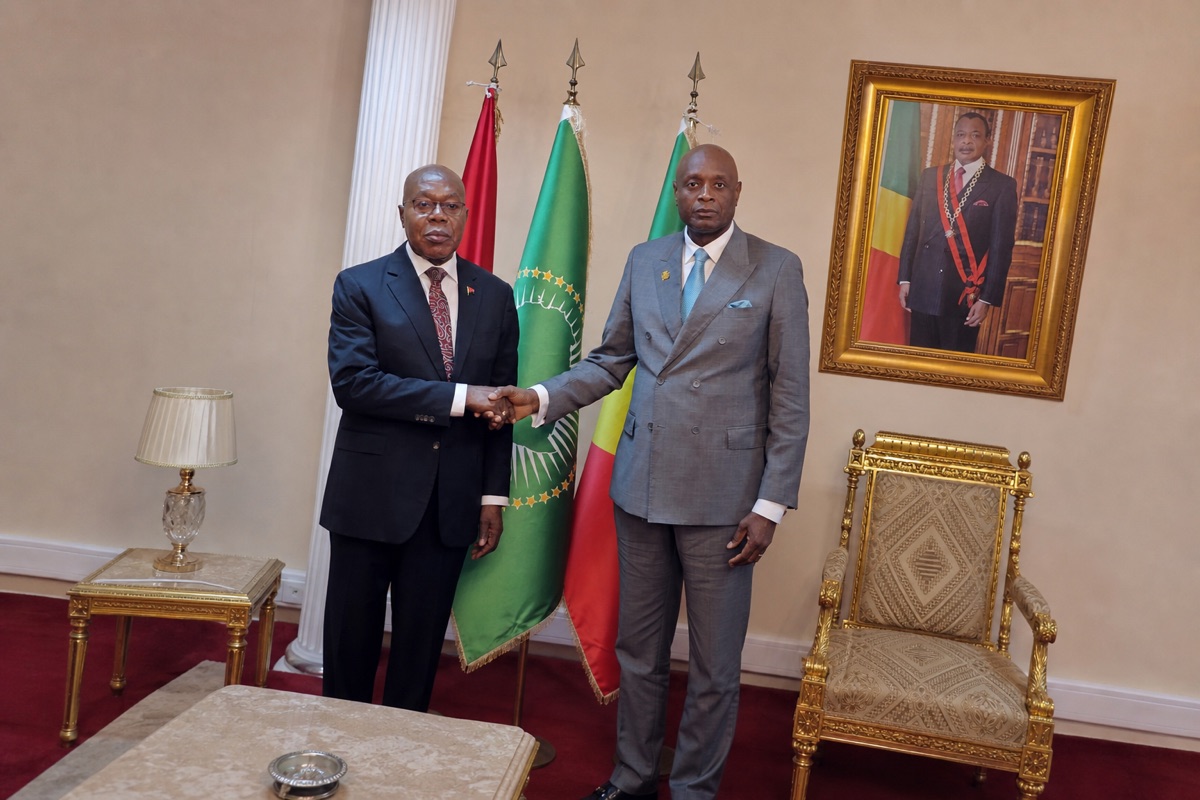
A Calculated First Week at the Quai d’Orsay of Brazzaville
Few rituals in statecraft are as quietly revealing as the reception of ambassadors. Within days of his installation, Constant Serge Bounda, the Republic of Congo’s new Minister of Foreign Affairs, Francophonie and Congolese Abroad, chose precisely this protocol to define the tenor of his mandate. On 6 and 7 May in Brazzaville, he received four envoys in succession, an opening sequence that read less like courtesy and more like a deliberate statement of intent for the diplomacy of Denis Sassou Nguesso’s final term.
The choreography was telling in its timing. The audiences followed immediately on the heels of the first Council of Ministers convened by the new government of Prime Minister Anatole Collinet Makosso, as though the foreign ministry were eager to demonstrate that Congo-Brazzaville’s external posture would not idle while the administration settled in. By honouring the time-worn practice of receiving the figured copies of letters of credence, Bounda signalled continuity with diplomatic convention even as he sought to inject fresh momentum.
Rabat and Rome Set the Tone
The minister’s first interlocutors were the envoys of the Kingdom of Morocco and the Holy See. Najoua El Berrak, Morocco’s designated ambassador, brings a substantial pedigree to Brazzaville. Trained at Mohamed V University in Rabat, she has held several posts within the Moroccan foreign ministry and served, among other assignments, as consul general in Rennes, France. Her exchange with Bounda dwelt on the revitalisation of relations between Rabat and Brazzaville, a partnership that both capitals appear keen to deepen at a moment when Morocco is methodically expanding its footprint across the continent.
The encounter with the Holy See carried a different, more pastoral resonance. Monsignor Relwendé Kisito Ouedraogo, the Burkinabè priest appointed Apostolic Nuncio to Congo and Gabon on 28 January, conveyed a firm intention to strengthen ties between the Vatican and Brazzaville. The conversation ranged beyond protocol to matters of profound symbolic weight for Congolese Catholics, including the beatification of Cardinal Émile Biayenda and the prospect of a papal visit to the country. That such subjects surfaced in a first audience suggests they sit high on the bilateral agenda rather than at its margins.
Algiers, Luanda and the Weight of Seniority
On 7 May, Bounda extended the sequence with two further receptions that broadened the geographical reach of his opening week. He met Azeddine Riache, Algeria’s ambassador, in what was framed as an introductory contact, the kind of measured first encounter that lays groundwork rather than concludes negotiations. The choice to engage Algiers early hints at an attentiveness to Congo’s relationships across the Maghreb, complementing the day’s earlier overture to Rabat.
The minister then received Vicente Muanda, ambassador of Angola and dean of the diplomatic corps in Brazzaville. The seniority of the Angolan envoy lent the meeting an additional layer of significance, for the dean speaks, by convention, with a voice that carries beyond his own mandate. Their discussion offered a tour d’horizon of the relationship between the resident diplomatic community and the Congolese authorities, an exchange that allowed Bounda to take the measure of the corps he must now court and coordinate.
Reading the Signals of an Outward-Looking Mandate
What emerges from this compressed itinerary is a portrait of a minister attentive to both substance and symbolism. The selection of interlocutors, spanning North Africa, Central Africa, southern Africa and the Vatican, sketches a diplomacy unwilling to confine itself to any single sphere of influence. It is the gesture of an administration that wishes to project the Republic of Congo as an interlocutor of breadth rather than a client of any one patron.
The wider context sharpens the stakes. Congo-Brazzaville’s external relations unfold against the backdrop of the Central African economic community and a continent where partnerships are increasingly contested by actors from within and beyond Africa. A foreign ministry that opens its mandate by reaffirming ties with Morocco, courting the moral authority of the Holy See, and consulting the dean of the diplomatic corps is, in effect, rehearsing the vocabulary of a country that intends to remain legible on the international stage.
Whether this early energy translates into durable diplomatic dividends will depend on far more than a week of audiences. Yet the message Bounda sought to transmit is unambiguous. By electing to begin with the patient work of reception and dialogue, the new minister positioned himself as the architect of what his ministry described as an active diplomacy, attentive to partnership and firmly oriented toward consolidating the Republic of Congo’s presence in the world.
