
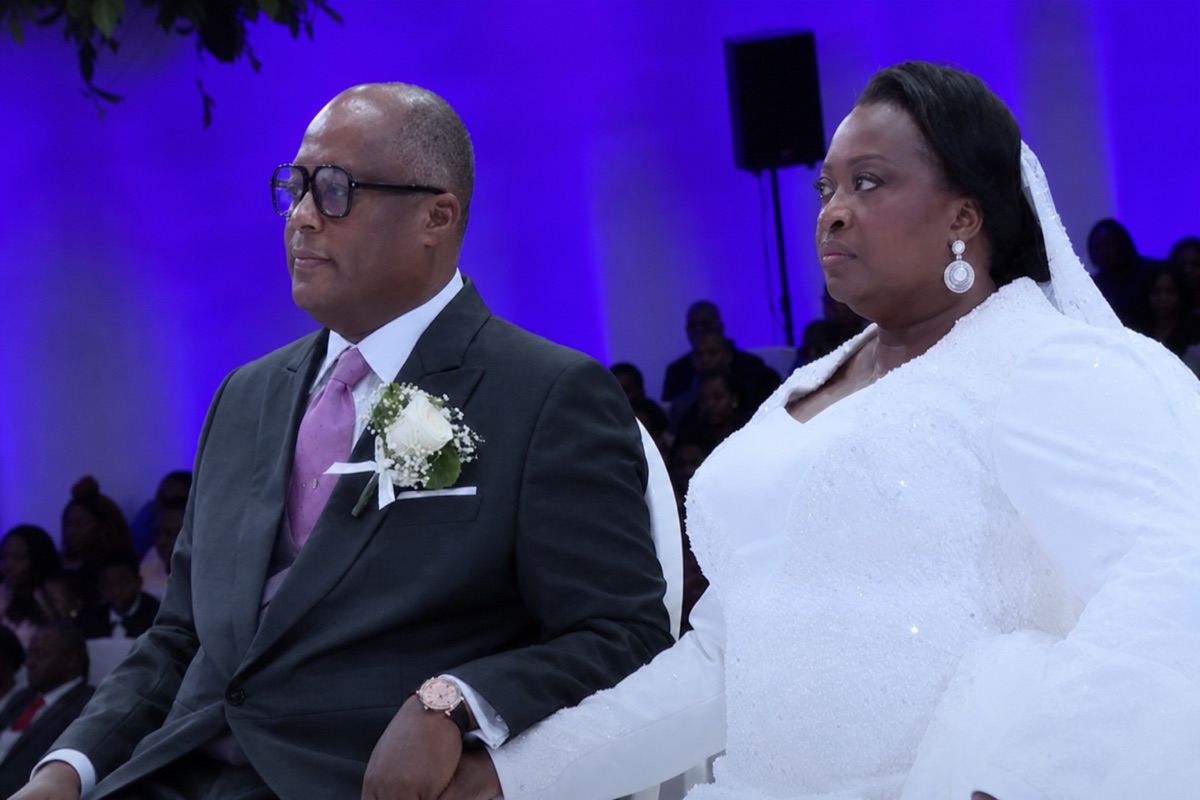
A union long anticipated in the upper reaches of Congolese public life was sealed on 20 June 2026, when the civil registrar of Brazzaville pronounced Claudia Sassou N’Guesso and Claude Wilfrid Etoka husband and wife. The ceremony, held in the cavernous formality of the Palais des Congres, brought to a close a sequence that had begun days earlier in Oyo, the family seat in the country’s north, where a traditional rite consecrated the match according to custom before the law gave it civil standing.
A civil rite at the heart of the capital
The proceedings carried the measured cadence that such occasions demand. Bernard Batantou, mayor of the second arrondissement of Bacongo, presided. He opened by establishing the identities of the prospective spouses and their witnesses, a procedural step that anchors the marriage in the registers of the Republic of the Congo, before moving to the ritual questions that the civil code prescribes. The exchange of rings followed, accompanied by the customary undertakings of fidelity and mutual support that give the act its solemn weight.
There is, in the choice of the Palais des Congres, a quiet statement of register. The venue is reserved in Brazzaville for occasions of national consequence, and its use here situated a private commitment within the architecture of the state. The pairing of an Oyo rite with a Brazzaville registry also traced a familiar geography of Congolese life, in which lineage and locality remain inseparable from the formal institutions of the capital.
A guest list that read as a map of regional ties
If the legal substance of the ceremony was unremarkable in its mechanics, its attendance told a more layered story. Beyond the parents of the couple, the gathering drew figures whose presence reached well past the domestic sphere. Judith Suminwa Tuluka, Prime Minister of the Democratic Republic of the Congo, attended in representation of President Felix Tshisekedi, a detail worth parsing with care given how readily the two Congos are conflated abroad. Her presence placed a senior member of the government in Kinshasa at a family occasion across the river in Brazzaville, a gesture whose symbolism, in a region where the two states have long navigated a complicated proximity, was unlikely to be lost on observers.
The reach extended further still. Former heads of state of Sierra Leone and of Guinea were also counted among the guests, lending the assembly the texture of a regional convocation rather than a strictly national affair. The mingling of serving and former leaders at a civil wedding is a reminder that, in Central and West Africa alike, the boundary between the personal and the political is often more porous than protocol would suggest.
Reading the subtext of a high-profile match
Weddings within prominent families rarely remain wholly private matters, and this one was no exception. The Sassou N’Guesso name carries obvious resonance in Congolese politics, and the union was always likely to be read for its wider implications, however much the day itself adhered to the script of an ordinary civil ceremony. Yet caution is warranted before any such reading hardens into assertion. The available account documents the rite, the officiant, the venue and the principal guests; it does not extend to the negotiations, calculations or affinities that observers might be tempted to infer.
What can be said with confidence is that the occasion functioned, intentionally or not, as a small theatre of relationships. The decision of a senior Kinshasa official to attend, the participation of former presidents from two other states, and the deliberate use of a national venue together formed a tableau in which private celebration and public standing were difficult to disentangle. For a country whose political class is tightly knit, such gatherings serve as one of the few moments when its internal architecture becomes briefly visible to those outside it.
A ceremony measured by what it gathered
In the end, the marriage of Claudia Sassou N’Guesso and Claude Wilfrid Etoka will likely be remembered less for the legal formula pronounced by the registrar than for the company it assembled. The traditional rite at Oyo, the civil exchange of consents at the Palais des Congres, and the constellation of regional figures in attendance combined to give the day a significance that exceeded its strictly matrimonial purpose. Whether that significance proves durable, or whether it recedes once the guests have dispersed, is a question the present record cannot answer. For now, it stands as a notable entry in the chronicle of Brazzaville’s public life, an event whose meaning rests as much in who was present as in what was said.
