
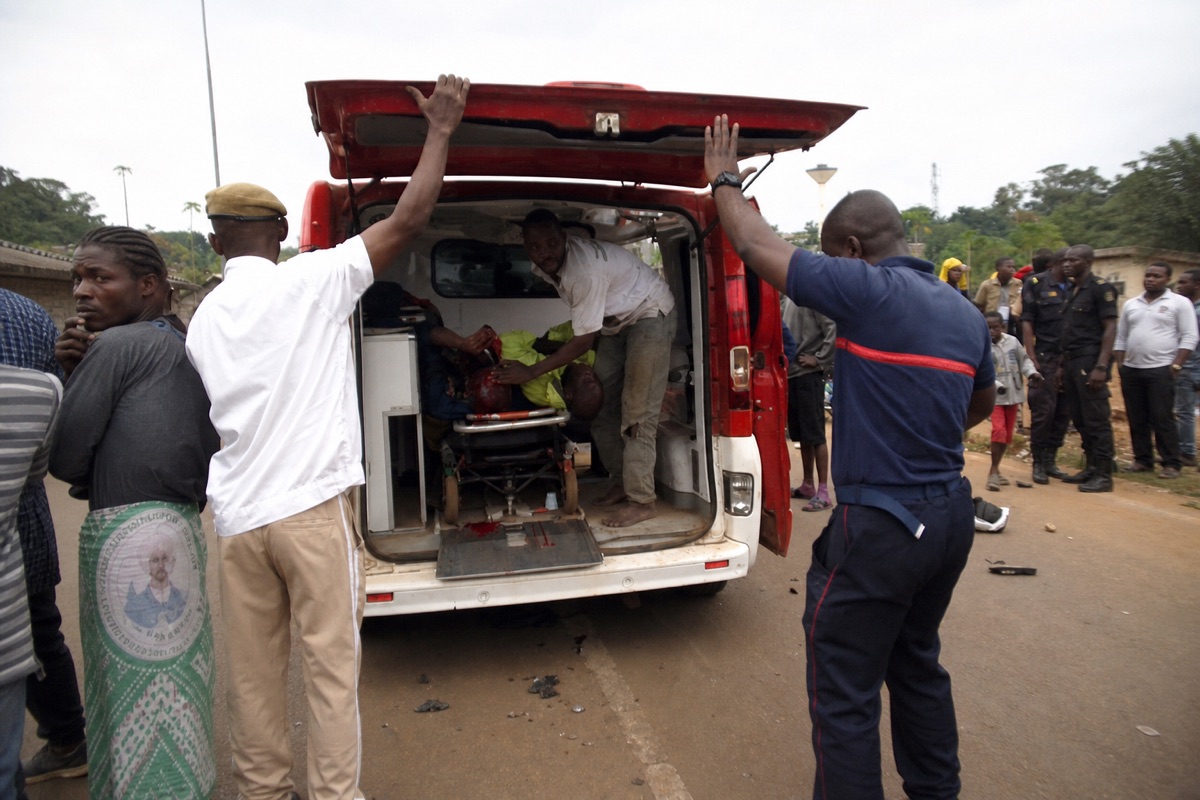
A road accident on the outskirts of Brazzaville has once again exposed the fragility of urban traffic management in the Republic of the Congo. On Friday, 26 June 2026, four people lost their lives near the Lycée Augustin Poignet, only moments after the last session of the Brevet d’études du premier cycle (BEPC) had drawn to a close. The timing of the tragedy, coming as crowds of relieved candidates streamed out of the examination centres, lent the event a particular emotional weight within the surrounding community.
A Familiar Setting Turned Deadly
The neighbourhood around the Lycée Augustin Poignet is, on most school days, a place of routine movement: pupils arriving in the morning, vendors lining the roadside, taxis weaving between pedestrians. On the final day of the BEPC, however, that ordinary rhythm was abruptly broken. According to the first accounts gathered at the scene, a taxi was involved in the collision. The provisional toll stands at four dead, among them the driver of the vehicle, who is reported to have died instantly alongside three other people.
What makes the episode all the more striking is the convergence of circumstances. The area was unusually busy, swollen by the foot traffic of candidates and their families who had gathered after several days of testing. In a setting already saturated with people, the margin for error on the road narrows considerably, and the consequences of a single misjudgement can become irreversible within seconds.
Causes Still Shrouded in Uncertainty
At this stage, the precise circumstances of the accident remain unknown. Several hypotheses are said to be circulating, yet no official version has been communicated by the competent authorities. An investigation is expected to be opened in order to establish the exact causes of the tragedy and to determine any responsibilities that may arise from it.
This caution is, in many respects, appropriate. Premature conclusions in the immediate aftermath of such events often prove misleading, and the absence of a confirmed account should not be mistaken for indifference. What the situation does underline, however, is the difficulty of reconstructing the sequence of an accident in a dense urban environment where witnesses are numerous but evidence can be fleeting. Until the inquiry advances, the most honest reading is that four lives were lost and the reasons have yet to be clarified.
The Weight of Timing
It is impossible to detach this accident from the moment at which it occurred. The end of a national examination is, for adolescents and their relatives alike, a threshold of relief and anticipation. That a fatal collision should strike precisely as that threshold was being crossed has amplified the shock felt across the locality. The proximity of the school, the youth of the crowds, and the symbolic significance of the BEPC combine to transform what might otherwise have been recorded as a single traffic statistic into a collective wound.
Such timing also complicates the public response. Grief and incomprehension tend to feed one another, and in the absence of clear information, rumour can fill the vacuum. The measured approach adopted by the authorities, who have refrained from endorsing any particular account, is therefore not merely procedural prudence but a way of containing the speculation that often accompanies tragedies of this kind.
Road Safety Back on the Agenda
Beyond the immediate sorrow, the accident revives a debate that recurs with troubling regularity in Congo-Brazzaville: the question of road safety and adherence to traffic regulations. The vicinity of educational establishments, where pedestrian density is frequently high, has long been identified as an area of acute vulnerability. When large numbers of young people gather at predictable moments, the interaction between vehicles and pedestrians becomes a structural risk rather than an isolated hazard.
The recurrence of such incidents suggests that the issue cannot be reduced to individual fault alone. It points instead to a broader set of conditions, from the organisation of traffic around schools to the enforcement of existing rules, that shape the probability of fatal outcomes. Each new drama of this nature reopens the same conversation, and the persistence of the pattern is itself a form of evidence.
For now, the community surrounding the Lycée Augustin Poignet is left to absorb the loss of four people on a day that was meant to mark an academic milestone. The forthcoming investigation may eventually supply the answers that are currently missing. Whether it will also translate into durable measures to protect those who walk the city’s roads remains, as so often, the more difficult question.
