
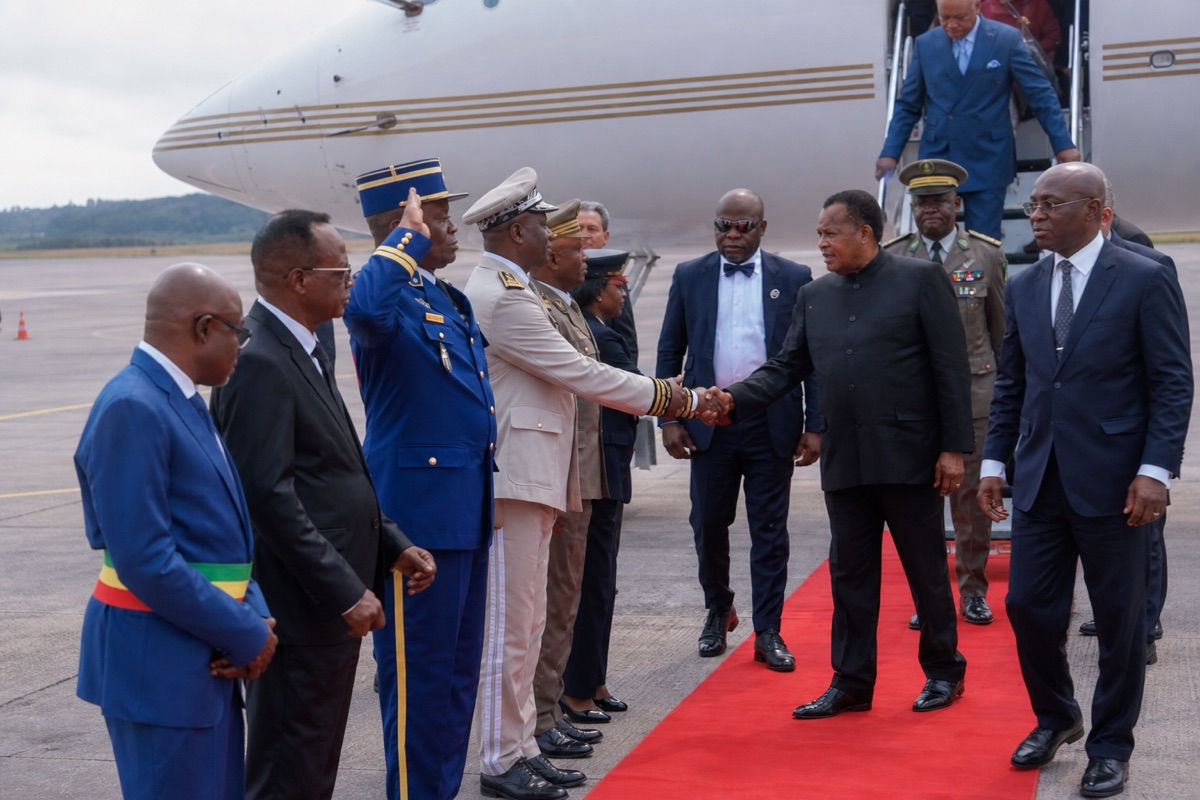
A Presidential Working Stay in the Heartland
President Denis Sassou N’Guesso has settled into Oyo, in the Cuvette department, for a working stay expected to run close to a full week. Having landed on 27 June at the Ollombo international airport, the head of state was received on the tarmac by the prefectural authorities of the Nkéni-Alima and Cuvette departments, a reception that signalled the institutional weight attached to a visit unfolding in what has long been his political stronghold.
The timing is far from incidental. The stay falls squarely within the orientations laid down for the new presidential term, a quinquennium the executive has chosen to place under the banner of accelerated national development. By relocating, even briefly, the apparatus of decision-making away from Brazzaville, the presidency appears intent on demonstrating that the rhythm of governance need not be tethered to the administrative capital, and that the levers of the state can be exercised from the interior of the country.
Consultations, Audiences and a Possible Cabinet in Oyo
During the stay, the president is expected to receive a number of figures as part of broader consultations on the country’s principal priorities. These audiences, customary in such working sojourns, allow the head of state to gather perspectives and recalibrate the direction of public action away from the formality of the capital’s corridors.
According to the information available, a meeting of the Council of Ministers could also be convened in person in Oyo, barring any last-minute change. Such a prospect, though not formally confirmed, would lend the stay an unmistakably operational character. A cabinet held outside Brazzaville is more than a logistical curiosity; it carries a symbolic charge, projecting the image of a government willing to deliberate at the heart of the territory it claims to be transforming. The conditional framing here matters, for the eventuality remains contingent rather than settled.
Economic and Fiscal Imperatives at the Centre
What appears to occupy the presidential agenda most insistently is the cluster of economic and financial questions that shape the country’s growth trajectory. The improvement of public finances stands among the foremost concerns, alongside the containment of inflationary pressures, the monitoring of the monetary situation, and the evolution of the principal macroeconomic indicators. These are presented as the priority axes of governmental action, and they reflect a recognition that political ambition cannot be divorced from the discipline of the balance sheet.
The emphasis is telling. In a regional environment where fiscal consolidation and price stability remain delicate undertakings, the attention devoted to these indicators suggests a leadership conscious that credibility, both domestic and external, rests on measurable performance rather than declarations of intent. The careful weighing of monetary developments, in particular, points to an awareness that the country’s economic standing is bound to dynamics it does not control in isolation.
The 2026-2031 Plan as Strategic Frame
All of this unfolds at a determining moment: the launch phase of the 2026-2031 Action Plan. Presented as the strategic framework intended to underpin the economic and social transformation of the country, the plan provides the conceptual scaffolding against which the Oyo stay should be read. The consultations, the audiences and the prospective cabinet are not isolated gestures but components of an effort to set in motion an agenda whose horizon stretches across the entire term.
The choice to inaugurate this phase from Oyo, rather than from the seat of government, reinforces the narrative of a development drive rooted in the whole of the national space. Whether the ambitions articulated in the plan translate into the improvements in public finances and macroeconomic stability that the presidency has identified as priorities will be the measure by which the coming years are judged. For now, the stay functions as a statement of method as much as of intent: deliberation conducted close to the ground, with the strategic document serving as its compass.
A Stay to Watch
Taken together, the elements of this working visit compose a coherent picture. A head of state installed in a familiar setting, a sequence of consultations, the possibility of a cabinet meeting held in person, and a consistent focus on the economic and financial conditions of growth, all converge on the early implementation of a multi-year plan. The contours of the stay remain partly provisional, and several of its events are framed as probable rather than certain. Yet its orientation is clear enough. Oyo, for the span of a week, becomes the vantage point from which Congo-Brazzaville’s leadership intends to impart momentum to the agenda it has set for itself.
