
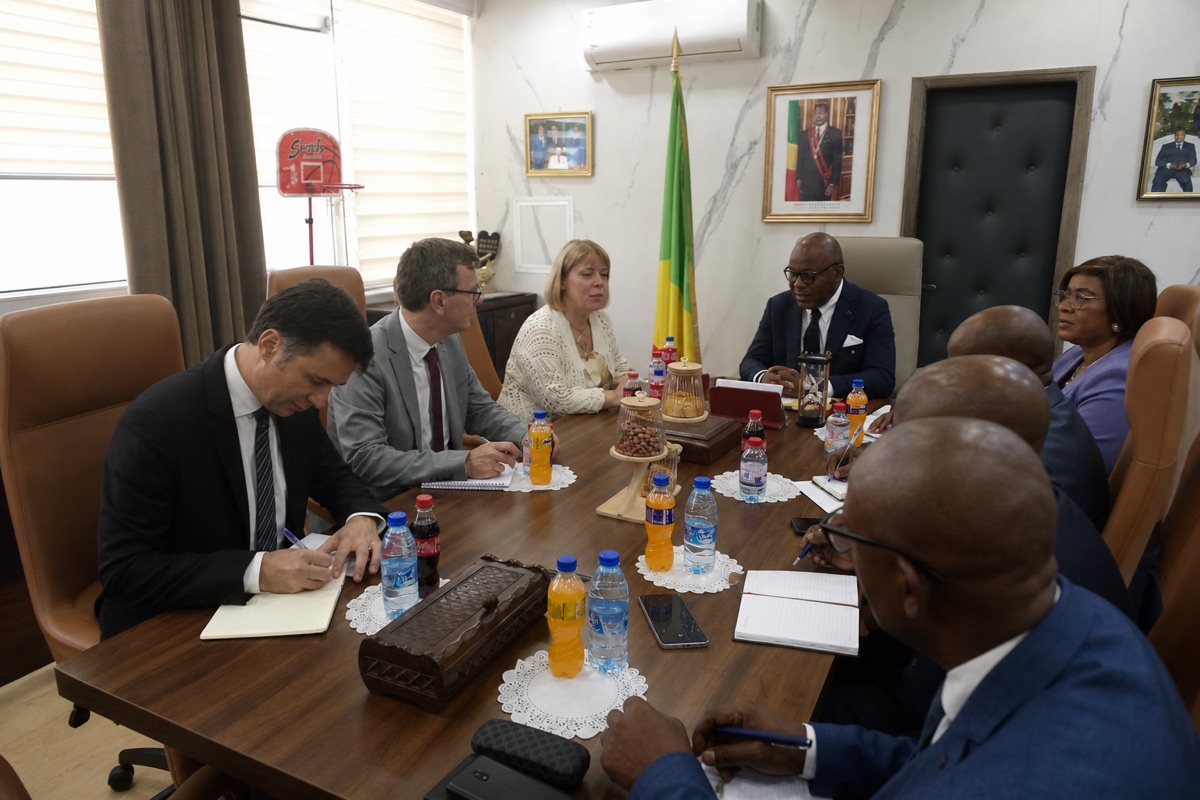
When the rains arrive in Pointe-Noire and Brazzaville, water has long been both a promise and a peril: scarce when it should run from the tap, and overwhelming when it pours through ill-drained streets. France has signalled that it intends to remain a fixture in the slow work of reconciling those two faces of the same resource. According to the French ambassador to Congo, Claire Bodonyi, Paris is sustaining its commitment to water supply and sanitation infrastructure in the Republic of Congo through two major projects now under way, a position she set out during a meeting on 25 June with the Minister of Energy and Hydraulics, Bruno Jean Richard Itoua (Adiac Congo).
A Coastal City Pressing for Reliable Taps
In Pointe-Noire, the country’s economic capital and its principal port, the effort is directed at strengthening the systems that distribute drinking water. The ambition, as conveyed by the ambassador, is straightforward in its logic and demanding in its execution: to widen and steady residents’ access to a resource whose absence shapes daily life far more than its presence is ever noticed. For a city whose population has expanded faster than its utilities, the question is less one of grand engineering than of consolidation, ensuring that what is produced actually reaches households rather than dissipating in losses and intermittent service.
The framing matters. By presenting the work as a reinforcement of existing distribution networks rather than a wholesale reconstruction, the partnership implicitly acknowledges the constraints under which urban utilities in Central Africa operate, where the gap between installed capacity and delivered supply often proves the decisive obstacle.
Draining Brazzaville Before the Next Downpour
In the capital, the accent falls on sanitation and the management of waterways. Here the threat is reversed: not the scarcity of water but its sudden, destructive abundance. Channelling works are intended to mitigate the flooding that recurrently afflicts several neighbourhoods, a hazard that intensifies with each season of heavy rain and that bears most heavily on the districts least equipped to absorb it.
The ambassador drew particular attention to progress along the Tsiemé river, where, she indicated, the channelling of watercourses is in active execution. She likened the approach to earlier interventions carried out at Makélékélé, situating the current effort within a continuity of method rather than as an isolated undertaking. The objective, in her account, is to blunt the consequences of run-off during intense rainfall, the mechanism by which ordinary storms become local emergencies.
That comparison to Makélékélé is instructive. It suggests an iterative strategy in which lessons drawn from one drainage operation inform the next, a patient accretion of expertise that, if it holds, may prove more durable than any single showcase project.
The Quiet Architecture of Franco-Congolese Cooperation
Steering this cooperation is the French Development Agency (AFD), the institution through which much of Paris’s developmental engagement in the region is channelled. Its involvement places the two projects within a broader architecture of partnership that links infrastructure financing to questions of governance, public service delivery and the management of rapidly growing cities.
For Brazzaville, the symbolism is not negligible. Water and sanitation sit at the intersection of public health, urban planning and social equity, and a foreign partner’s continued presence in these sectors is read, inevitably, as a statement about the resilience of bilateral ties. The meeting between the ambassador and Minister Itoua functioned, in that sense, as both a technical review and a reaffirmation, a reminder that diplomatic relationships are sustained as much by the unglamorous follow-through on drainage canals as by formal declarations.
What Completion Could Change on the Ground
Both projects are expected to reach completion in the coming months, a horizon close enough to be tested against results rather than promises. Should they deliver, the anticipated dividends are concrete: improved access to drinking water for households long accustomed to uncertainty, and a measurable reduction in the flooding that disrupts livelihoods and damages property across vulnerable quarters.
The caveat, as with all infrastructure of this kind, lies in the distance between completion and lasting benefit. A channelled river and a reinforced network are only as valuable as the maintenance and institutional capacity that sustain them. The Congolese authorities, with French support, have set a timetable; the more exacting test will come afterwards, in the seasons when the rains return and the works must prove that they were built not merely to be inaugurated, but to endure.
For now, the message from Paris and Brazzaville is one of persistence. In a domain where progress is rarely spectacular and setbacks are easily forgotten, the decision to keep going may itself be the most consequential development.
