
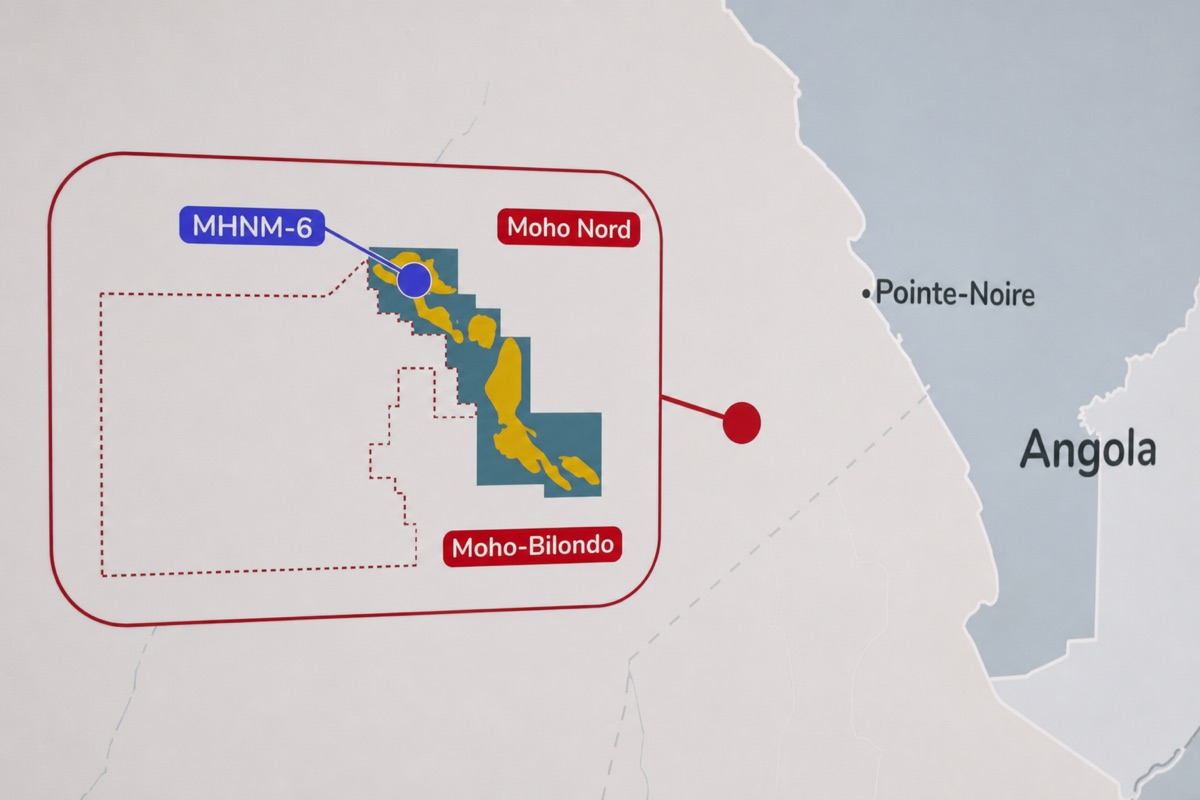
A fresh hydrocarbon find off the coast of the Republic of Congo (Congo-Brazzaville) has once again drawn attention to the deepwater acreage that has anchored the country’s petroleum economy for more than a decade. On 13 April 2026, TotalEnergies EP Congo, which operates the Moho permit with a 63.5 percent interest, confirmed that exploratory drilling had encountered a substantial column of oil-bearing reservoirs in waters it has worked for years. The announcement, modest in tone yet consequential in substance, signals that the Moho cluster still holds untapped potential beneath sediments long thought to be fully mapped.
A 160-Metre Column Beneath Familiar Waters
The discovery rests on the MHNM-6 NFW well, a near-field exploration borehole drilled within reach of installations already pumping crude. According to the operator, the well intersected a 160-metre column of hydrocarbons hosted in reservoirs described as being of good quality. The phrasing matters: in offshore geology, the combination of column height and reservoir quality determines whether a find is a curiosity or a commercially developable asset. Here, the early indications point firmly toward the latter, lending weight to the company’s measured optimism.
Read alongside the neighbouring Moho F structure, the new accumulation is estimated to hold close to 100 million barrels of recoverable resources. That figure, while a fraction of Congo’s cumulative production history, is far from negligible for a basin where most of the obvious prospects have already been drilled. It suggests that incremental exploration around proven hubs may yet extend the productive life of fields that many observers assumed were entering a gradual decline.
The Economics of Drilling Close to Home
What distinguishes this find is less its volume than its location. Because the resources sit within the footprint of existing production infrastructure, TotalEnergies expects to bring them on stream through what it terms a short-cycle, low-cost development. The logic is straightforward and, in the current climate of capital discipline, compelling: tying new wells back to facilities already in place spares the operator the considerable expense of building standalone platforms or vessels.
Nicola Mavilla, Exploration Director at TotalEnergies EP Congo, framed the appeal in precisely these terms. The discovery, he observed, “benefits from its proximity to existing production infrastructure,” a feature that underpins the prospect of a profitable development. His remark captures a broader shift in the offshore industry, where the appetite for sprawling greenfield projects has given way to a preference for bolt-on barrels that can be monetised quickly and at modest risk.
For Congo-Brazzaville, that calculus carries real fiscal significance. Hydrocarbons remain the backbone of public revenue, and additions that require little fresh capital translate more directly into government receipts than developments burdened by heavy upfront spending. In an environment where the state must balance budgetary pressures against the imperative to sustain output, low-cost barrels offer a rare alignment of corporate and national interest.
Inside the Moho Partnership
The Moho permit is not the work of a single company. Alongside TotalEnergies EP Congo as operator, the licence is held by Trident Energy, with a 21.5 percent stake, and by the Société Nationale des Pétroles du Congo, the national oil company, holding 15 percent. This tripartite structure binds the international operator’s technical reach to the participation of a domestic player whose presence ensures that a share of the value created remains within the country.
Production from the permit currently flows through two floating units, Alima and Likouf, which together yield roughly 90,000 barrels of oil equivalent per day. These vessels form the industrial spine to which the new wells would be connected, and their existing throughput illustrates why a tie-back strategy is so attractive. Rather than commissioning additional hardware, the partners can route fresh volumes into systems already calibrated for the basin’s crude.
A Measured Signal for Congo’s Offshore Future
It would be premature to read the Moho announcement as a reversal of the maturity that characterises much of West and Central African offshore production. The volumes involved, however welcome, do not by themselves rewrite Congo’s energy outlook. Yet the discovery does carry a subtler message, one that resonates beyond the immediate barrel count. It demonstrates that disciplined, infrastructure-led exploration can still extract value from terrain assumed to be exhausted, provided operators are willing to drill close to home and forgo the allure of frontier prospects.
For a country navigating the twin demands of fiscal stability and energy transition, such incremental gains may prove more durable than headline-grabbing megaprojects. The Moho find, anchored in proven geology and pragmatic economics, exemplifies the kind of cautious, returns-focused activity likely to define Congo’s offshore sector in the years ahead.
