
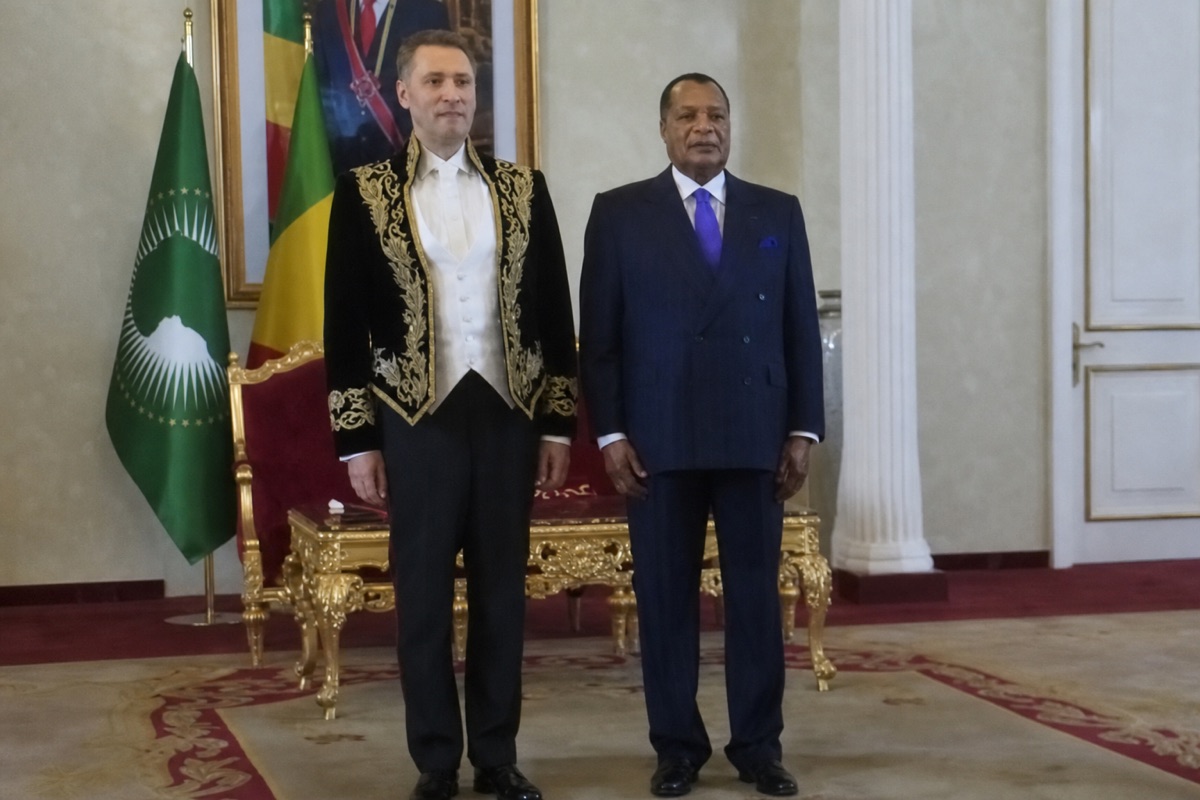
A measured but unmistakable signal of strategic intent unfolded at the presidential palace in Brazzaville on 3 June, when Jean Galiev, the newly appointed Extraordinary and Plenipotentiary Ambassador of Kazakhstan to the Republic of the Congo, formally assumed his functions. The ceremony, held with the solemnity that such occasions traditionally command, saw the Kazakh envoy present his letters of credence to President Denis Sassou N’Guesso, thereby inaugurating what both capitals appear keen to frame as a more deliberate phase in their bilateral engagement.
A Credentials Ceremony Laden With Symbolism
The handing over of credentials is, in diplomatic grammar, far more than a procedural formality. It is the moment at which a foreign representative is invested with the full authority to act on behalf of his head of state, and the setting chosen for Galiev’s accreditation underscored the weight Brazzaville attached to the occasion. Received in the ambassadors’ hall, the diplomat was welcomed by the Congolese head of state in the presence of Constant-Serge Bounda, Minister of Foreign Affairs, Francophonie and Congolese Abroad, alongside the ministry’s secretary-general and its director of protocol.
That such senior figures should attend is itself instructive. The composition of the receiving party suggested that Astana’s overture is being read in Brazzaville not as a routine rotation of personnel, but as an opening worth cultivating. For a Central African state long accustomed to calibrating its external partnerships, the arrival of an experienced Eurasian envoy carries an implicit invitation to widen the circle of interlocutors beyond the more familiar axes of cooperation.
A Seasoned Diplomat for a Delicate Brief
Galiev does not arrive untested. Before his posting to Brazzaville he represented Kazakhstan in France, Monaco and Portugal, where he contributed to the development of bilateral relations between his country and several European partners. That European apprenticeship is not incidental to the task now before him. A diplomat schooled in the patient, often understated work of consolidating ties across differing political cultures brings to his new mission a temperament suited to relationships that must be built incrementally rather than proclaimed.
His professional itinerary also hints at the register Astana hopes to strike in Congo. Kazakhstan, a country that has made of its balancing diplomacy a defining feature of its foreign policy, tends to favour envoys capable of translating broad strategic ambition into concrete, sector-specific engagement. In dispatching a representative whose prior assignments lay in the heart of Western Europe, the Kazakh authorities appear to be signalling that they regard their African partnerships with the same seriousness they accord their continental neighbourhood.
Mapping the Terrain of Cooperation
In remarks delivered at the close of the ceremony, the new ambassador reaffirmed his determination to strengthen the bonds of friendship and cooperation between Brazzaville and Astana. The vocabulary, while conventional, was anchored in a tangible agenda. The relationship between the two states already spans the political, economic, energy, agricultural and transport sectors, as well as information and communication technologies, and it is across this terrain that Galiev’s tenure will be measured.
The emphasis on energy and technology is especially telling. Both Kazakhstan and Congo are hydrocarbon producers acutely aware that the long-term value of their economies will rest on diversification and on the mastery of new technologies. A partnership that pairs Astana’s accumulated experience in resource management and digital infrastructure with Congo’s developmental priorities offers, at least in principle, a complementarity that transcends mere diplomatic courtesy. Agriculture and transport, meanwhile, point to a more grounded ambition: the construction of supply chains and connectivity that could, over time, give substance to declarations of intent.
The Test of Implementation
Whether this accreditation marks a genuine inflection or simply another entry in the ledger of cordial relations will depend on what follows the ceremony. Diplomatic openings of this kind are frequent; their consequences are rarer. The challenge for both Brazzaville and Astana lies in converting the lexicon of friendship into agreements, investments and exchanges that withstand the friction of execution.
For the moment, the significance of 3 June resides in its signalling function. By dispatching a senior, Europe-tested envoy and receiving him with conspicuous formality, the two governments have indicated a shared readiness to invest political capital in their relationship. Galiev’s mandate now begins in earnest, and the coming months will reveal whether the partnership he has been charged with deepening can move from the carefully scripted choreography of protocol to the harder, more rewarding work of substantive cooperation.
